
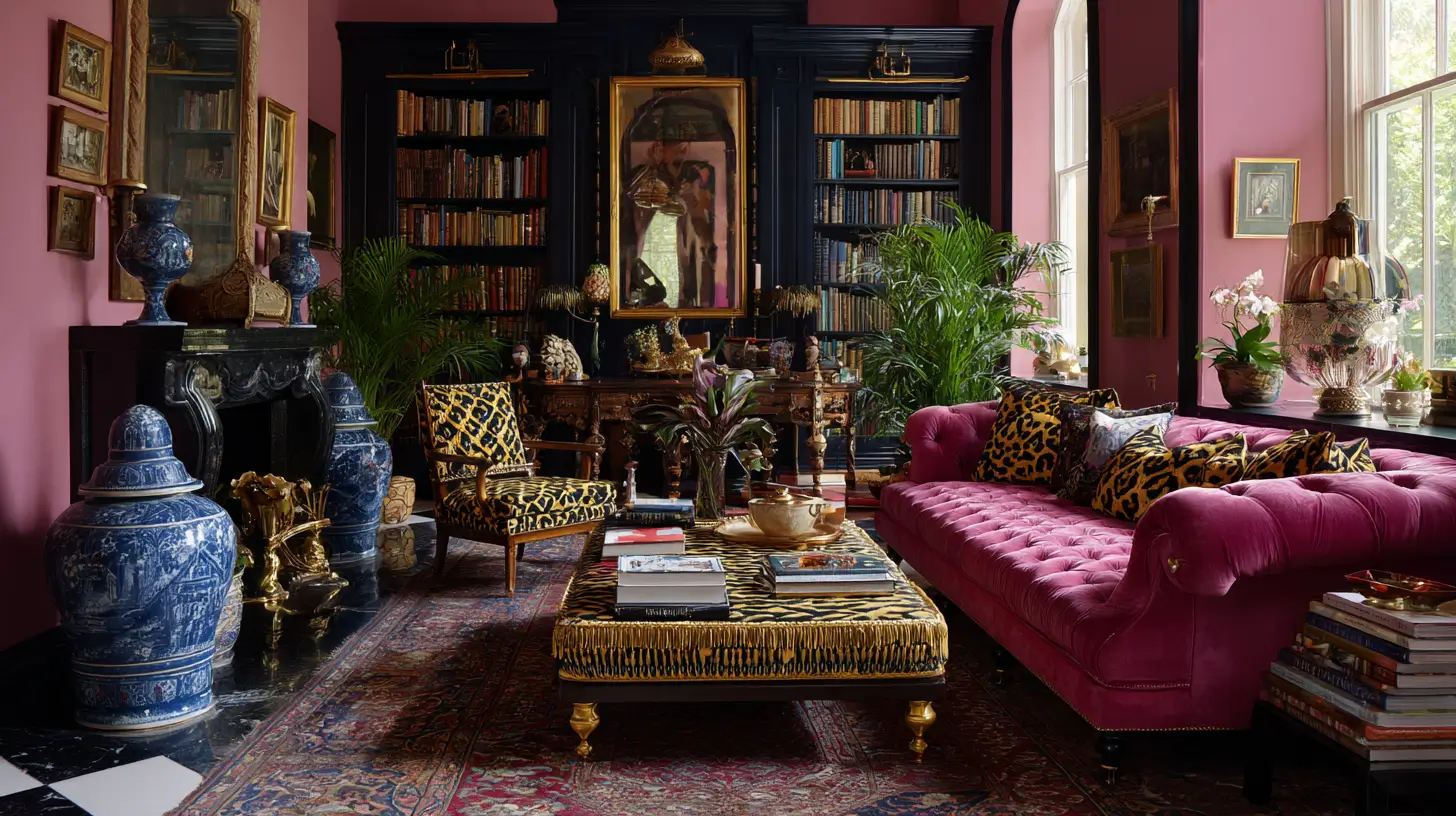
Minimalism told us to own less, decorate less, feel less. And a lot of us quietly hated it.
You want a living room that looks like you. Not a hotel lobby. Not a Pinterest board that could belong to anyone. But every time you try to add something bold, you second-guess yourself. You put it back. You buy another beige throw pillow.
This guide is here to stop that cycle.
Below are 18 real, specific maximalist living room ideas. Some cost under $30. Some take a weekend. All of them will make your space feel more alive. Pick one. Start there.
What Is Maximalist Design and Why Is Everyone Doing It in 2026?
Maximalism is not clutter. That is the most important thing to know before you read anything else.
Maximalism means more done with intention. Every object has a reason to be there. Every color was chosen. The room feels full because it is full, but not random.
The design world has been moving this way for years. Google Trends data shows searches for “maximalist decor” climbed around 140% between 2021 and 2024. Major paint brands like Sherwin-Williams and Benjamin Moore now dedicate full trend reports to bold color choices. IKEA’s 2025 Life at Home Report pointed to expressive, layered spaces as a top desire among homeowners globally.
The “dopamine decor” movement, covered by Architectural Digest, House Beautiful, and Elle Decor across 2023 and 2025, put a name to what many people already felt. Rooms should make you happy. Rooms should reflect your personality. Rooms should not feel like a showroom where no one actually lives.
The difference between maximalism and hoarding is curation. You choose what stays. You repeat colors. You edit, even when it does not feel like it.
Now here is how to do it.
The 18 Best Maximalist Living Room Ideas
1. Commit to a Color Palette First

Most people get this backwards. They buy things they love and then wonder why the room feels chaotic. Start with your colors instead.
Choose three to five colors. Then repeat them everywhere. A deep teal sofa. Teal in a throw pillow on an armchair. A small teal vase on the shelf. That repetition is what makes a bold room feel designed and not accidental.
A 2024 Sherwin-Williams ColorSnapshot survey found that 62% of respondents wanted more color in their homes than they currently had. Most people are already craving this. They just do not know where to start.
Use the 60-30-10 rule as a loose guide. Sixty percent of the room in a dominant color, thirty percent in a secondary, ten percent in an accent. Then push that accent to 20% and see how it feels. Maximalism can handle it.
Look at the apartments of Iris Apfel or the rooms designed by Luke Edward Hall for proof that more color does not mean messy. It means alive.
Try this: Pick three colors from something you already own and love, like a piece of art or a rug. Build your entire palette from those three.
2. Layer Two Rugs Instead of One

Nothing changes a room faster than this one move.
Most people put down one rug and call it done. A maximalist uses two. You get more texture, more pattern, and a layered look that feels collected over time, not bought all at once.
Start with a large flat-weave or neutral rug as your base. Something in an 8×10 or larger size works best. Then add a smaller patterned rug on top, around 5×7, and offset it slightly, about 6 to 12 inches from center. The base rug should be visible around the edges.
Mix different textures. Jute under wool. A flat kilim under a thick shag. The contrast is the point.
Interior designer Justina Blakeney of Jungalow has built a whole aesthetic around this kind of layering. Her own home features stacked rugs, mixed patterns, and zero apologies.
Try this: Go to a thrift store or Facebook Marketplace and find a vintage patterned rug under $40. Lay it on top of what you already have.
3. Build a Gallery Wall That Tells Your Story

A gallery wall done right is basically a biography on your wall. It shows where you have been, what you love, and what makes you laugh.
The mistake most people make is trying to keep it too uniform. Same frames, same sizes, same spacing. That is a nice look, but it is not maximalism. Mix your frames. Metal next to wood next to ornate gold. Mix your content. Framed photos next to art prints next to a small mirror next to a vintage postcard.
The IKEA MOSSLANDA picture ledge hack is still one of the best budget tools for this. You can rearrange pieces without putting new holes in the wall every time you change your mind.
For affordable art, check Society6, Desenio, and Framebridge for prints. For vintage frames, Etsy is hard to beat. For the mock-up method: tape paper outlines of your frames on the wall before hammering anything.
Try this: Start with just five pieces. A mix of three frame styles, two sizes of art. Arrange them on your floor first until you love it. Then put them up.
4. Mix Patterns Without Fear

Pattern mixing sounds scary. It is not, once you know the one rule that makes it work.
Vary the scale.
That is it. Combine a large floral with a medium stripe and a small geometric. When the scales are different, the eye can separate them. When they are all the same scale, they fight each other.
Keep them in the same color family and the mix will feel intentional. A dusty pink floral, a rust and cream stripe, a tiny terracotta dot. Three patterns. One family. Total confidence.
Fabric brands like House of Hackney and Schumacher have built their entire identity around fearless pattern mixing. You do not need their price points to borrow their logic.
Try this: Use your sofa fabric as the anchor pattern. Pull two of its colors. Find two other patterns in those same colors at different scales. That is your mix.
5. Color Drench Your Walls, Ceiling, and Trim

Color drenching is when you paint the walls, ceiling, and trim all the same color. The whole room becomes the color. It feels like being inside a jewel box.
This is not a new idea, but it has had a serious comeback. The Houzz 2025 Remodeling Trends Report showed painted ceilings up 38% in project photos compared to previous years. Benjamin Moore and Farrow & Ball have both featured this technique in their 2025 and 2026 trend guidance.
Deep colors work best for this. Forest green, burgundy, navy, terracotta. Lighter colors can work, but rich tones are what give the room that gallery-like, cocooning feel.
The trim is key. Most people paint trim white by default. When you match it to the walls and ceiling, the room stops looking like a box and starts feeling like a place.
Try this: Pick one Farrow & Ball or Benjamin Moore color that makes you slightly nervous. Paint a large sample board, at least 12 inches by 12 inches, and live with it for two days before committing.
6. Choose a Statement Sofa in a Bold Color or Print

Your sofa is the biggest piece of furniture in the room. It will set the tone for everything else.
A neutral sofa is not wrong. But a maximalist room with a bold sofa almost designs itself. The sofa does the heavy lifting. Everything else responds to it.
Velvet sofas in jewel tones, deep green, sapphire, burnt orange, have been strong for several years and are not going away. A printed sofa, a floral or a graphic stripe, works especially well when your walls are calm. The sofa becomes the art.
Brands worth looking at include Anthropologie, Interior Define, and Castlery for new options. Chairish and 1stDibs are great for vintage pieces with character.
Try this: If you are not ready to commit to a new sofa, buy a large throw blanket and two bold pillows in the color you wish your sofa was. Live with that color in the room for a month first.
7. Style Your Shelves Like a Curator

A shelf full of books is a library. A shelf full of objects next to books, next to a small plant, next to a piece of art, is a maximalist vignette.
Every shelf should tell a small story. Group objects by color. Vary the heights so your eye has somewhere to travel. Lean framed art against the back of the shelf instead of hanging it. Mix books with things.
The “shelfie” is a real cultural moment. The hashtag #shelfie had over 11 million posts on Instagram by 2024. People care deeply about this. It is a form of self-expression that costs almost nothing to update.
Use the 1/3 rule loosely. About a third books, a third objects, a third space. The space is what lets everything else breathe.
Try this: Take everything off one shelf. Put back only what you genuinely love. Then arrange it in a color-grouped or height-varied way before adding anything new.
8. Treat Your Lighting Like Sculpture

In most rooms, lighting is an afterthought. In a maximalist room, it is a statement.
An oversized chandelier, a beaded pendant, a floor lamp with a fringed shade, these are not just ways to light a room. They are objects you look at even when the light is off.
The shape and scale of a light fixture changes a room in a way that almost nothing else can. A chandelier with presence makes a normal ceiling feel grand. A fringed floor lamp in a corner makes a reading nook feel intentional.
Brands like Anthropologie and Rejuvenation have accessible options. West Elm has more budget-friendly picks. GUBI is worth knowing for design inspiration, even if the price is high.
Try this: Replace one standard lamp shade with something unexpected. A pleated fabric shade, a beaded one, or a bold color. It costs under $40 and changes the feel of the whole corner.
9. Paint Your Walls Dark

Most people are afraid of dark walls. They worry the room will feel smaller. In reality, a dark room feels more dramatic and more intentional than a light one.
Deep forest green, midnight navy, burgundy, and near-black are the maximalist go-tos. Farrow & Ball’s Hague Blue and Railings are widely cited for a reason. Benjamin Moore’s Black Forest Green has been a designer favorite for years.
Dark walls make art pop. They make furniture stand out. They create a gallery-like atmosphere that you cannot fake with a light wall.
If you are renting and cannot paint, removable wallpaper is a real option now. Brands like Tempaper and Chasing Paper make dark, patterned, and mural-style options that go up and come down without damage.
Try this: Paint one wall dark before committing to the whole room. The accent wall approach gets a bad reputation, but it is a good way to test whether you can live with the color.
10. Put Your Collection on Display

If you collect something, it belongs on your wall or your shelves. Not in a box. Not in a closet.
Antique ceramics. Vintage travel posters. Records. Matchbooks. Pressed flowers in frames. Rocks from places you have been. Whatever you have been quietly accumulating, that is your maximalist material.
Designer Jonathan Adler has built an entire career around the idea that your home should make you happy. His own spaces are full of objects with personality. The lesson is not to copy his style. The lesson is to stop hiding the things that make you, you.
A collection displayed with intention looks designed. The same objects in a box look like clutter. The only difference is the shelf.
Try this: Find the one thing you own more of than anything else. Give it a dedicated spot. Group them together. Display them proudly.
11. Wallpaper One Wall (or All of Them)

Bold wallpaper has been one of the strongest interior trends since 2023. It shows no signs of stopping.
A single papered wall in a maximalist print can transform a room. You do not need to paper every wall. One is enough to change the entire feel of the space.
Brands like Graham & Brown, Cole & Son, and Rifle Paper Co. make patterns that are genuinely remarkable. Spoonflower lets independent designers sell their patterns, so you can find something no one else has.
The scale of the pattern matters. A large-scale pattern works on a wide wall. A smaller, denser pattern works in a narrow space or a powder room.
Try this: Order samples from two or three wallpaper brands before buying. Tape them to your wall and look at them in natural and artificial light before deciding.
12. Mix Furniture From Different Eras

Matching furniture suites are the enemy of personality.
A Victorian settee next to a 1970s tulip chair next to a clean-lined modern side table tells a story. A matching three-piece sofa set tells you nothing except where someone shopped.
The key to mixing eras is visual weight, not historical consistency. A heavy carved wooden piece needs something lighter nearby. A sleek chrome chair needs something warm and organic next to it.
Facebook Marketplace and Chairish are the best places to find vintage pieces at real prices. 1stDibs is worth browsing for inspiration even if the prices are high.
Try this: Replace one standard piece of furniture with a vintage find. One chair, one side table, one lamp stand. Let that piece be the most interesting thing in the room.
13. Make Plants Part of the Design

A plant in a plain terracotta pot is nice. A large Bird of Paradise in an ornate painted pot, placed in the corner your room has been missing, is maximalism.
Go big. A Monstera deliciosa, a Bird of Paradise, or a Fiddle Leaf Fig makes a visual impact that smaller plants simply cannot. The size matters as much as the variety.
Use pots that coordinate with your palette. A pot is not just a container. It is a design choice. Justina Blakeney and plant stylist Hilton Carter, author of “Wild Interiors” and “Wild at Home,” both make the case that plants are as important as any piece of furniture in a room.
Try this: Buy one large plant for a corner that feels empty. Then find a pot for it in one of your room’s accent colors. The combination costs less than a new piece of furniture and adds more life.
14. Do Something With Your Ceiling

The ceiling is the most ignored surface in most homes. Maximalists treat it like a fifth wall.
Ceiling medallions around a light fixture add instant architecture. A painted geometric pattern on a white ceiling adds pattern without touching the walls. Pressed tin tiles add texture and a vintage feel. Beadboard adds warmth.
Even a single bold color on the ceiling, different from the walls, creates a sense of drama that most people never think to try.
This is one of the lowest-cost, highest-impact changes you can make in a rental or a home you are not ready to fully renovate.
Try this: Paint your ceiling the same color as your walls. No trim, no break. See how the room changes in a single afternoon.
15. Layer Textiles Until the Room Feels Like a Hug

Maximalist rooms feel cozy because they are tactile. You can feel the richness before you even sit down.
Layer velvet with boucle. Add a fringe throw. Use embroidered pillows. Pile cushions in odd numbers because odd numbers look more natural than even. Mix sizes: one large, two medium, three small.
The goal is not to make sitting on the sofa harder. The goal is to make the room feel generous. Like there is more than enough. Like someone thought carefully about what feels good.
Try this: Add one unexpected textile. A velvet throw in a color you have been avoiding. An embroidered pillow from an Etsy seller. One thing that is softer or richer than what you already have.
16. Use Mirrors as Art, Not Just Mirrors

Most mirrors in most homes are purely functional. You look in them before you leave. That is it.
In a maximalist room, a mirror is art. An oversized ornate mirror above a fireplace reflects light and doubles the visual space. A cluster of three or five different-shaped mirrors on one wall creates a composition that feels intentional.
Gilded baroque frames, sunburst shapes, vintage hand-held mirrors mounted on the wall, these are all valid maximalist choices. The shape and frame matter as much as the reflection.
Try this: Visit a thrift store with the goal of finding one interesting mirror under $30. The older the frame, the better.
17. Create One Dedicated Vignette Corner

A vignette is a small, styled moment. One corner of the room where everything is intentional. A bar cart with interesting glassware, a framed print leaning against the wall, a small plant, a stack of books.
This actually helps a maximalist room feel less overwhelming. When your eye has a focal point, it does not need to process everything at once. The vignette gives it somewhere to rest.
The bar cart approach is popular because it is moveable and endlessly restyable. But a corner bookshelf, a side table with a curated collection, or a plant stand surrounded by objects all work the same way.
Try this: Choose one corner. Clear it. Style it with five objects you love. Nothing else goes there.
18. Think About Your Floor as Part of the Design

Most people stop at the rug. A maximalist thinks about the floor itself.
Painted floors, especially checkerboard patterns in high-contrast colors, are one of the most dramatic changes you can make in a room. Encaustic cement tiles add incredible pattern. Parquet adds warmth and geometry.
If you rent, peel-and-stick tile options have genuinely improved. Brands like Quadrostyle and FloorPops make options that look far better than they did five years ago and come up cleanly when you leave.
Even a painted stencil pattern on wood floors costs almost nothing and looks remarkable.
Try this: Research “painted checkerboard floor” on Pinterest. Look at how much it changes a room. Then price out what it would cost in your space. You may be surprised.
How to Start Your Maximalist Living Room Transformation
The reason most people do not start is this: they try to picture the finished room before they have taken the first step. That is too much. It feels overwhelming and impossible. So they do nothing.
Start with one anchor piece instead.
Pick the one bold thing you already own and love, or the one thing you have been wanting. A statement rug. A piece of art. A sofa in a color that excites you. Make that the starting point. Build outward from its colors and its energy. Let it tell you what comes next.
Then add in layers. Maximalism is not bought all at once. The best maximalist rooms are built over months and years. Each thing responds to what came before it.
Here is a rough idea of what different budgets can accomplish:
Under $500: A DIY gallery wall using Etsy prints and thrifted frames, plus a layered rug using a secondhand find, plus two or three large plants in interesting pots. This combination changes a room completely.
Between $500 and $2,000: Add a statement sofa or a papered accent wall. Either one becomes the center of the whole room.
Above $2,000: A full furniture rethink, mixing eras and styles, with a bold paint choice and custom or vintage lighting.
One common mistake to avoid: going maximalist in color but keeping all your furniture the same height and shape. Vary the silhouettes. A low sofa next to a tall bookshelf next to a round side table gives your eye somewhere to go.
The Only Rule That Actually Matters
Maximalism is not about owning more stuff. It is about curating boldly.
The 18 ideas in this guide cover every budget and every commitment level. You can start with a $25 thrifted rug on top of your existing one this weekend, or you can plan a full room overhaul over six months. Both are valid. Both are maximalism.
Pick one idea. Do it this week. The best maximalist rooms were never built in a day. They were built one bold choice at a time, by someone who finally stopped second-guessing and started trusting what they loved.
Your living room should look unmistakably like you. In 2026, that is not a risk. That is the whole point.

- 17 Classy Living Room Ideas for a Cozy Elegant Look - April 23, 2026
- 16 Dark Moody Living Room Ideas That Feel Rich and Warm - April 22, 2026
- 14 Elegant Bedroom Trends for 2026 You’ll Love - April 22, 2026

