
Introduction
Your garden should feel like a break from the day. Not another thing to manage.
But for most people, it doesn’t feel that way. There are too many plants that don’t go together. Pots collected over years with no plan. A lawn that needs constant work. And somehow, none of it feels peaceful.
That’s the problem minimalist garden design solves.
This isn’t about making your garden look empty. It’s about making every choice count. The most calming gardens in the world don’t have more. They have less, picked more carefully.
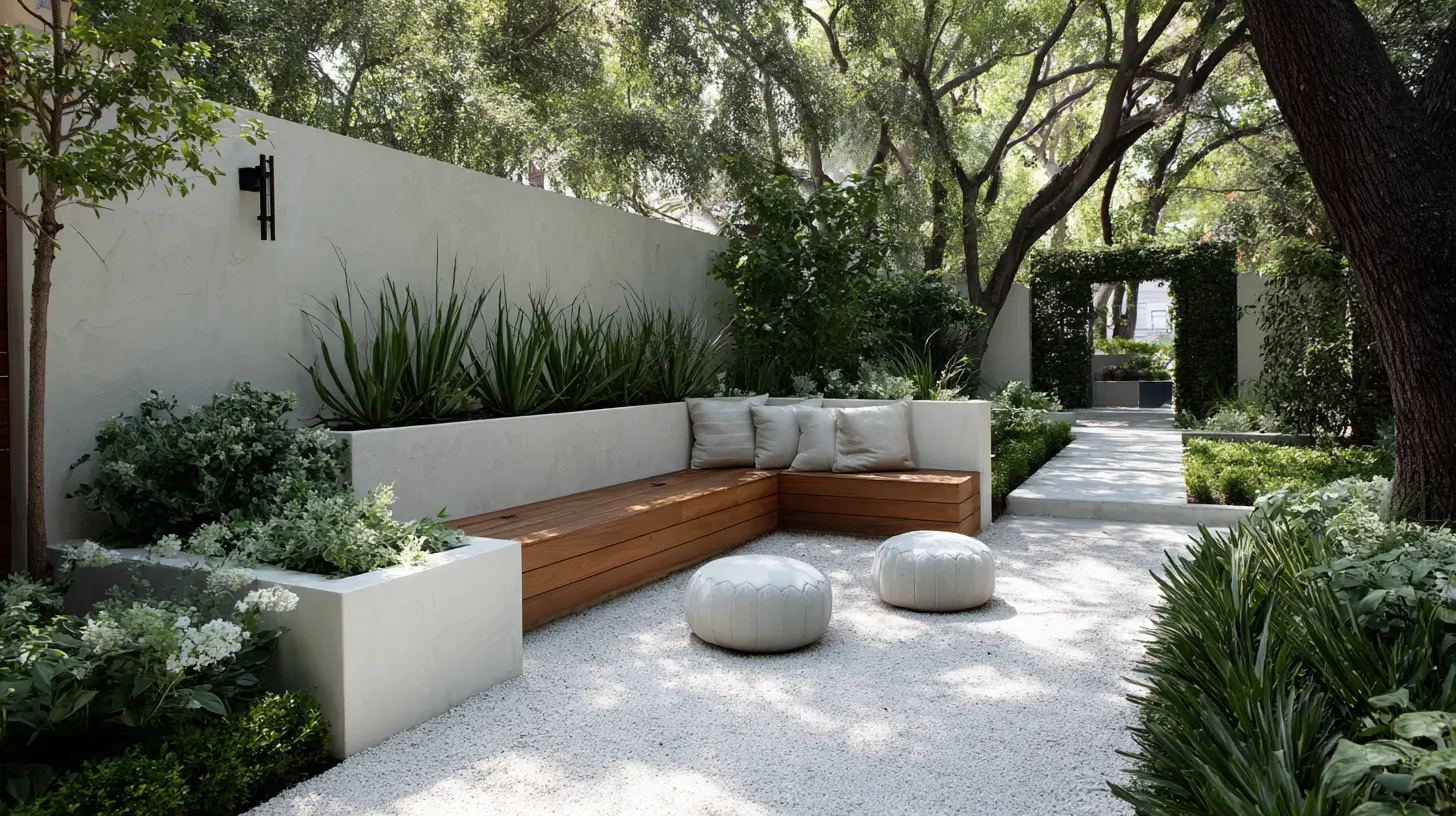
These 18 minimalist garden ideas will show you exactly what to do. You’ll learn which plants to choose, what to remove, how to use space, and how to build an outdoor area that actually feels good to be in. Every idea here is practical and works in 2026, whether you have a small backyard, a courtyard, or just a patio.
You don’t need a big budget. You need a clear plan.
What Makes a Garden Truly Minimalist (Not Just Empty)?
Most people get this wrong at the start. They think minimalist means bare. It doesn’t.
A neglected garden looks bare. A minimalist garden looks intentional. The difference is every single element was chosen on purpose.
There are three principles behind every great minimalist garden: repetition, restraint, and intention. Repetition means using the same plant or material more than once to create rhythm. Restraint means resisting the urge to add more. Intention means every plant, stone, and pot has a reason to be there.
The Japanese have a word for this: ma. It means meaningful empty space. It’s a design idea used in architecture, art, and garden design for centuries. Japan’s Ryoan-ji garden, built around 1500 AD, uses only 15 rocks and raked gravel. No flowers. No colour. It’s considered one of the most calming spaces on earth.
That’s the goal. Not empty. Intentional.
Scandinavian garden design works on the same idea. Clean lines, natural materials, and just enough planting to feel alive. These aren’t trends. They’re proven frameworks that calm the eye and the mind.
Google Trends data shows that searches for “minimalist garden” have grown steadily since 2020. People are tired of busy, high-maintenance outdoor spaces. They want calm.
1. Start With Subtraction, Not Addition
Before you buy a single new plant, remove things.
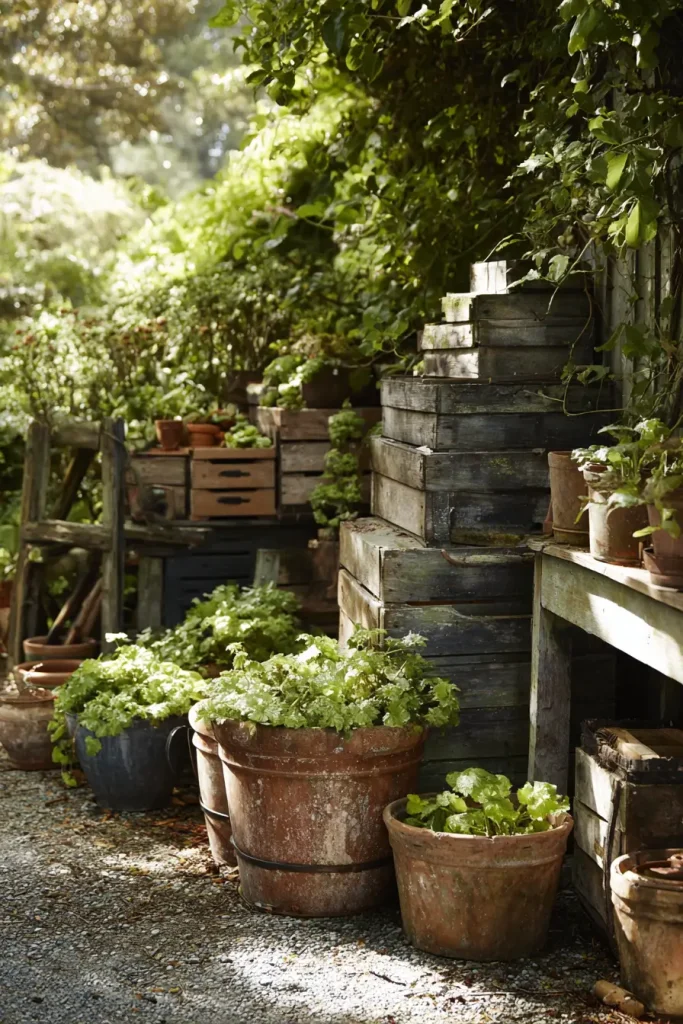
Most garden clutter isn’t planted on purpose. It’s leftover. A pot you kept from three summers ago. A shrub you don’t like but haven’t gotten around to cutting. Six different border plants that fight for attention.
Do a subtraction audit. Walk your garden with one question in mind: why is this here? If you can’t give a clear answer, remove it.
This is the single most effective thing you can do. It costs nothing. It takes one afternoon. And the results are immediate.
Start with duplicates. If you have five different grass types, pick the one you like most and remove the others. If you have three different coloured pots, swap them for one consistent material. Remove anything broken, faded, or past its best.
Marie Kondo’s approach to tidying a home translates well here. If something doesn’t serve a clear purpose or add something visually, it goes. This applies to gardens too.
Common mistake to avoid: Don’t confuse “tidy” with “minimalist.” A tidy cluttered garden is still cluttered. The subtraction audit is about reducing the number of things, not just organising them.
2. Limit Your Colour Palette to 2 or 3 Choices
One of the fastest ways to create a calm garden is to restrict your colours.
Pick two or three and stick to them. That’s it. A white, grey, and green palette works almost everywhere. So does black, terracotta, and green. Or silver, cream, and sage.
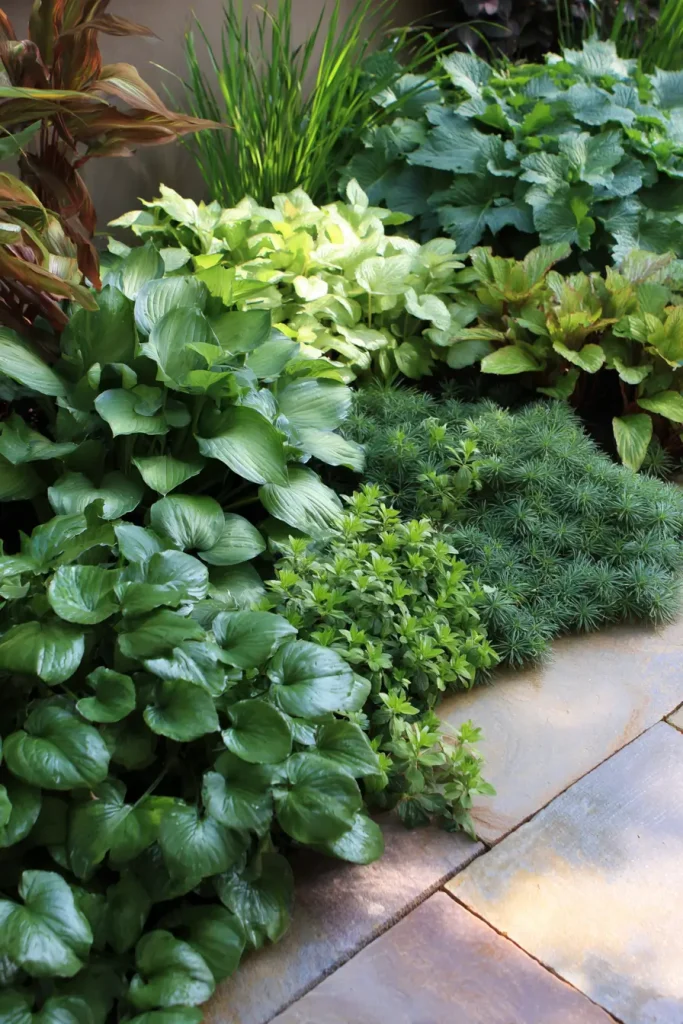
The mistake most people make is choosing plants by flower colour. The problem is flowers come and go. Foliage stays all year. So base your palette on leaf colour first, and treat flower colour as a bonus.
The “green on green” approach is one of the most reliable options. You use different textures of the same hue. A dark glossy Fatsia next to a soft silver Stachys next to a fine-leaved ornamental grass. All green. But rich and varied.
Landscape designer Piet Oudolf, known for some of the most admired garden designs in the world, uses tonal restraint even when working with large naturalistic plantings. He limits colour ranges deliberately. The result always reads as intentional.
Your hardscape matters here too. If your paving is warm sandstone, choose warm-toned plants. If your paving is cool grey concrete, lean into silver and blue-green foliage. Match the tones. When everything shares a temperature, the eye relaxes.
3. Repeat Plants Instead of Collecting Them
A collection garden feels busy. A designed garden feels calm. The difference is repetition.
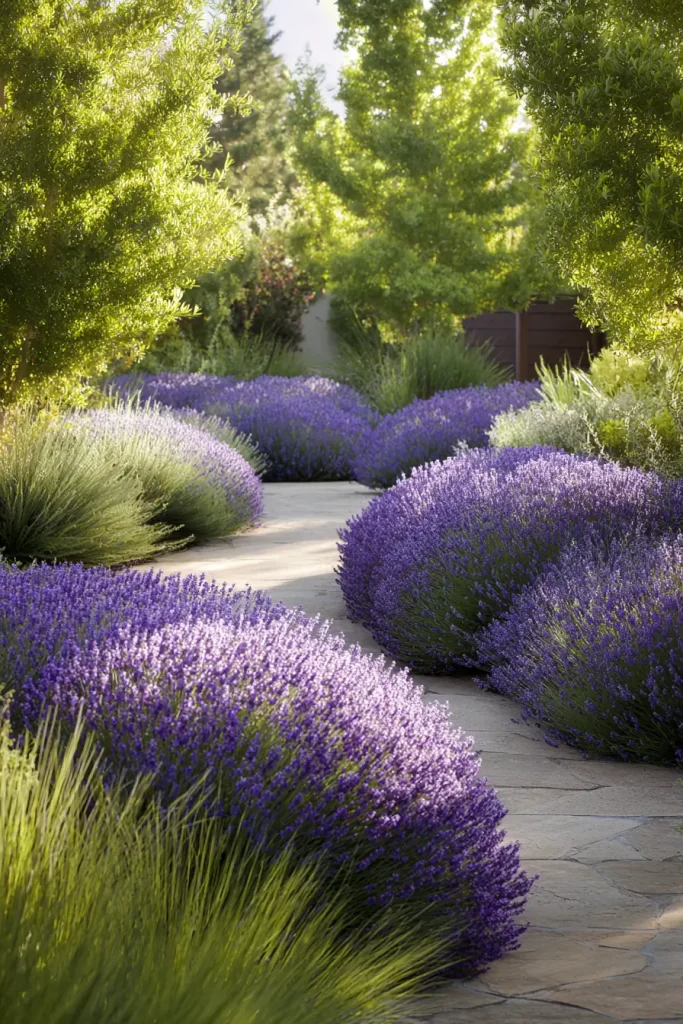
When you plant the same thing three, five, or seven times, something shifts. The eye stops searching and starts resting. That’s the goal.
The odd number rule is real. Groups of three, five, or seven read as natural and balanced. Groups of two or four feel formal and stiff. Groups of one feel random.
Pick one hero plant and repeat it throughout your garden. Lavender (Lavandula angustifolia) is a classic choice. It’s fragrant, it attracts pollinators, it’s drought tolerant, and when planted in a row or mass, it looks architectural and intentional.
Single-species hedging works on the same principle. A row of Hornbeam, Yew, or Box creates a clean, consistent boundary. It doesn’t compete for attention. It frames everything else.
Japanese gardens take this to its logical end. A single species of moss covers the entire ground plane. Nothing else. The result is extraordinary calm.
Ask yourself: what’s my one plant that does the most work? Plant more of that. Plant less of everything else.
4. Use Negative Space as a Design Tool
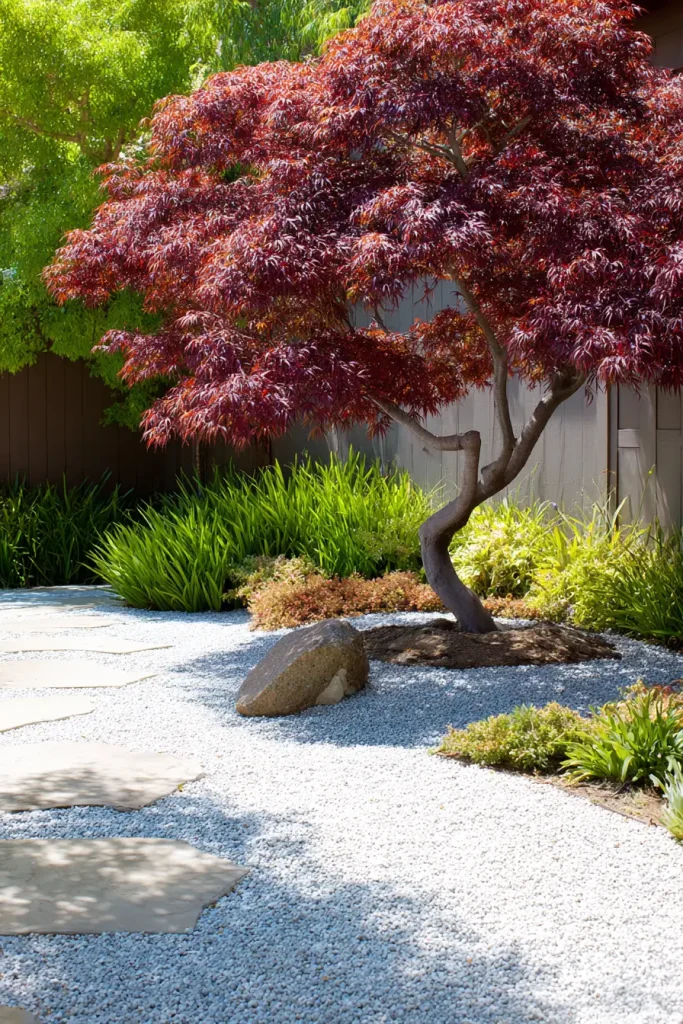
Empty space is not wasted space. It’s active.
Negative space in a garden is the gravel, the mown lawn, the low ground cover, the paved area with nothing on it. These areas give your eye a place to rest. They also make your focal points more powerful.
A single Japanese Maple (Acer palmatum) surrounded by raked gravel stops you in your tracks. The same tree surrounded by 12 other plants disappears.
Gravel gardens have become one of the most popular minimalist choices in the UK and Europe, partly because of the drought-resistant benefits and partly because they create this negative space effect beautifully. The Chelsea Flower Show has featured negative space prominently in multiple award-winning designs from 2023 onward.
A simple rule: if you think you need more plants, wait a season. See what the space looks like with less. You can always add. You can’t unsee the clutter once it’s there.
The right amount of negative space is the amount that makes your focal point feel significant. Test this by standing at your main viewing point, usually from a window or a doorway, and asking whether your eye knows where to go. If the answer is no, you have too much competing for attention.
5. Replace Lawn With Low-Maintenance Ground Cover
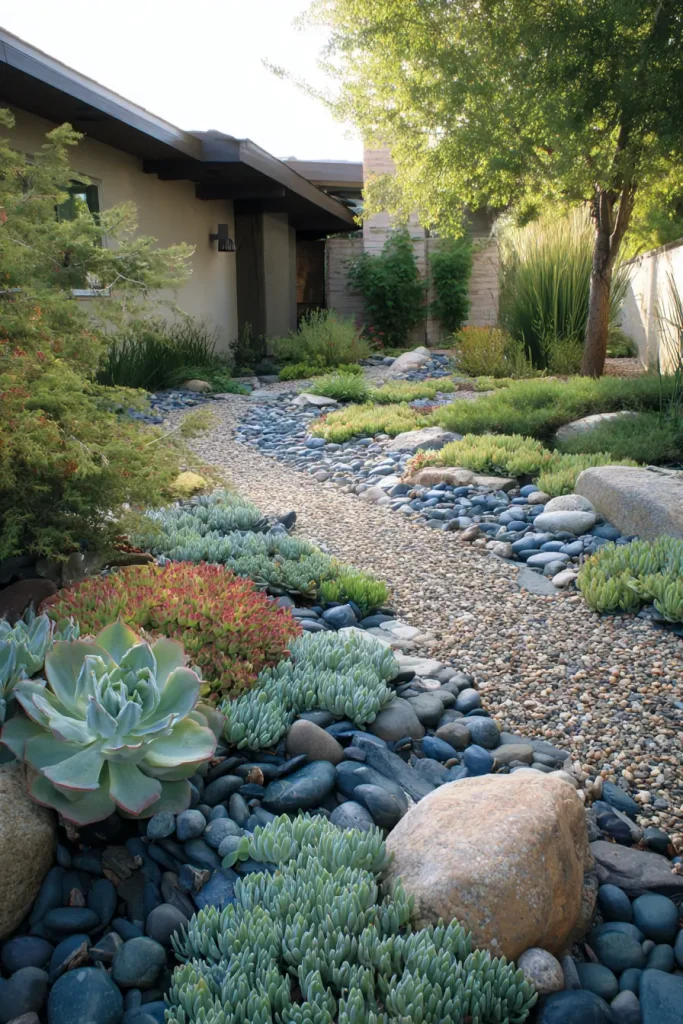
Traditional lawn is one of the most demanding surfaces you can have. It needs mowing, feeding, watering, edging, and treating for moss and weeds. For a minimalist garden, that’s too much effort for one surface.
Ground cover alternatives give you the same visual calm with far less work.
The best options for 2026 include Sedum (low-growing, drought-tolerant, great for pollinators), Thyme (fragrant, walkable, spreads naturally), Ajuga reptans (shade-tolerant, glossy purple leaves), Ophiopogon planiscapus ‘Nigrescens’ (black grass, dramatic, almost no maintenance), and gravel with planting pockets.
The Royal Horticultural Society reported in 2023 that lawn alternatives can reduce garden water use by up to 50% in dry summers. That’s a significant saving, and a significant reduction in the time you spend with a hose.
You don’t have to do this all at once. Start with one section. Remove the lawn, lay weed-suppressing membrane, add ground cover or gravel. See how it feels. Expand from there.
Gravel became the UK’s fastest-growing garden trend in 2022 and 2023, and it’s showing no signs of slowing. The reason is simple. It looks clean, requires almost no maintenance, and works in almost any climate.
6. Give Each Area One Focal Point Only
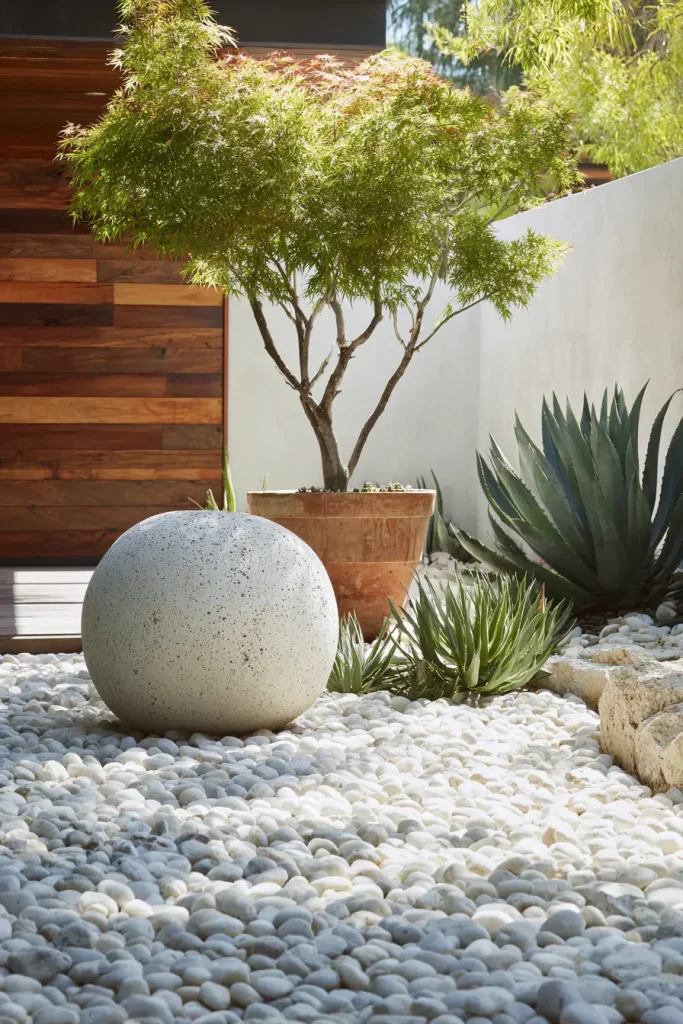
This is one of the most important rules in minimalist garden design. One focal point per zone. Not two. Not three. One.
A focal point is the thing your eye goes to first. It could be a specimen tree, a sculptural plant, a water feature, a single large pot, or a simple piece of stone. What it can’t be is one of several things competing for attention.
When there are multiple focal points in a small space, the eye doesn’t know where to land. That creates a feeling of restlessness, which is the opposite of what you want.
A single Acer palmatum (Japanese maple) in a gravel courtyard is perfect. A concrete sphere sitting in a lawn panel works. One large terracotta pot with a bold Agave commands attention without asking for anything else around it.
The key is framing. Your focal point needs empty space around it. That space is what elevates it from a plant to a statement.
Walk your garden now and count focal points per area. If you have more than one, decide which one stays. Move or remove the rest.
7. Choose Architectural Plants for Year-Round Structure
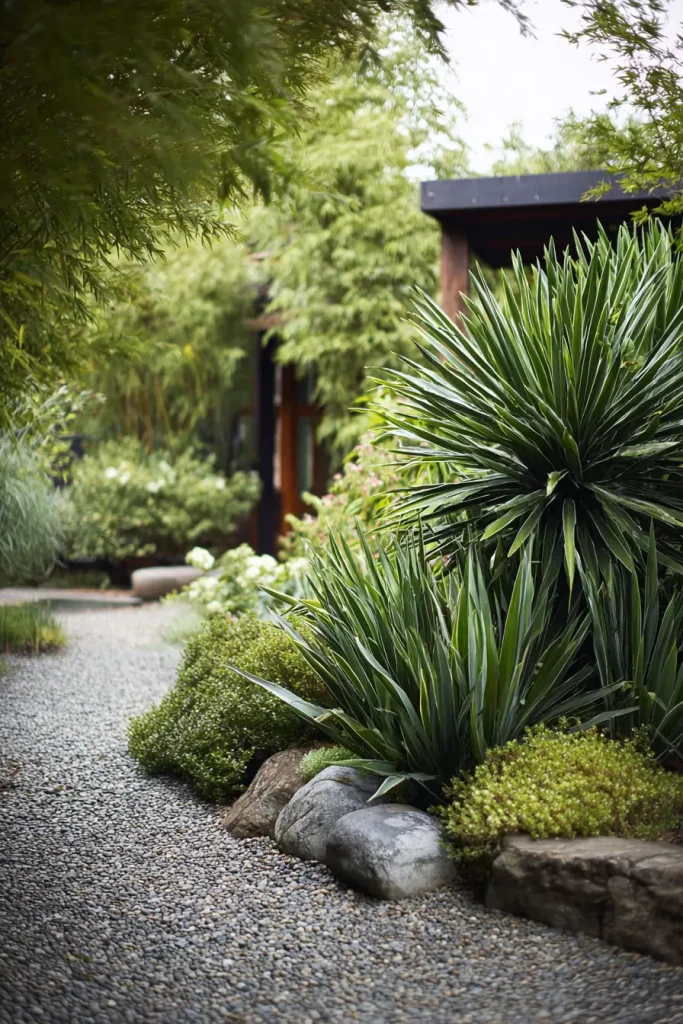
Flowers are seasonal. Structure is permanent.
Architectural plants hold their form all year. They look good in January when everything else has died back. They don’t need constant cutting or managing. And in a minimalist garden, they do the heavy lifting.
The best structural plants for 2026:
Phormium tenax (New Zealand flax) is bold, spiky, and almost indestructible. It comes in green, bronze, and burgundy. One large specimen in a gravel bed is enough.
Miscanthus sinensis (ornamental grass) is tall, elegant, and beautiful in winter when left standing. The seed heads catch light in a way that few plants match.
Fatsia japonica has huge, glossy, tropical-looking leaves. It grows in shade, which makes it useful in spots where most plants struggle. It never looks messy.
Cortaderia selloana, in its dwarf forms, is making a return in 2025 and 2026 after years of being out of favour. Used with restraint, a single clump is striking.
The principle: choose plants that earn their place in every season, not just summer.
8. Use One Paving Material Throughout
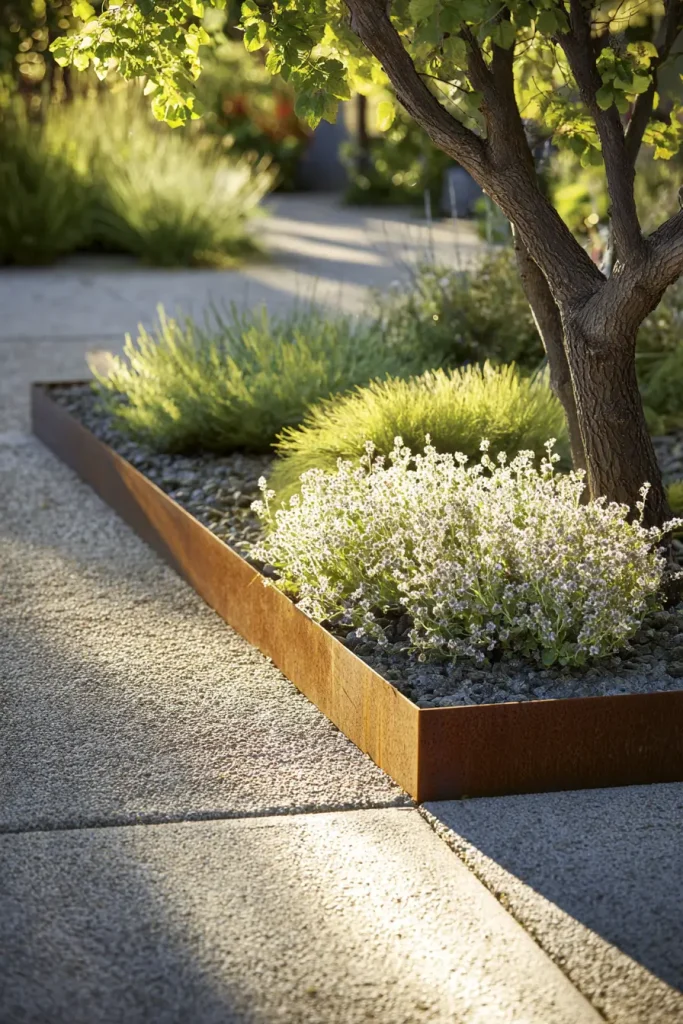
Mixed paving is one of the most common mistakes in small gardens. When you combine three types of surface (decking here, gravel there, slate by the door), the space feels fragmented and busy.
Use one material and use it consistently.
Large format concrete pavers (600x600mm or larger) are a reliable choice for a modern, clean look. They’re affordable, durable, and pair with almost any planting palette.
Limestone gives a warmer, more natural feel. It weathers beautifully and ages well. It does require occasional sealing.
Self-binding gravel is one of the most cost-effective options available. It compacts firmly, drains well, and creates a consistent, clean surface throughout.
Corten (weathered steel) edging is worth mentioning separately. It isn’t a surface, but it separates surfaces with a clean, sharp line. Using it to define the boundary between gravel and planting makes both areas look more intentional.
The rule is simple: pick one and commit. The visual calm that comes from material consistency is immediate.
9. Pick Containers That Support the Plant, Not Compete With It
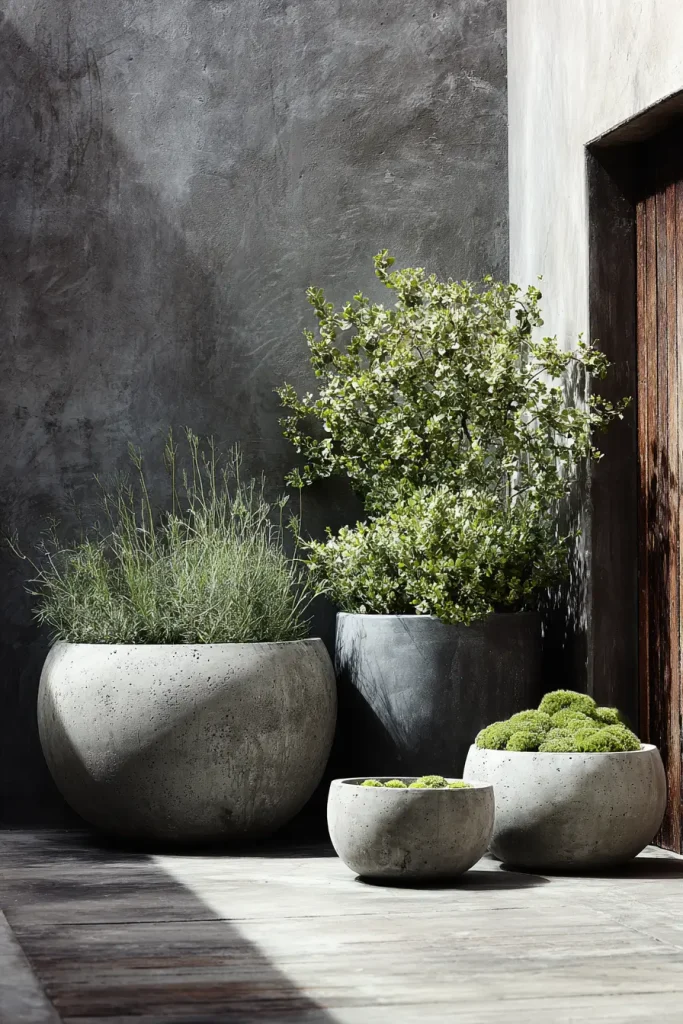
Your pots should be background characters, not the headline act.
Highly decorative pots with patterns, bright colours, or elaborate shapes take attention away from the plant. In a minimalist garden, the plant is the point.
The best container materials are raw concrete, unglazed terracotta, matte black powder-coated metal, and zinc. All of these recede visually. They let the plant lead.
Scale matters more than most people realise. One large terracotta pot (60cm diameter or bigger) filled with a single Phormium makes a clear statement. Six small mismatched pots make a mess. Fewer, bigger containers always read as more considered.
Group in odd numbers if you’re using more than one. Three containers in graduated heights look deliberate. Two containers look accidental.
Budget version: standard terracotta pots from any garden centre. Buy the largest size you can afford. One big one beats three small ones.
Elevated version: bespoke concrete or fibreglass planters, hand-cast in a single clean form. Available from specialist suppliers and increasingly popular in 2025 and 2026.
10. Apply a Simple Grid or Geometric Structure
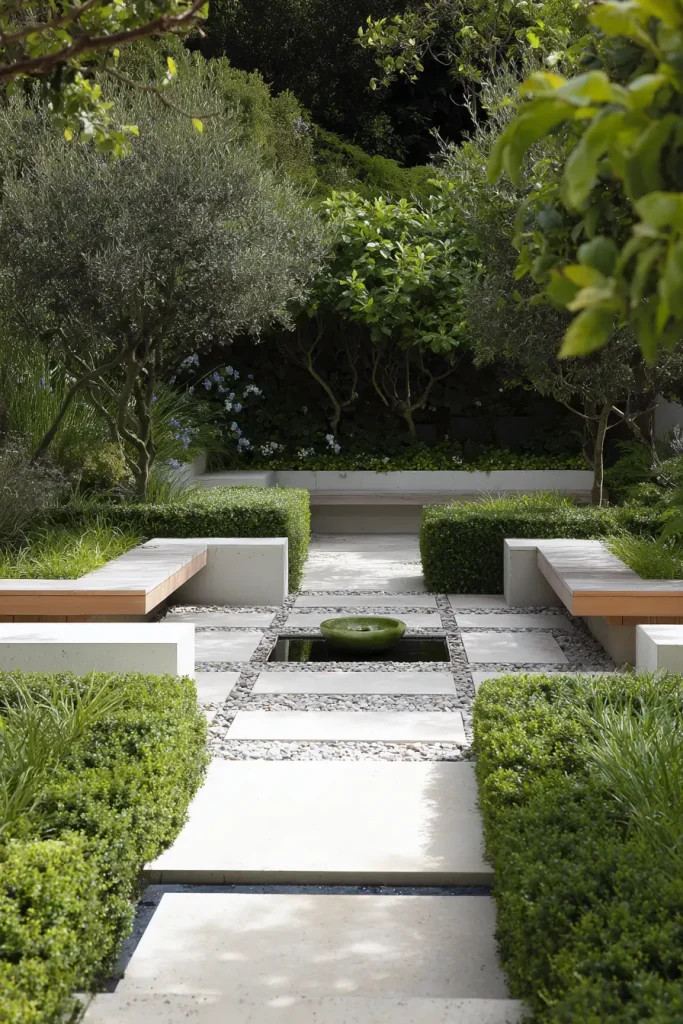
Structure creates calm. It doesn’t need to be complicated.
A simple grid layout, where planting beds, paths, and paved areas relate to each other on a consistent measurement, gives the eye a clear system to follow. The brain finds patterns relaxing. That’s the science behind why geometry works in garden design.
You don’t need to redesign your entire garden. Start with one zone. Create a square or rectangular raised bed. Add a path that runs parallel to your house wall. Align your seating area to the same axis.
The four-quadrant layout is one of the most reliable minimalist structures. Four equal planting beds arranged around a central point, with a focal element at the centre. It works at any scale. It works in modern and traditional gardens.
The Japanese technique of shakkei, or “borrowed landscape,” extends this further. You align your garden’s geometry with the view beyond your boundary. A distant tree becomes part of your design. You don’t own it, but you include it. This is a free way to make a small garden feel much larger.
Even if your planting is relaxed and naturalistic, a geometric structure underneath it creates order.
11. Use Still Water Instead of Moving Water
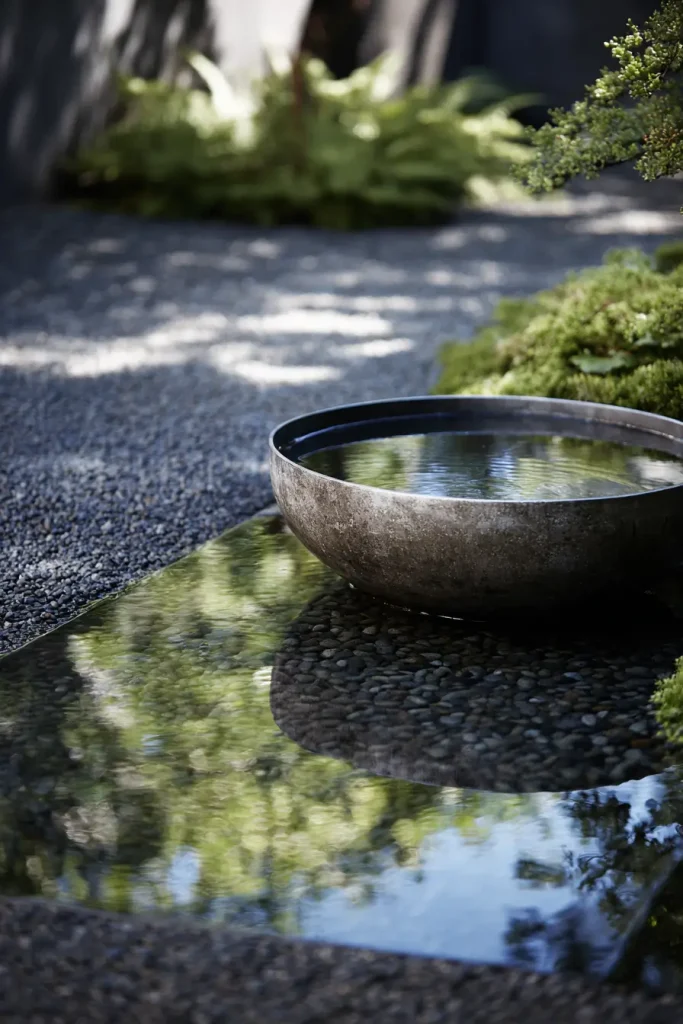
Water makes a garden feel more alive. But not all water features create calm.
Noisy fountains and busy bubblers add sound, which can feel stimulating rather than restful. Still water, a reflecting pool, a shallow stone basin, a galvanised trough, does something different. It mirrors the sky. It creates depth. It slows you down.
Research from the European Centre for Environment and Human Health (ECEHH) at the University of Exeter has shown that being near water, what researchers call “blue space,” reduces cortisol levels and improves mental wellbeing. You don’t need a pond. Even a small basin of still water has an effect.
Wallace J. Nichols, marine biologist and author of Blue Mind (2014), describes how water engages a mild meditative state in the brain. His work has been widely referenced in wellness and design circles since publication.
DIY options for 2026: a galvanised water trough (available from agricultural suppliers cheaply) placed in a gravel bed. A preformed basin sunk flush with your paving. A large concrete mixing bowl sealed and filled.
One small still pool beats a large noisy fountain every time.
12. Keep Lighting Simple After Dark
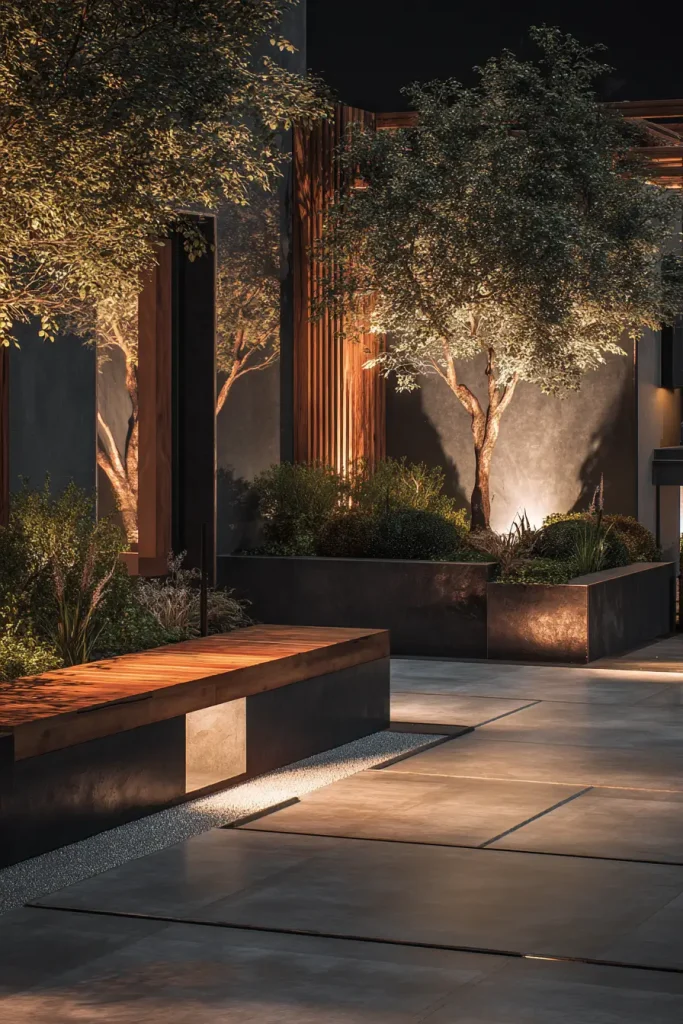
Minimalist gardens should look as good at 9pm as they do at midday.
The mistake most people make is flooding their garden with light. Festoon lights strung everywhere. Spotlights on every corner. The result looks like a car park, not a garden.
Use lighting to highlight, not illuminate everything.
One uplight beneath a specimen tree is all you need to create drama. Recessed ground lights flush with paving create depth without cluttering the eye. Low-level path lighting with directional shields guides movement without spilling light where it isn’t needed.
Colour temperature matters. Use warm white only, between 2700K and 3000K. This is the warm, amber-toned light that flatters plants and feels natural. Avoid cool white (4000K and above). It makes gardens feel clinical. Avoid colour-changing lights entirely. They have no place in a calm outdoor space.
Solar-powered warm amber spike lights have improved significantly and are now a practical option for most gardens. LED spike uplighters are affordable, easy to install, and last for years.
One rule: if it would look like too much light inside your house, it’s too much outside.
13. Have One Seating Area, Not Several
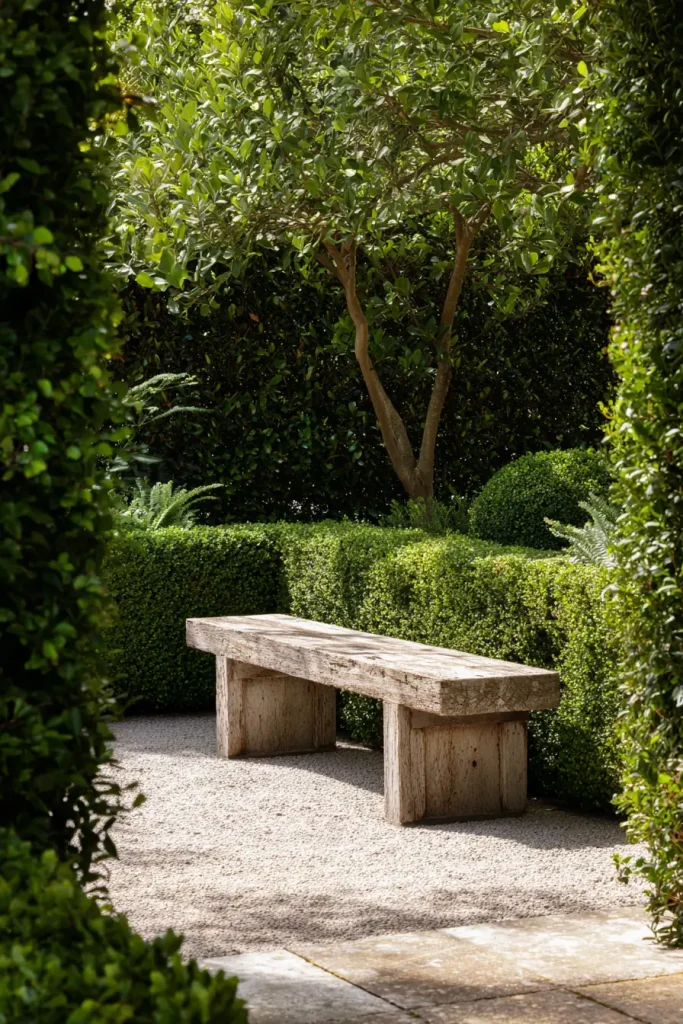
Multiple seating spots fragment a garden. Your eye travels between them and can’t settle. The space feels unresolved.
One well-chosen, well-placed seating area communicates intention. It says: this is where you sit. This is the view. This is the moment.
Material choices for minimalist garden seating: weathered teak ages beautifully and requires very little maintenance. A concrete bench is permanent, sculptural, and develops character over time. Powder-coated steel in black or anthracite is clean and modern.
The placement matters as much as the seat itself. Frame it. A hedge on one side and planting on another creates a sense of enclosure. That enclosure, even a partial one, makes sitting there feel safe and peaceful. You want your back to something and a clear view ahead.
A single teak bench recessed into a clipped yew alcove is one of the most effective minimalist garden moments possible. You don’t need a table, cushions, and a full outdoor dining set to feel comfortable. Sometimes two good chairs and a clear view is enough.
Common mistake: buying garden furniture that matches a catalogue set rather than the garden’s character. Buy for the space, not the photo.
14. Treat Your Walls and Fences as Part of the Design
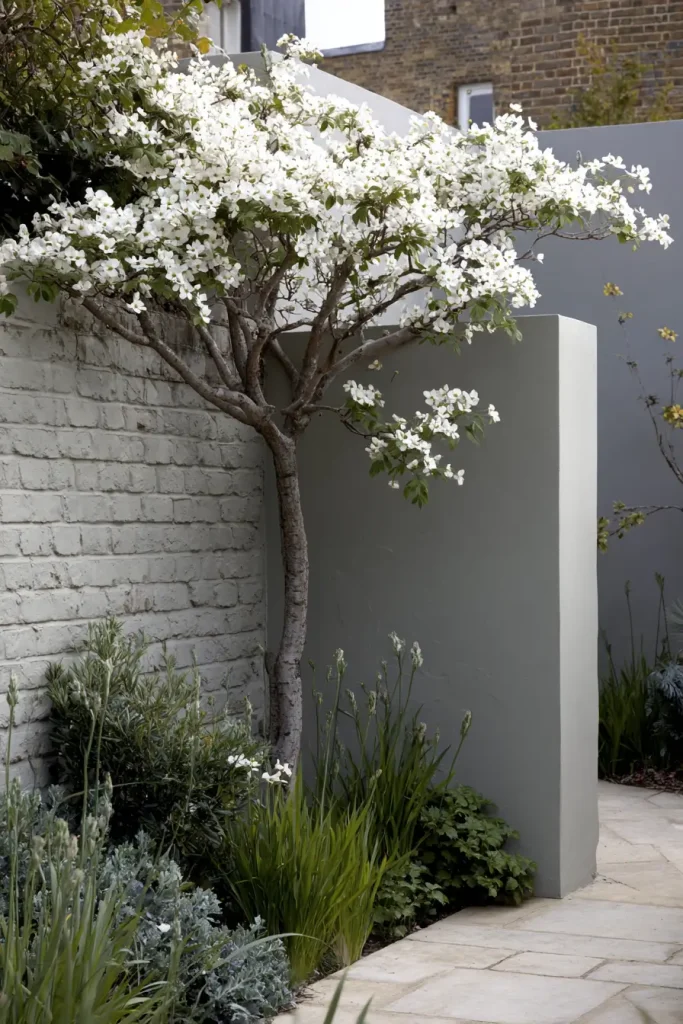
Most people treat their garden boundaries as a problem to solve. Hide the fence. Cover the wall. Plant in front of it.
The better approach is to make the boundary part of the design.
Paint your fence or wall in a considered colour. Not white. White is too harsh in most outdoor contexts and turns grey in British light within one season. Choose instead a warm putty, a dark charcoal, a pale sage, or a muted clay.
A painted wall becomes a backdrop. And a good backdrop elevates everything in front of it. A dark charcoal fence with a single white Japanese Anemone planted against it is one of the most striking and simple combinations in garden design.
Lime-washed brick walls have a long history in Mediterranean and walled garden design. They soften hard surfaces while keeping the muted, natural tone that works in a minimalist setting.
Climbing plants can work here, but use them sparingly. A single trained Hydrangea anomala or an espalier Apple gives vertical interest without covering everything. Covering a wall entirely with climbers removes the backdrop effect and adds visual noise.
The boundary is a surface. Use it.
15. Stick to Natural Materials Throughout
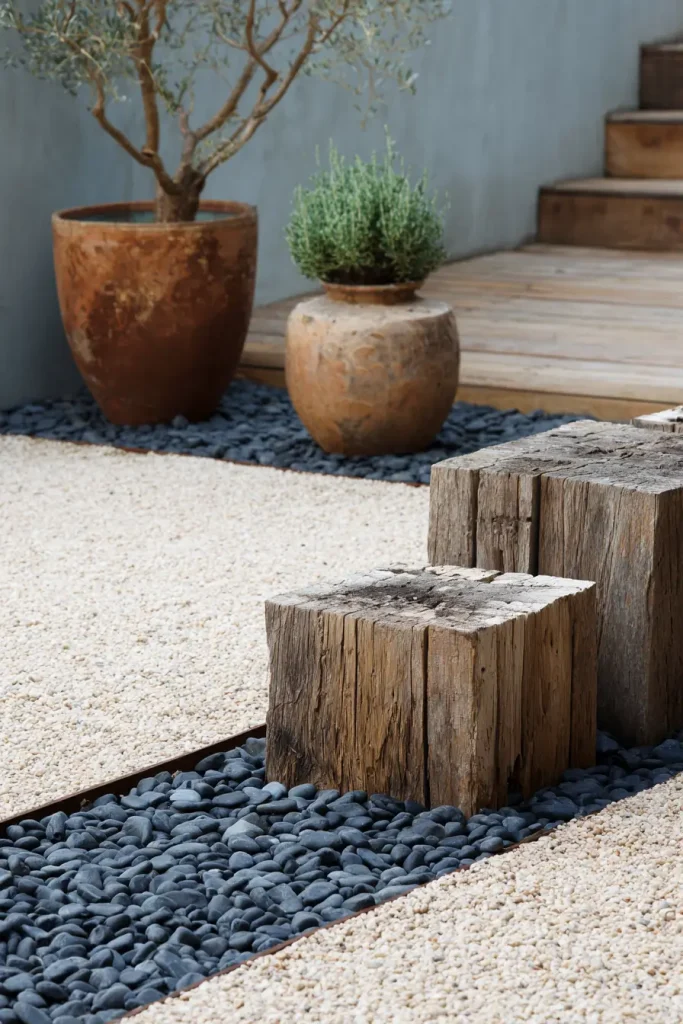
Synthetic materials look good when new. After a few years, they fade, crack, or look out of place. Natural materials age in the opposite direction. They develop character.
Weathered oak looks better at ten years than at one. Sandstone darkens and softens with use. Terracotta develops a patina that no manufactured finish can replicate.
Stick to one family of natural materials per garden.
Warm palette: sandstone or limestone paving, oak sleeper edging, terracotta planters, buff gravel. This reads as Mediterranean and timeless.
Cool palette: slate chippings, weathered steel edging, grey limestone, dark timber decking. This reads as contemporary and calm.
Avoid mixing warm and cool material families in the same space. A warm sandstone patio with cool grey gravel beside it creates tension rather than calm.
Bamboo screening is worth mentioning for urban gardens. Use controlled varieties only. Phyllostachys nigra (black bamboo) is particularly striking and doesn’t spread aggressively when root-balled correctly. It creates privacy without looking like a temporary fence panel.
One material family. Consistent throughout. That’s the rule.
16. Maintain on a Schedule, Not When It Gets Too Bad
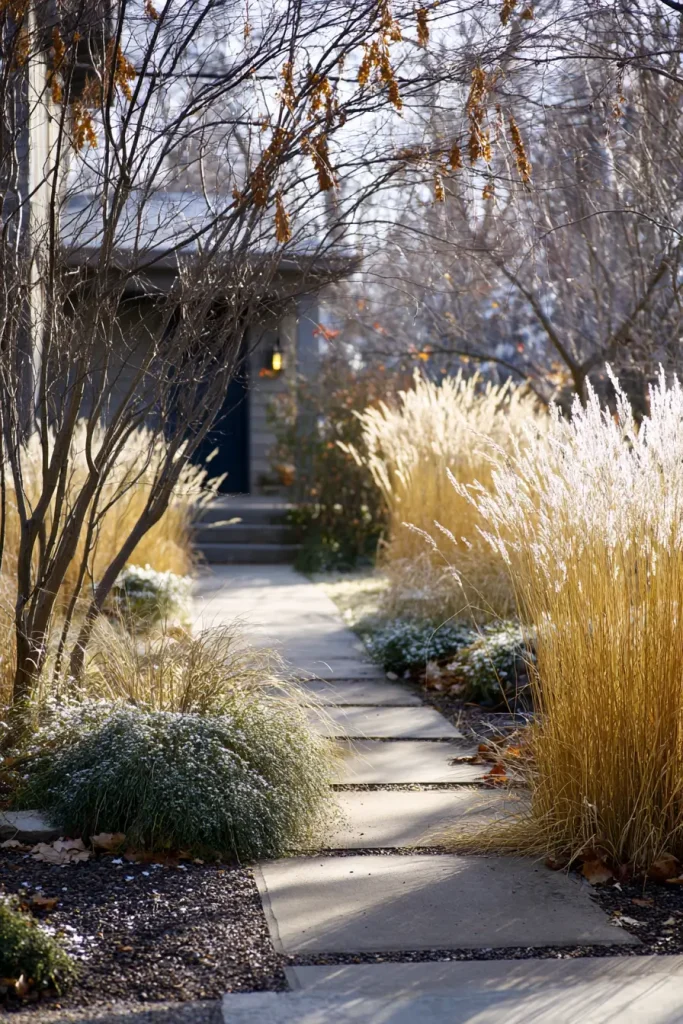
A minimalist garden looks intentional only if it stays that way.
The most common mistake is reactive maintenance. You ignore the garden until it looks bad, then spend a full weekend recovering it. That cycle is exhausting. It also means your garden looks neglected for most of the year.
Schedule two or three focused maintenance sessions per year instead. Late winter (February or March), early summer (June), and autumn (October). Each session follows the same pattern: cut back, rake, re-mulch, done.
Choose plants that look good even when going to seed. Ornamental grasses are the best example. Miscanthus sinensis left standing through winter catches frost and low light in a way that’s genuinely beautiful. You cut it back hard in late February. For eight months of the year, it asks for nothing.
Annual mulching is one of the highest-value maintenance tasks available. A 5 to 7 centimetre layer of bark mulch suppresses weeds, retains moisture, and makes the entire garden look freshly dressed. One bag of mulch covers roughly 3 square metres. One application per year is enough.
Plan your maintenance before it’s needed. Not after.
17. Match Your Garden to Your Interior
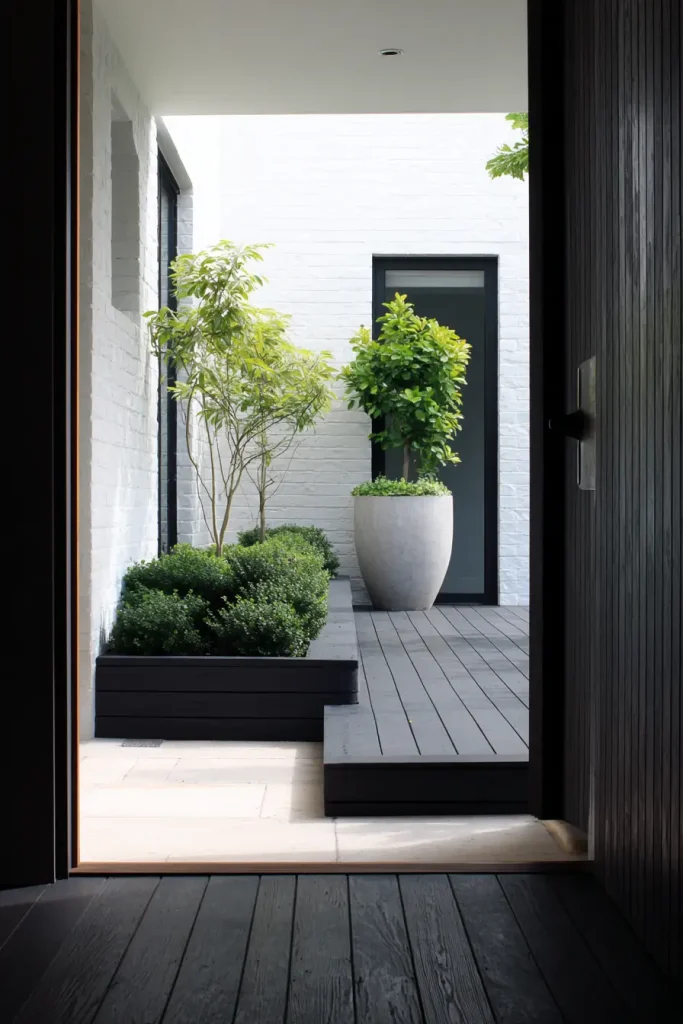
The most cohesive minimalist gardens are extensions of the house, not separate spaces.
If your kitchen has dark timber joinery, dark planters and charcoal decking outside will feel connected. If your living room has concrete floors and white walls, pale limestone paving and white planting outside will blur the threshold between inside and out.
This isn’t just an aesthetic idea. Studies on spatial wellbeing consistently show that visual continuity between indoor and outdoor spaces reduces cognitive load. Your brain doesn’t have to switch gears. Everything reads as one connected environment.
The practical way to apply this is to look at your garden from your main window before making any design decisions. That window view is your most important vantage point. Whatever you see from there is what needs to work as a composed picture.
Match materials where you can. Match tones where materials differ. And keep the window sill clear of objects that interrupt the view. Inside-outside flow is as much about what you remove as what you add.
Budget version: choose outdoor cushions and pots that match your interior colour scheme.
Elevated version: extend your interior flooring material directly outside through bifold or sliding doors. Concrete to concrete. Timber to timber.
18. Add One Wild Element to Prevent Sterility
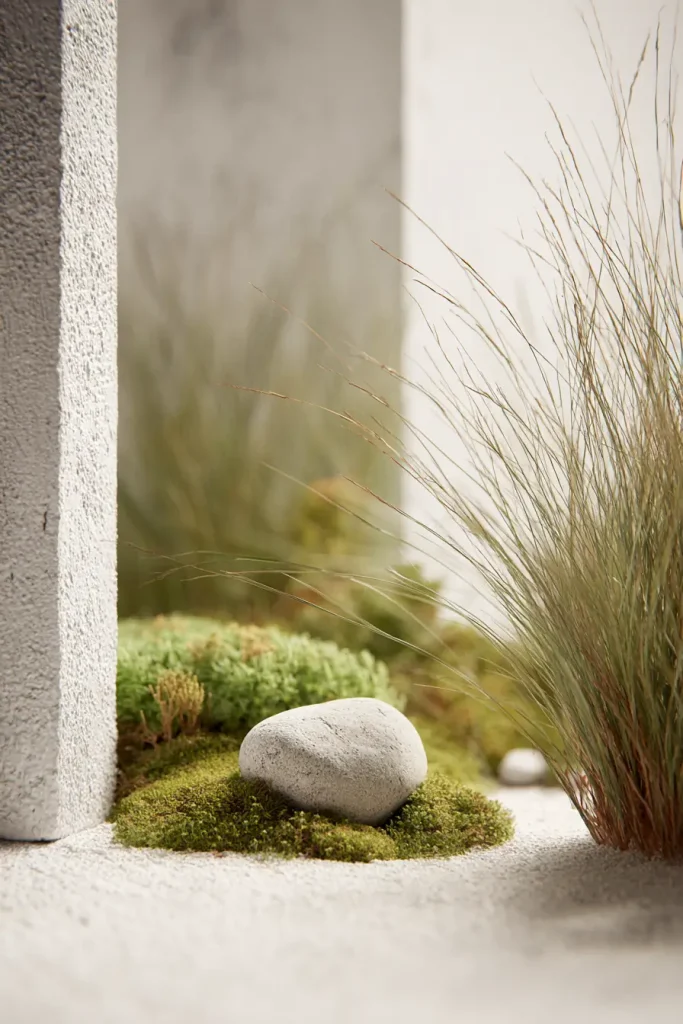
Here’s an honest caveat: purely minimalist gardens can feel cold.
The fix is one wild element. Not many. One.
This could be a single ornamental grass left to move in the wind. A moss-covered stone that you don’t clean. A meadow panel, a small patch of mixed wildflowers, contained within a clean geometric frame. Bee-friendly ground cover that grows slightly unevenly.
That small amount of wildness softens the hard edges. It signals that this is a living space, not a showroom.
The framing is what keeps it minimalist. Wild planting inside a clean geometric raised bed looks intentional. Wild planting spreading unchecked looks neglected. The structure holds everything together.
Many of the most admired contemporary gardens combine precise structure with loose planting. The Oudolf Field at Hauser and Wirth in Somerset does exactly this. Tight geometric mowing patterns contain loose, naturalistic planting. The result is both calm and alive.
You don’t need to choose between clean and natural. Use one to set off the other.
How to Start This Week
You now have 18 specific ideas. The question is where to begin.
Start with the subtraction audit. Walk your garden today. Remove three things that don’t belong. It costs nothing. It takes less than an hour. And you’ll feel the difference immediately.
Then pick one more idea from this list that you can act on this season. Just one. Restrict your colour palette on the next planting decision. Replace a small lawn section with gravel. Repaint your fence in a colour that works.
Minimalist garden ideas work because intention is more powerful than abundance. Your outdoor space doesn’t need more. It needs the right things, placed with purpose.
Pick one. Start there.

- 17 Classy Living Room Ideas for a Cozy Elegant Look - April 23, 2026
- 16 Dark Moody Living Room Ideas That Feel Rich and Warm - April 22, 2026
- 14 Elegant Bedroom Trends for 2026 You’ll Love - April 22, 2026


