
Waking up in a bedroom without a window can feel less like a sanctuary and more like a survival bunker. But in 2026, with urban living shrinking and basement apartments becoming the norm, the “dark bedroom” is a challenge we can solve with modern technology and smart design.
You might struggle to wake up in the morning. Your sleep cycle feels off. The room feels cramped, maybe even a little damp. Getting dressed is a guessing game because the lighting makes every color look wrong. These are real problems that come from a bedroom with no natural light.
Here’s the good news: you don’t need to knock down a wall. The goal isn’t to fake a window. It’s to master layering artificial light, use color tricks, and pick textures that make the space feel open and relaxing. In this guide, you’ll learn 16 actionable ideas for a windowless bedroom—some are renter-friendly, others are bigger projects for homeowners. Each one will help you turn that dark room into a space you actually want to spend time in.
Let’s get started.
1. Use Circadian Lighting Systems (Not Just Bulbs)

Most people put a single overhead light in a dark room and call it done. That’s like trying to cook a steak with a candle. You need layers.
The three layers of light are:
- Ambient: General light that fills the room.
- Task: Focused light for reading or working.
- Accent: Mood light that highlights art or architectural details.
In 2026, the real upgrade is tunable white bulbs. These are smart bulbs that shift from bright, cool light (like midday sun) to warm, soft light (like sunset). You can set them on a schedule. In the morning, they help you wake up. At night, they tell your brain to produce melatonin.
A 2025 study from the Sleep Foundation found that people using tunable white lighting in windowless rooms fell asleep 22% faster. That’s a huge difference.
What to buy: Look for systems like Philips Hue or Govee. Make sure the bulbs cover a range from 2700K (warm) to 6500K (cool daylight).
Place lights at different heights. A floor lamp that points up draws your eye to the ceiling and makes the room feel taller. Table lamps on nightstands give you task light. Add a small spotlight on a piece of art to create depth.
Renter-friendly: Yes. Smart bulbs just screw in. You can take them with you when you move.
2. Install a High‑Tech False Window

Stickers of a beach scene on your wall won’t cut it. They look fake and do nothing for actual light.
Instead, consider a backlit light panel. Companies like Lumicube and Seura make panels that look like real windows. They have depth, adjustable color temperature, and some even change scenes throughout the day—morning sky to sunset to starry night.
Place the panel on your largest wall. That tricks your brain into thinking the room extends further than it does. It becomes a focal point.
DIY option: Mount a Samsung Frame TV vertically on the wall. Set it to display landscape art. It costs more, but it doubles as entertainment.
Renter-friendly: Some panels are plug-and-play, but check with your landlord before mounting anything heavy.
3. Try Color Drenching (Yes, With Dark Colors)

Your first instinct is to paint a dark room white. Stop. In a room with zero natural light, white walls often look like a dirty gray cave wall.
Instead, use “color drenching.” That means painting the walls, trim, and ceiling all the same deep color. It blurs the edges of the room, so the lack of corners feels intentional. The room becomes cozy instead of cramped.
For 2026, the trending palettes for windowless rooms are:
- Deep terracotta: adds warmth without being too bright.
- Benjamin Moore’s ‘Witching Hour’: a rich charcoal that feels luxurious.
- Saturated olive: brings a subtle nature vibe.
Warm tones (reds, oranges, terracotta) actually help prevent the “cold tomb” feeling. Farrow & Ball’s 2026 trend report calls this “cocooning colors”—colors that wrap around you and make a space feel safe.
Renter-friendly: If you can’t paint, use peel-and-stick wallpaper in a deep color on one accent wall. Or hang large fabric panels in a rich shade.
4. Place Mirrors Where They Actually Help

A small mirror over your dresser won’t do much. What matters is placement.
The best spots:
- Opposite the bedroom door. This reflects light coming in from the hallway, making the room feel brighter instantly.
- On closet doors. Mirrored sliding doors double the perceived square footage and bounce light from your lamps around the room.
- In a gallery wall. A mix of mirror sizes creates sparkle and texture without a single heavy piece.
One feng shui note: try not to place a mirror directly facing your bed. Some people find it unsettling. If your room is small, angle it slightly or use a mirror that doesn’t face the bed head-on.
5. Pick High‑Texture Fabrics Over Patterns
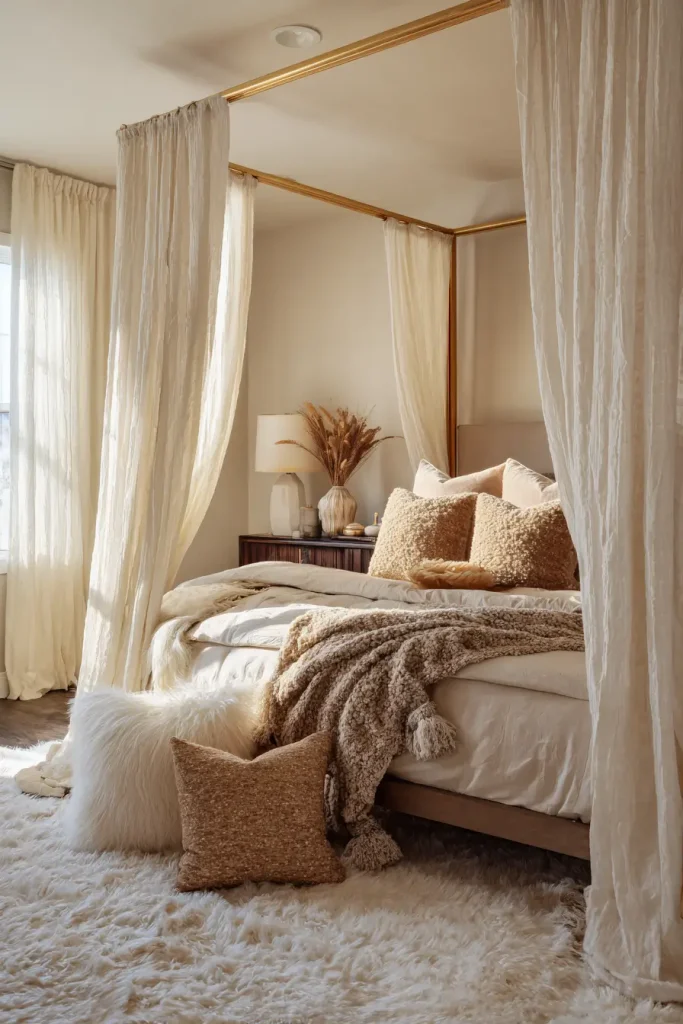
Flat matte paint and smooth surfaces look dull in the dark. They don’t reflect anything.
The solution is texture. Velvet, bouclé, and high-pile wool rugs add visual interest because they catch light in different ways. They also feel good to touch, which makes up for the lack of natural light.
Try a canopy bed with sheer drapes. Even if you have no window, the drapes create a “room within a room.” It feels soft and adds height.
Studio McGee, a well-known design firm, uses this technique in basement bedrooms. They layer chunky knit throws, velvet pillows, and a wool rug to create warmth where sunlight doesn’t reach.
6. Control Humidity and Airflow

This isn’t a design tip—it’s a health tip. A windowless bedroom traps moisture from your breath and sweat. Over time, that leads to mold and mildew.
Two ways to fight it:
- Passive: Keep furniture away from walls. Leave a two‑inch gap behind your headboard and dresser so air can circulate.
- Active: Use a dehumidifier or an air purifier with HEPA filtration. The EPA says ventilation is critical in spaces without operable windows. In 2026, units like the Mila or Dyson Purifier are common choices. They run quietly and double as smart home devices.
If you smell mustiness, don’t ignore it. That’s a sign your humidity is too high. Aim to keep it below 50%.
7. Add Reflective and Glossy Surfaces

Glossy surfaces bounce light. Matte surfaces absorb it. In a dark room, you want bounce.
Ideas that work:
- Paint your ceiling with high-gloss white. It reflects light from your lamps back down, making the room feel taller. Keep walls matte for contrast.
- Use acrylic furniture. A clear Lucite nightstand or ghost chair doesn’t block light, so the room feels less cluttered.
- Choose polished nickel or chrome hardware for door handles, drawer pulls, and lighting fixtures. They act like tiny mirrors, catching and spreading light.
A simple DIY: if you own your place, paint just the ceiling in a high-gloss finish. You’ll notice the difference immediately.
8. Create a “Functional Decor” Wall
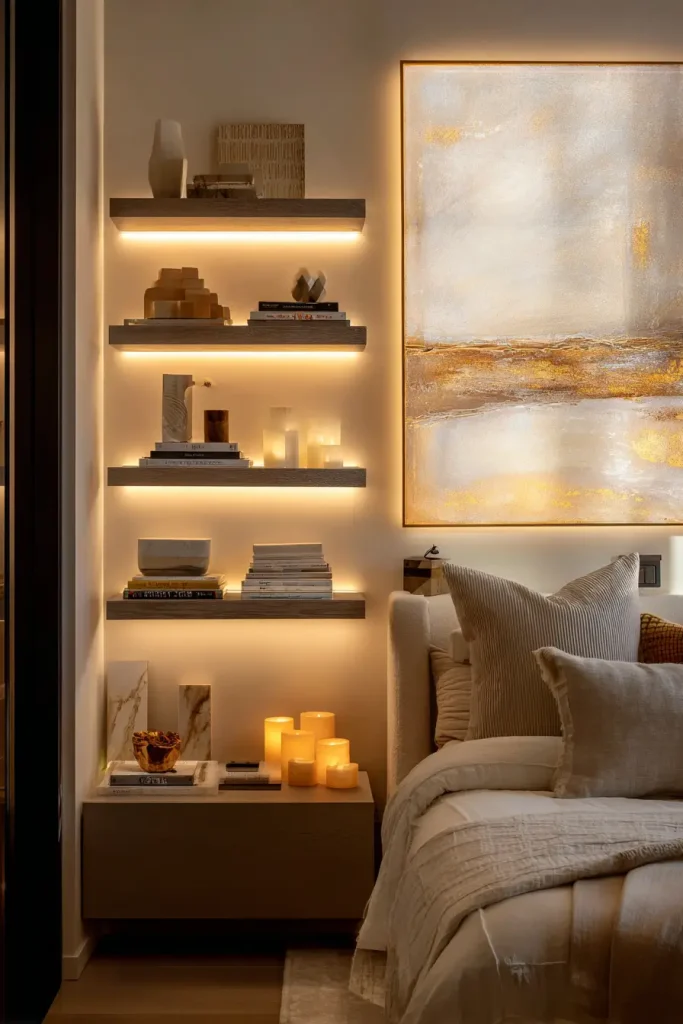
Clutter makes a dark room feel chaotic. Every object that doesn’t serve a purpose adds visual weight.
Instead, pick one wall to mount floating shelves with integrated LED strips. Display a few curated items—candles, a stack of books, a small sculpture. The hidden lighting makes those objects pop, drawing attention away from the lack of a window.
For art, choose large‑scale pieces with light backgrounds. Black‑and‑white photography with high contrast works well. So does abstract art with metallic gold leaf—it catches lamp light and adds sparkle.
This approach keeps the room clean and gives you a focal point.
9. Pick the Right Plants (Or Skip Live Ones)

Most plants die in a windowless room. That’s just reality. You don’t want a collection of sad, brown leaves.
If you want live plants, stick to the tough ones: ZZ plants, snake plants (sansevieria), and pothos. They can survive on artificial light alone. But even they need some light, so keep them near a lamp that’s on for several hours a day.
For 2026, a better option is preserved moss walls. They give you the biophilic look without any maintenance. Or use high‑quality botanical prints framed behind glass. They add green without the risk of decay.
10. Consider Glass Block Walls (If You Can)

If you’re renovating or own your home, glass blocks can replace a section of wall. They let light pass through from an adjacent room while still providing privacy.
You’ll often see this in basements that share a wall with a hallway. The glass blocks bring borrowed light into the bedroom. They also add a modern, architectural look.
Renter-friendly? No, this is a construction project. But it’s worth mentioning because it’s a permanent solution that works well.
11. Remove Closet Doors

A dark bedroom often feels smaller because of big, bulky closet doors. Swinging doors take up floor space and block light.
Try removing the doors altogether. Turn the closet into an open storage area with organized shelves and hanging rods. You can also replace the doors with sliding barn doors or a simple curtain.
If you use a curtain, pick a light‑colored fabric that doesn’t block the light from the room. This small change can make the whole space feel more open.
12. Add Under‑Bed Lighting

The floor is a dark void in most bedrooms. Adding light under the bed makes the room feel larger because you can see all the way to the edges.
Stick a strip of LED lights under the bed frame. Use a warm white (around 3000K) to match your other lights. Connect it to a smart plug so it turns on automatically in the evening.
This is also a safety feature. If you get up at night, you won’t trip over shoes or slippers.
13. Use Floor‑to‑Ceiling Curtains (Even With No Window)

This trick is pure visual illusion. Hang curtain rods all the way up near the ceiling and use floor‑length drapes on an entire wall. Even if there’s no window behind them, the vertical lines make the ceiling feel higher and the room feel grander.
Choose a light‑colored fabric, like linen or cotton, to keep it airy. You can even put sheer panels in the middle with heavier drapes on the sides. It looks intentional and adds softness.
14. Try a Scent Strategy

You can’t see a window, but you can smell one. A fresh scent helps counter the “basement” smell that sometimes lingers in windowless rooms.
Avoid heavy, sweet candles that add to air pollution. Instead, use a reed diffuser with clean scents like eucalyptus, cedar, or white tea. If you use an essential oil diffuser, keep it clean to prevent mold inside the unit.
The goal isn’t to mask odors but to create an association: the room smells fresh, so it feels fresh.
15. Install Cove Crown Molding Lighting

If you’re up for a small electrical project, cove lighting is a game changer. It’s indirect lighting installed in a ledge near the ceiling. The light reflects off the ceiling, creating a soft, even glow.
This type of lighting eliminates harsh shadows and makes the room feel taller. You can buy LED cove lighting kits that are easy to install, or hire an electrician to hardwire them.
Even if you can’t do full cove lighting, placing LED strips on top of tall cabinets or bookcases gives a similar effect.
16. Keep Furniture Minimal and Low‑Profile

In a dark room, bulky furniture makes the space feel heavy. Choose pieces with thin legs that show floor underneath. That visual space makes the room feel larger.
A low-profile bed frame (platform style) keeps the center of gravity low, which also makes ceilings feel higher. Avoid tall, dark armoires. Instead, use floating shelves or a low dresser.
The less furniture you have, the more light can travel around the room. Every piece should earn its spot.
Conclusion
A bedroom with no natural light doesn’t have to feel like a cave. By using circadian lighting to support your sleep cycle, color drenching to create a cozy atmosphere, and paying attention to air quality for your health, you can turn a challenging space into a comfortable retreat.
Pick one or two ideas from this list and start there. Maybe you swap out your bulbs for tunable LEDs this weekend. Or you move your mirror to a better spot. Small changes add up.
Which of these 16 ideas will you try first? Try one, see how it feels, and keep going. You deserve a bedroom that feels good, even when the sun doesn’t shine in.

- 18 Scandinavian Bedroom Ideas That Are Calm & Livable (2026) - March 31, 2026
- 17 Kids Bedroom Ideas That Grow With Them - March 31, 2026
- 17 Industrial Bedroom Ideas for Urban Apartment Dwellers - March 31, 2026


