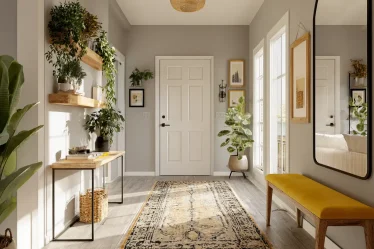
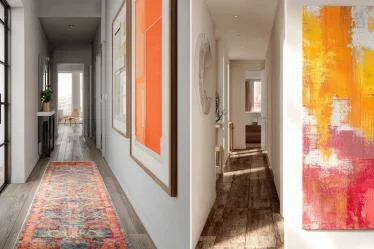
Your Hallway Is the First Thing People See. Most Homes Get It Wrong.
Your hallway is the first thing every guest sees. And most people are wasting it.
You walk past it every day without thinking. It collects coats, shoes, and stuff you meant to put away. It feels tight, dark, and messy. And somewhere in the back of your mind, you know it doesn’t look great.
Here’s the thing. You don’t need to knock down walls or spend thousands to fix it. You just need the right ideas and a plan.
In this guide, you’ll find 19 small hallway ideas that actually work. Some cost nothing. Some cost under $50. All of them are things you can do this weekend.
Whether your hallway is a narrow corridor or a tiny apartment entry, these ideas will help it feel bigger, cleaner, and more welcoming.
Let’s start with why this small space matters more than you think.
Why Your Hallway Matters More Than You Think
Research from Princeton University found that people form first impressions in less than one second. That’s faster than a blink.
When someone walks into your home, the hallway is what they see first. It sets the mood for everything else. A cramped, messy entry makes the whole home feel smaller. A clean, well-styled one makes people feel instantly comfortable.
Think about the last time you walked into someone’s home and felt good straight away. Chances are, the entry was tidy, well-lit, and had some kind of style to it.
Real estate agents know this too. A well-presented hallway signals that the rest of the home is cared for. It adds perceived value before anyone sees another room.
Small doesn’t mean unimportant. Your hallway deserves attention. And the good news is, changing it doesn’t require a renovation. It requires a plan.
Here are 19 ideas to get you started.
The 19 Best Small Hallway Ideas for 2026
1. Put Up a Large Mirror to Make the Space Feel Twice as Big
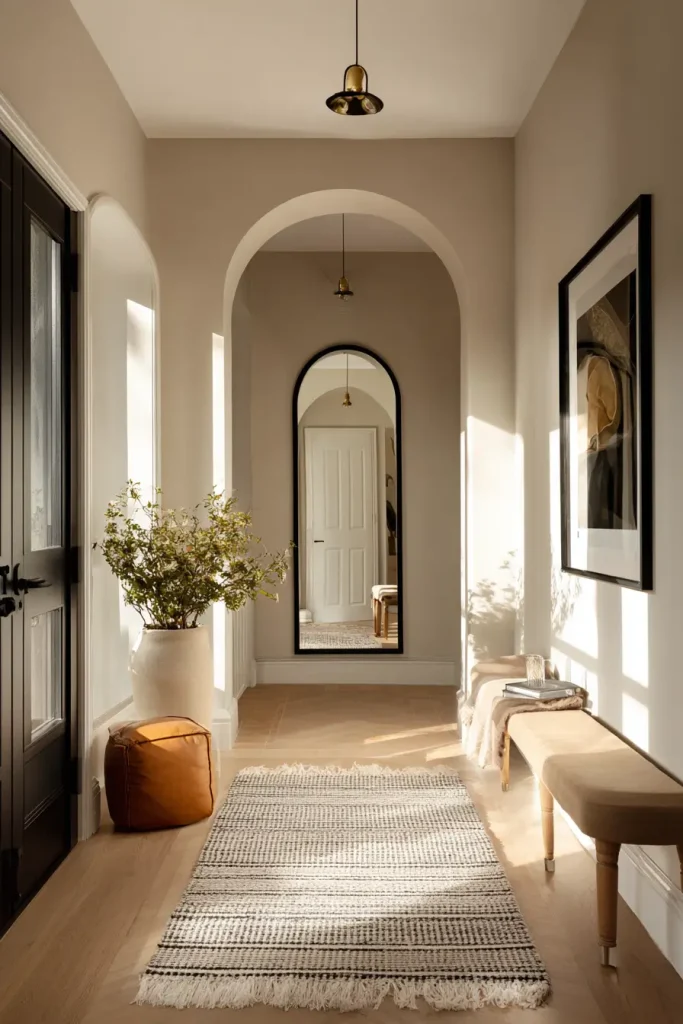
A large mirror is the single most effective tool for a small hallway. It reflects light and creates the illusion of depth. The space doesn’t get bigger, but it feels like it does.
Place it opposite the front door or at the end of the corridor. This draws the eye forward and makes the hallway feel longer.
Frame style matters. Slim metal frames in black or brass feel modern without taking up visual space. An arched mirror is one of the biggest hallway trends going into 2026. It adds height and softens the angular look of a tight corridor.
If wall space is limited, a leaner mirror propped against the wall works just as well. And it doesn’t require a single nail.
Pro tip: Clean your mirror weekly. A dusty mirror loses most of its effect and makes the space feel worse than no mirror at all.
2. Move Everything Off the Floor and Up the Wall
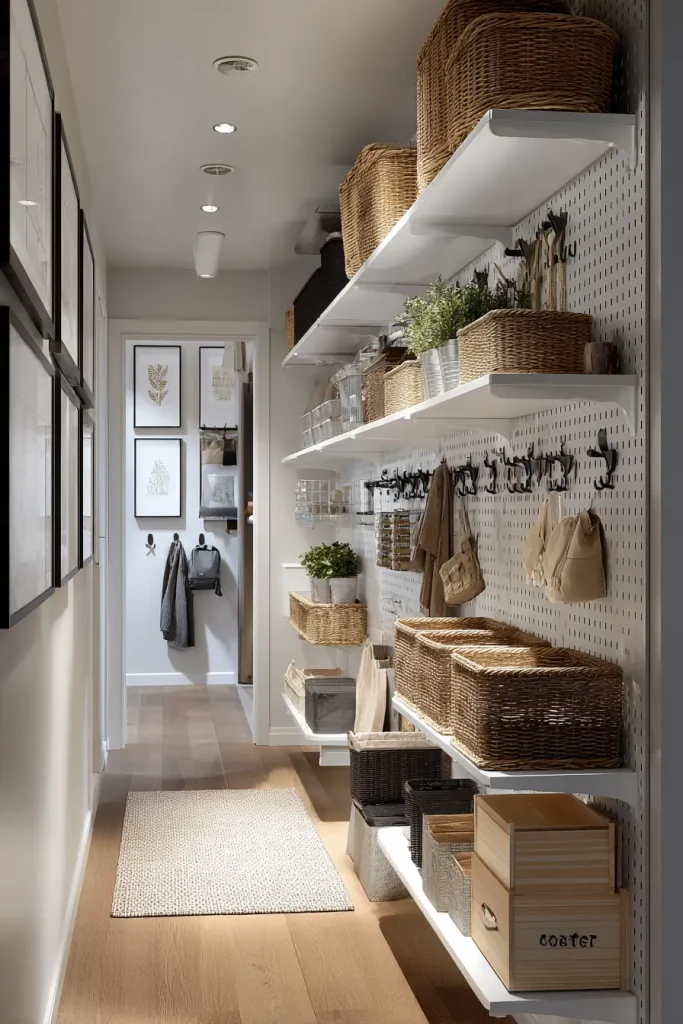
Floor space is precious in a small hallway. The moment you put something on the floor, the space feels smaller.
Wall-mounted storage changes everything. Coat hooks, floating shelves, and wall-mounted baskets all free up the floor while keeping your things close to hand.
The IKEA SKADIS pegboard system is a popular option in 2026. It’s modular, affordable, and you can reconfigure it as your needs change. Similar systems are available on Amazon for under $50.
Keep hooks at a consistent height for a clean look. Use labeled baskets on high shelves for seasonal items like scarves and gloves. That way, things have a home even when they aren’t in daily use.
The rule is simple: if it can go on the wall, it should go on the wall.
3. Swap Bulky Furniture for a Slim Console Table
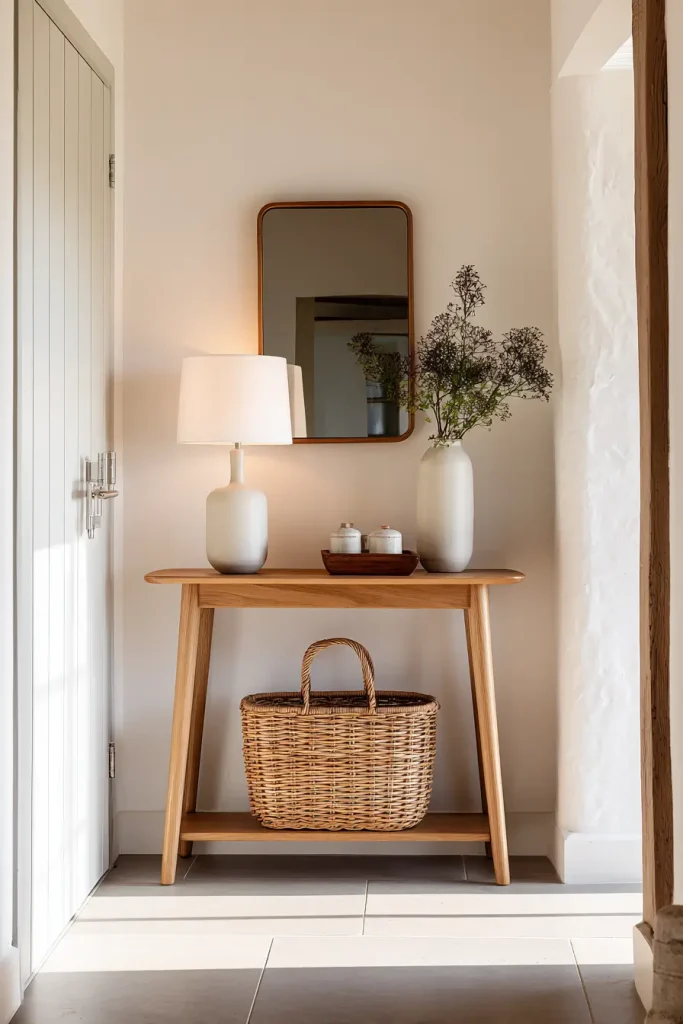
A wide, chunky piece of furniture in a narrow hallway is like a traffic jam. It blocks flow and makes the space feel tight.
A slim console table under 12 inches deep keeps the pathway clear. You still get a surface for a lamp, a keys tray, or a small plant. But you’re not sacrificing walking room to get it.
Use the surface with the rule of three: one functional item, one decorative item, one light source. That’s it. Anything more starts to look cluttered.
Add a basket or lower shelf underneath for bags or shoes. This gives you hidden storage without adding visual noise.
For 2026, light oak and white washed finishes are leading the trend for hallway furniture. They’re warm, they’re versatile, and they work with almost any wall color.
4. Paint Your Ceiling Lighter Than Your Walls
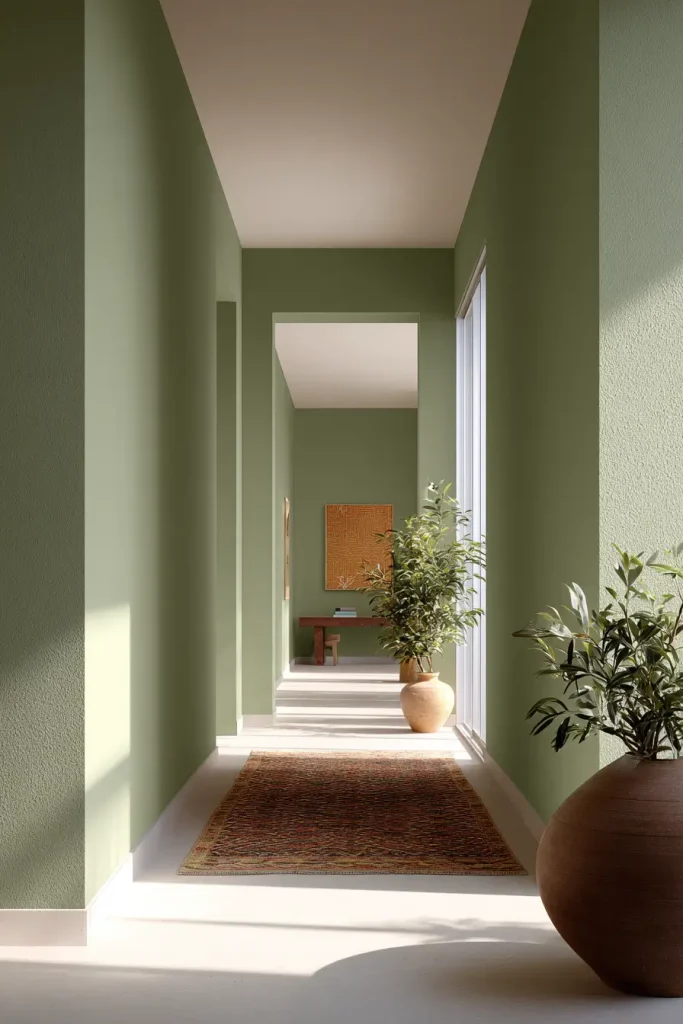
Most people paint everything white and wonder why the hallway still feels flat. Here’s what actually works.
Paint your walls a mid tone color. Sage green, warm grey, and terracotta are all popular in 2026. Then paint your ceiling white or off-white. This contrast draws the eye upward and gives the corridor a feeling of height.
All-white hallways often feel clinical rather than open. A warmer wall color with a bright ceiling is more inviting and does more visual work.
Interior designers consistently name ceiling color as one of the most overlooked tools in small space design. It costs the same as painting the walls, and it makes a noticeable difference.
Avoid dark ceilings in already tight spaces. They push the room down rather than lifting it up.
5. Lay a Runner Rug to Create the Feeling of Length
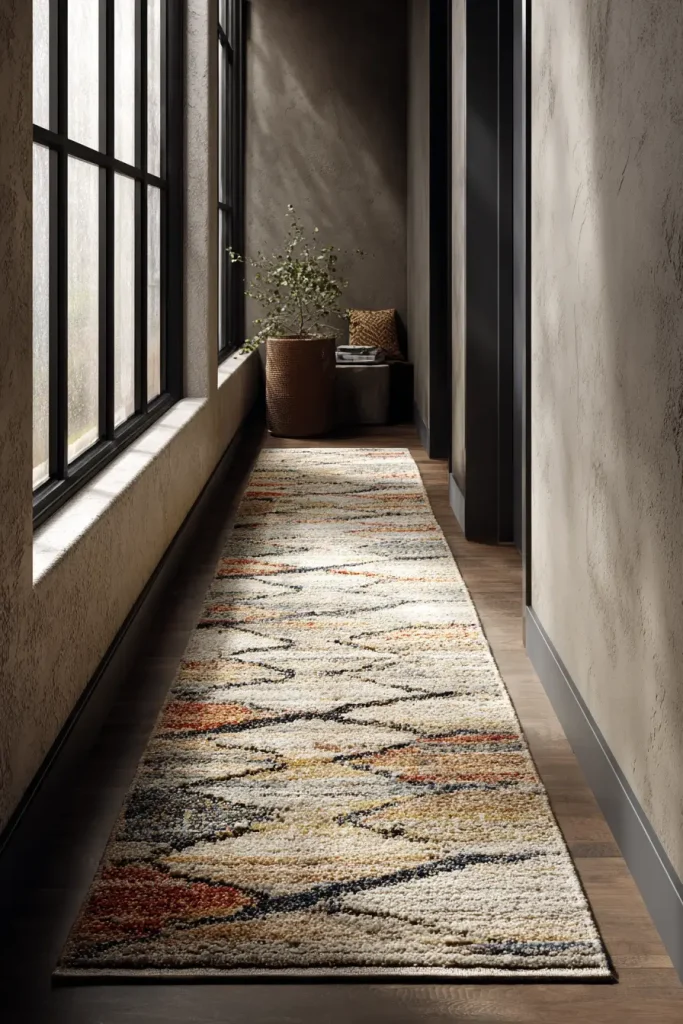
A long, narrow rug does something clever to a hallway. It stretches the eye down the corridor and makes the space feel longer than it is.
Stripes running lengthwise are especially effective. They work like a visual track that pulls your gaze forward.
Choose a low-pile rug. It’s easier to clean, less likely to bunch up, and less of a trip hazard. Leave two to four inches of floor visible on each side. This frames the rug and makes it look deliberate rather than jammed in.
Non-slip backing is not optional. It prevents movement and keeps the rug flat, which is safer for everyone, especially on hard floors.
Bold geometric patterns and earthy tones are the strongest hallway rug choices in 2026. Avoid pale rugs in high-traffic entries. They show dirt fast.
6. Install Recessed or Track Lighting Instead of a Pendant
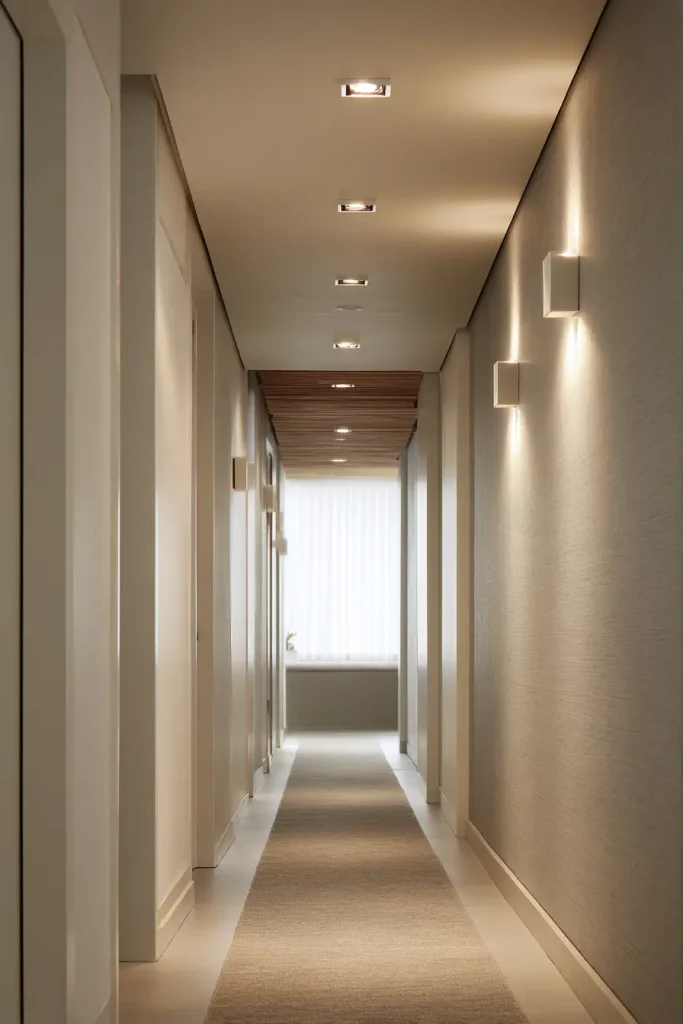
A pendant light hanging in a narrow hallway takes up visual width. In a tight corridor, that’s the last thing you want.
Recessed lighting sits flush with the ceiling. Track lighting mounts flat and directs light exactly where you need it. Both options keep the ceiling clear and make the space feel less crowded.
For bulb color, choose warm white in the 2700K to 3000K range. It makes a hallway feel welcoming rather than cold and clinical.
Layer your lighting if you can. A ceiling light plus one wall sconce creates depth. The combination feels more like a designed space and less like a corridor.
Smart bulb options from Philips Hue or IKEA TRADFRI let you control brightness and warmth without rewiring. They’re a practical upgrade that works in most standard fittings.
7. Use Wallpaper on One Wall Only
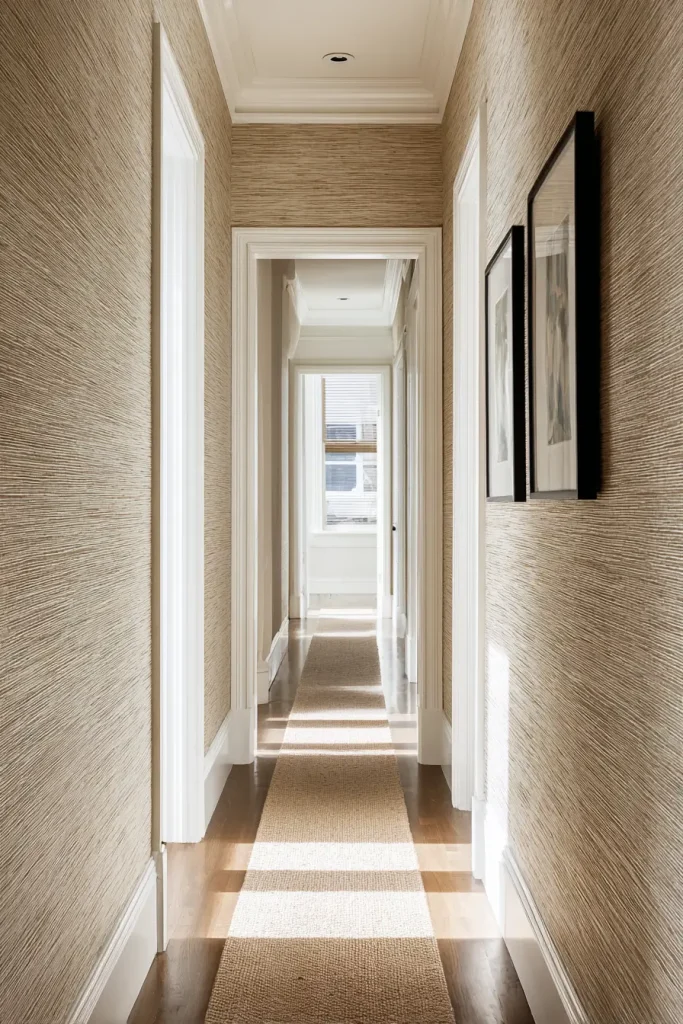
Full-pattern wallpaper in a small hallway can feel overwhelming. One accent wall is enough to add character without closing the space in.
Vertical stripe patterns add perceived height. Textured wallpapers like grasscloth add depth and warmth. Both are strong design choices for 2026.
For renters, removable wallpaper from brands like Chasing Paper or Tempaper is a practical option. It goes up without damage and comes down cleanly when you move. The quality and range of removable options has improved significantly.
Pair a bold accent wall with neutral flooring and white trim. This creates balance. The pattern gets to be the feature without competing with everything else in the space.
One wall. That’s all you need.
8. Add a Bench with Storage Underneath
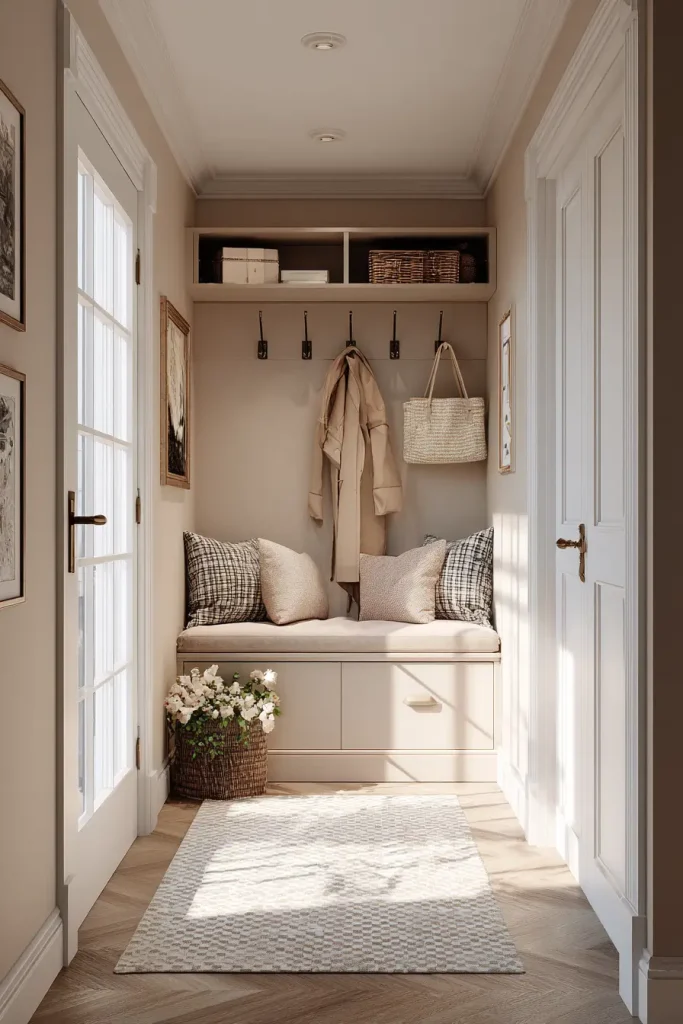
A hallway bench does two jobs at once. It gives you a place to sit when putting on shoes. And it hides clutter underneath.
Ottoman-style benches with a lift-top lid are ideal for small hallways. They hold shoes, umbrellas, dog leads, and seasonal accessories. All hidden. All accessible.
Keep the bench depth under 16 inches so it doesn’t block the walkway. An upholstered top adds softness to a hard, functional space. It makes the hallway feel more like a room and less like a utility zone.
Brands like SONGMICS, IKEA, and Wayfair all offer compact options under $100. This is one of the best value purchases you can make for a small entryway.
If you have children, a bench with hooks above it creates a complete system. Coats go on the hooks, bags go on the bench, shoes go underneath.
9. Hang Art in a Single Vertical Column
Gallery walls work well in living rooms and dining rooms. In a narrow hallway, they work against you.
A wide horizontal arrangement of frames draws attention to the width of the corridor. And narrow hallways don’t want that kind of attention.
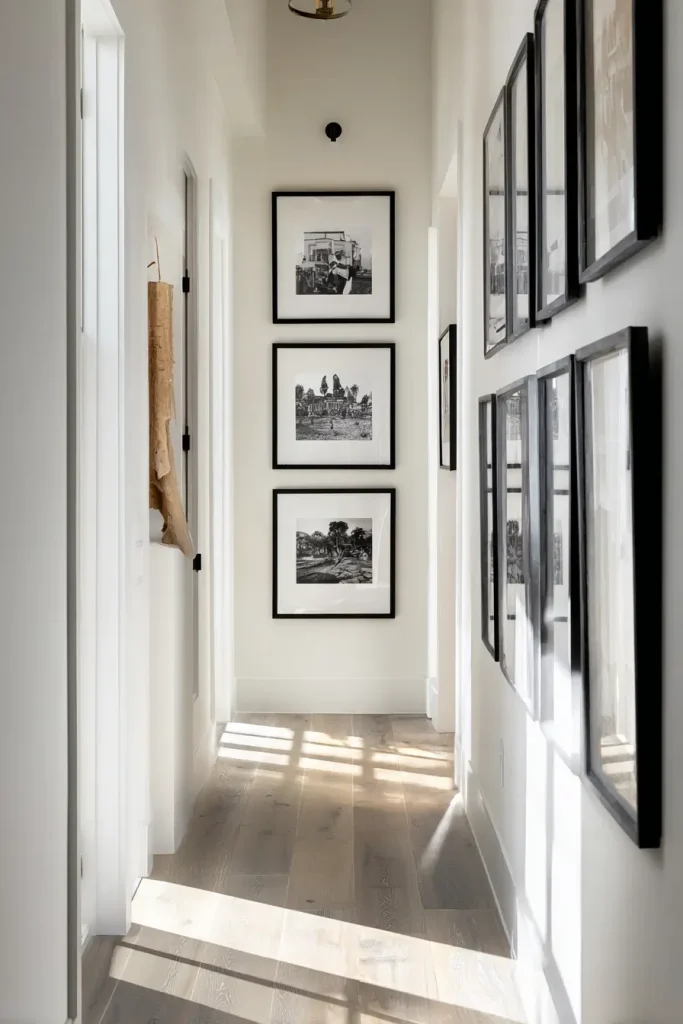
Instead, hang two or three prints in a single vertical column. This draws the eye up and creates a deliberate, curated look.
Black and white photography is a clean choice. It stays cohesive without adding competing colors. Mix one larger frame, around 16 by 20 inches, with two smaller ones at 5 by 7 or 8 by 10.
Center each piece at 57 to 60 inches from the floor. That’s the standard gallery hanging height. It keeps the arrangement at eye level and prevents that awkward floating or sinking effect.
10. Use One Color Family Throughout the Space
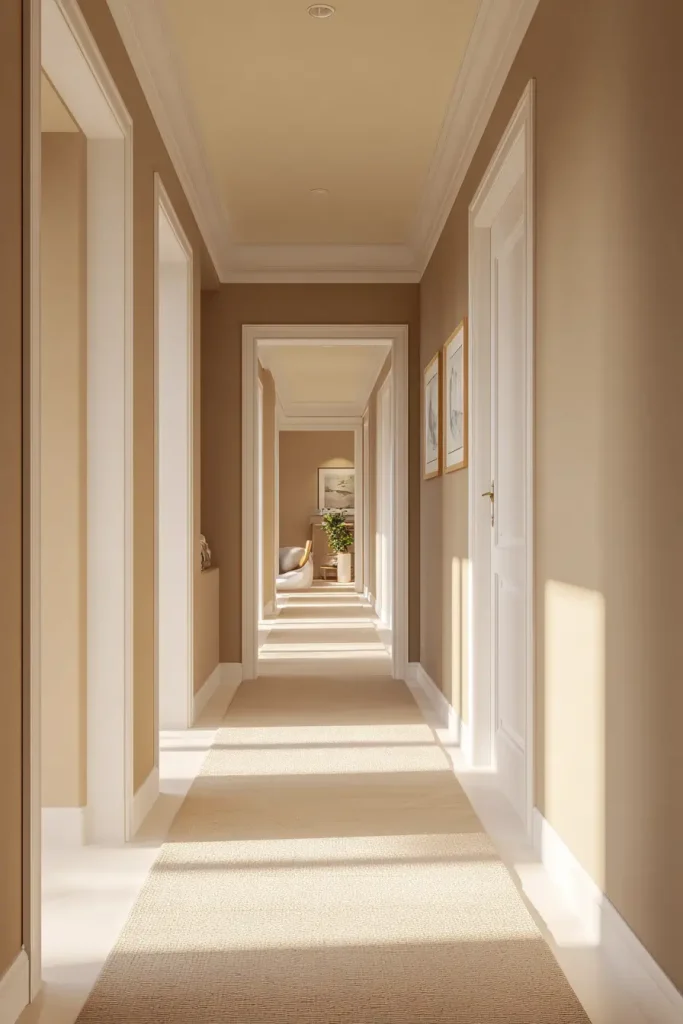
Using too many different colors in a small space makes it feel chopped up. It pulls the eye in different directions, and that makes a tight corridor feel even tighter.
A monochrome scheme solves this. One color family, used throughout the walls, trim, accessories, and even grout, creates visual continuity. The space reads as one flowing environment rather than a series of competing elements.
This doesn’t mean painting everything the same shade. Use different tones and textures within the same palette. A warm beige wall with a cream ceiling and sand-toned accessories all belong to the same family.
Popular monochrome palettes for hallways in 2026 include warm beige and sand, deep forest green, and dusty blue grey. Each creates a distinct mood while keeping the space visually calm.
11. Replace a Solid Door with a Glass Panel Door
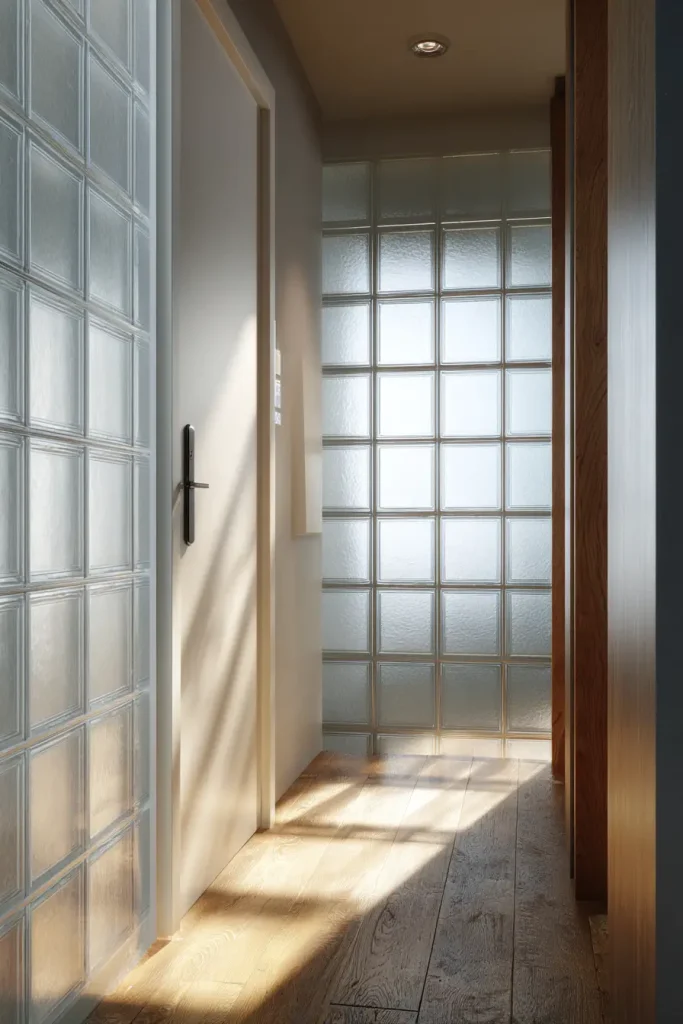
Dark hallways feel smaller than they are. Most of that darkness comes from having a solid door at one or both ends, blocking light from adjacent rooms.
A glass panel interior door fixes this without changing the layout. Frosted glass lets light through while maintaining privacy. Clear glass with a simple grid pattern works in modern and traditional homes.
This is one of the highest-impact changes you can make to a dark hallway. A standard interior glass panel door installed typically costs between $300 and $800, depending on the style and whether you hire someone or do it yourself.
For renters, this isn’t always an option. A practical alternative is positioning a large mirror to catch and reflect light coming through a nearby window or room.
12. Set Up Hooks at Different Heights for the Whole Family
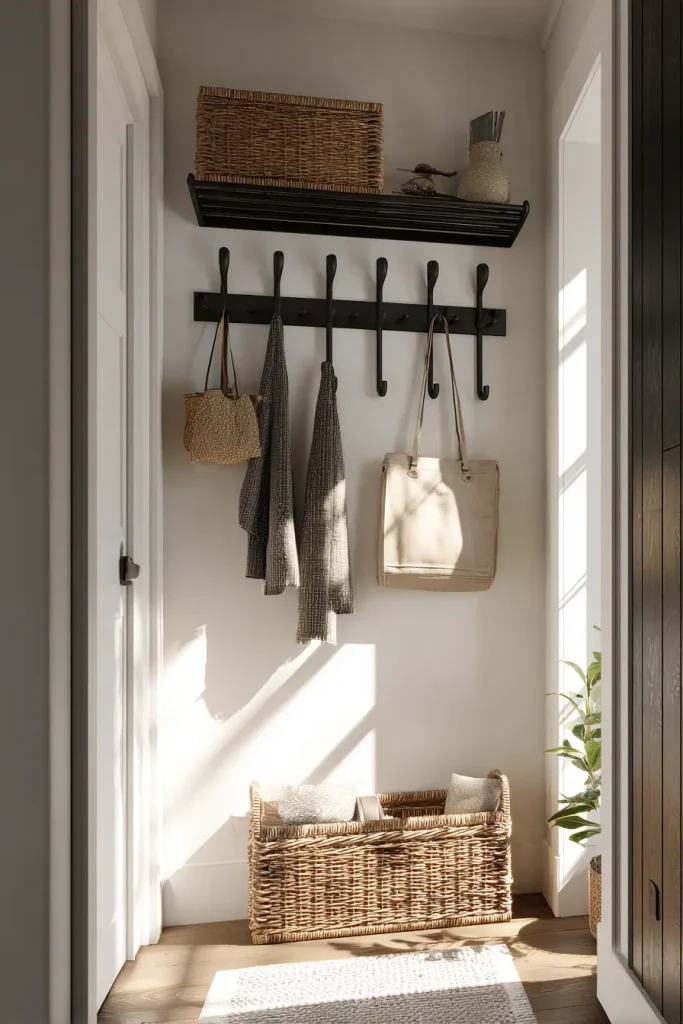
A single row of hooks at adult height leaves children hanging their things on the floor. Or on the wrong hook. Or nowhere.
A multi-height hook system solves the problem. Adult coats work best at 66 to 72 inches. Children’s hooks belong at 36 to 42 inches. Everyone has their own space. The morning routine gets easier.
Label each hook if you have a busy household. This sounds small, but it makes a real difference. When everyone knows which hook is theirs, things actually go back where they belong.
Matte black and brushed brass hook finishes are the most popular choices in 2026. Space hooks at least three inches apart to prevent coats from bunching together.
Add a small shelf above and a basket below to turn a row of hooks into a complete entryway system.
13. Use Floating Shelves Instead of a Freestanding Bookcase
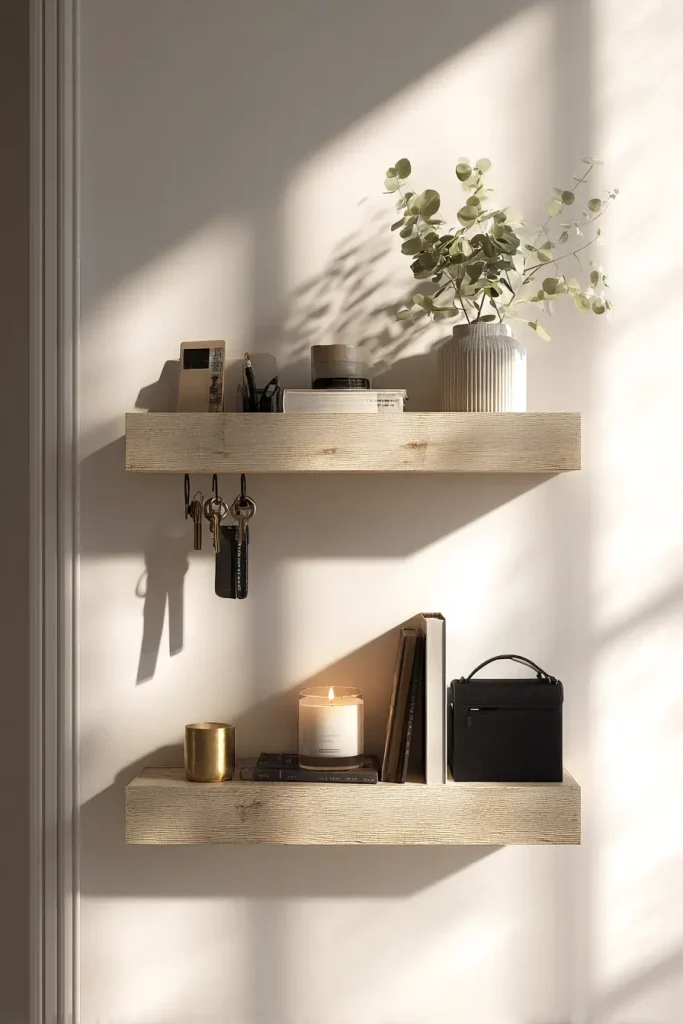
A freestanding bookcase eats floor space. It blocks sightlines. And in a narrow hallway, it makes the already tight corridor feel like an obstacle course.
Floating shelves do the same storage job without touching the floor. Keep them at shoulder height or above. This leaves the lower half of the wall open, which makes the hallway feel taller and less cluttered.
Limit yourself to two shelves. More than that creates visual noise rather than useful storage.
Style each shelf with a mix of functional and decorative items. A set of keys, a small plant, a candle. Keep it edited. The shelf should look like it was thought about, not loaded up.
IKEA LACK shelves are under 4 inches deep and work well in tight spaces. Similar options are available at most home stores.
14. Add One Statement Light Fixture as a Focal Point
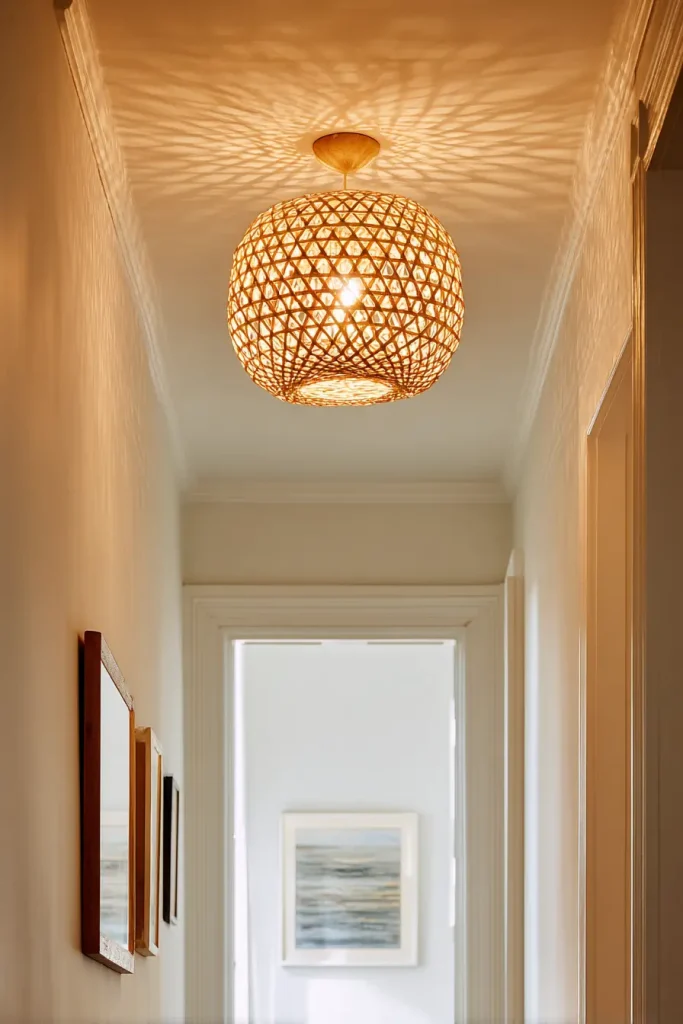
In a small hallway, one well-chosen light fixture does something that most other changes can’t. It gives people something to look at other than the size of the space.
A bold pendant, a small chandelier, or a sculptural flush mount draws the eye upward. It creates a focal point. And suddenly the hallway feels like a designed room rather than a connector between rooms.
Keep proportions in mind. The fixture should be no wider than one third of the hallway width. Going bigger than this overwhelms the space.
Woven rattan pendants and sculptural ceramic flush mounts are both strong 2026 choices. They add texture and warmth without looking overdone.
This is the one place in a small hallway worth spending a little more. A good light fixture is the first thing people notice and the last thing they forget.
15. Hide Your Shoes Instead of Displaying Them
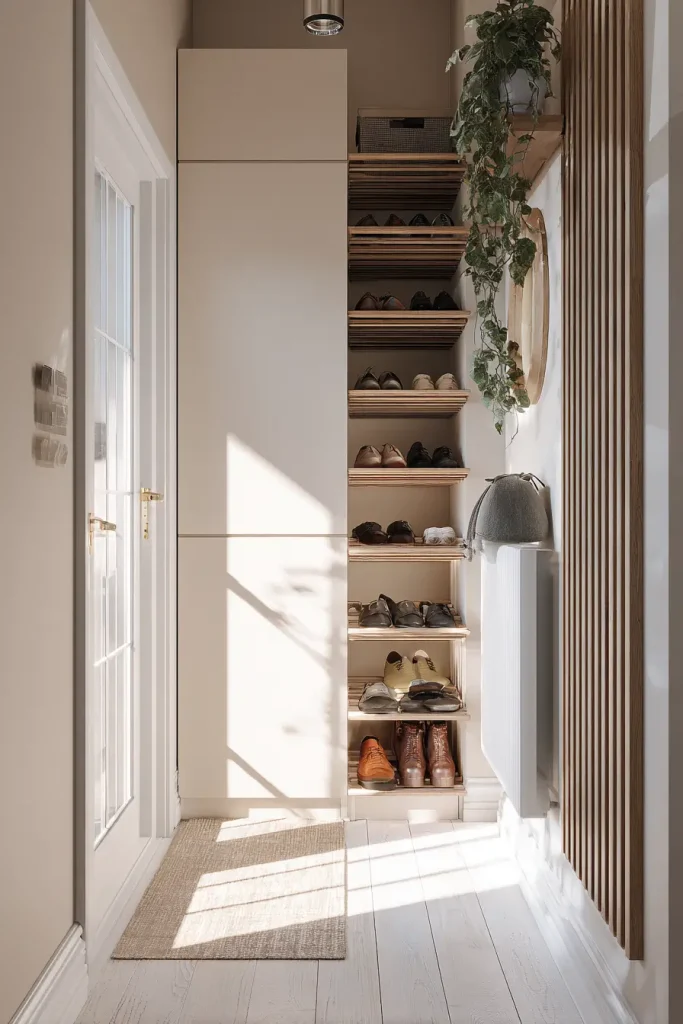
Visible shoes on the hallway floor are the number one reason entryways feel messy. Even two or three pairs create the feeling of chaos.
A slim shoe cabinet solves this completely. The IKEA HEMNES shoe cabinet and similar options from Vasagle fit in under 10 inches of depth. They hold multiple pairs and keep everything out of sight.
For renters or those with no floor space, over-door shoe organizers are a practical fix. They mount on the back of the front door and hold up to 12 pairs without taking up any floor or wall space.
The real key is rotation. Keep only the current season’s shoes near the door. Move everything else to a wardrobe, under a bed, or in another storage point. The hallway isn’t a shoe shop. It’s an entry.
16. Paint or Tile the Floor for a Designer Look
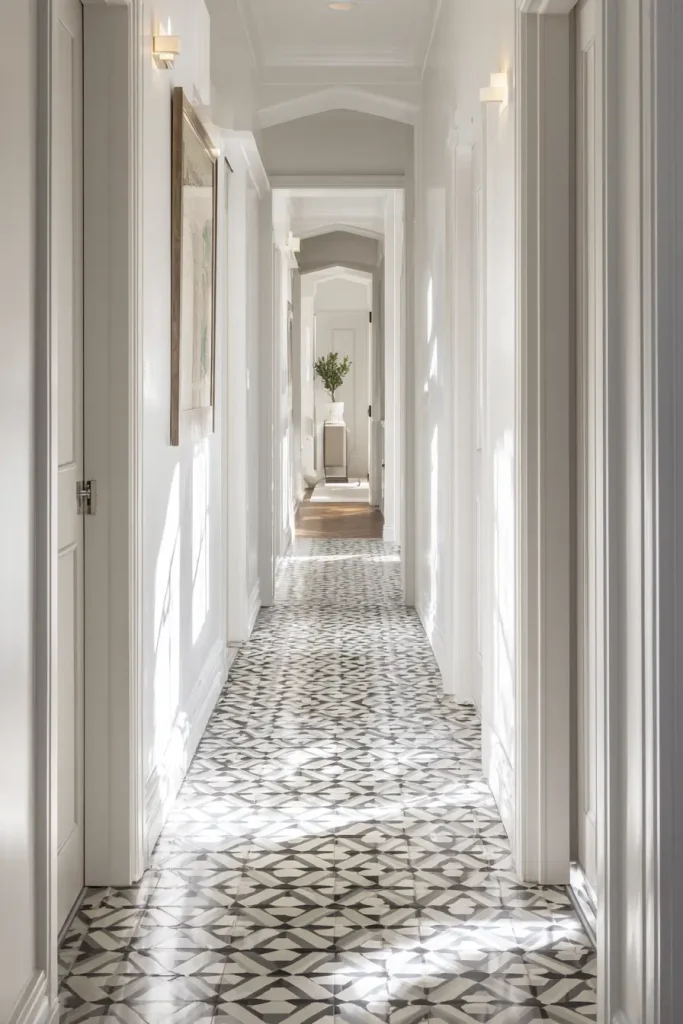
Most people focus on walls and furniture. They forget the floor. And in a small hallway, the floor is one of the most visible surfaces in the space.
A patterned tile, whether checkerboard, hexagon, or encaustic style, instantly makes a hallway feel curated. It signals that the space was designed on purpose.
For renters, peel and stick floor tiles are removable, affordable, and widely available in 2026. The quality is far better than it was five years ago. Many options look convincingly like real tile.
Dark floors with light walls create a grounded, sophisticated effect. Light floors with any wall color add brightness.
Geometric patterns that run lengthwise draw the eye forward. This makes the corridor feel deeper than it is, which is exactly the effect you want in a tight space.
17. Add One Slim Plant for Life and Color
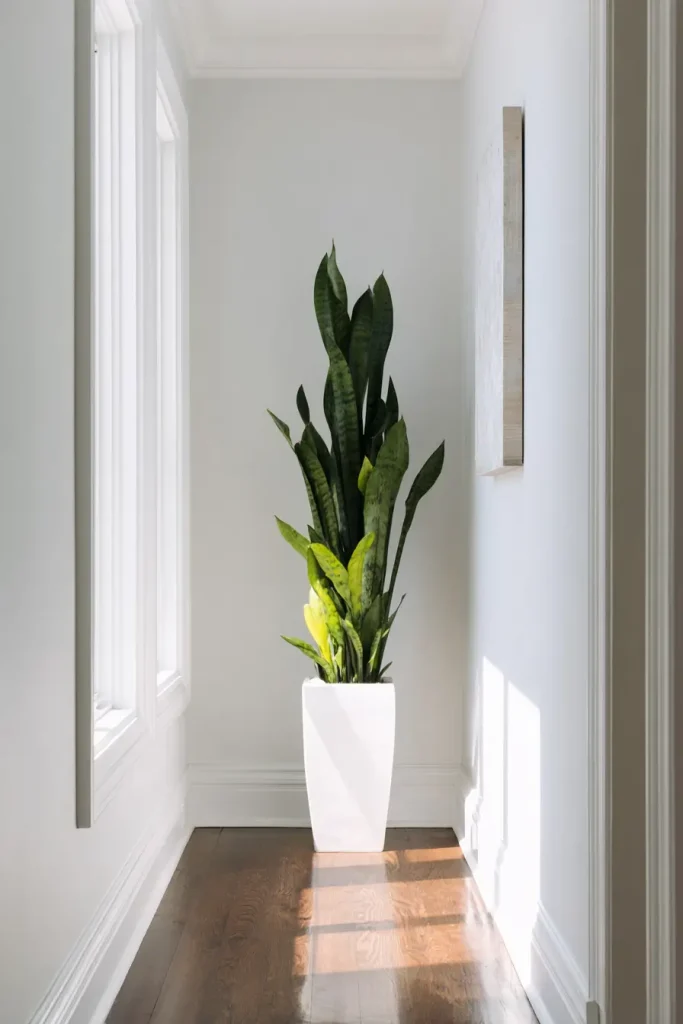
A well-chosen plant makes a hallway feel alive. It adds a natural texture that no painted surface or framed print can replicate.
Choose tall, slim varieties. A snake plant, a bamboo stem, or a peace lily all grow upward rather than outward. They add height without taking up walking space.
Avoid wide, bushy plants in narrow hallways. They intrude into the path and create a cramped feeling even in a space that’s otherwise well organized.
For very narrow hallways, wall-mounted planters are the best option. A trailing plant on a high shelf adds softness without using floor space.
Artificial plants have improved significantly in quality. If your hallway gets little natural light, a high-quality faux plant is a practical and honest choice. No one needs to know.
18. Install a Pegboard for a System That Grows With You
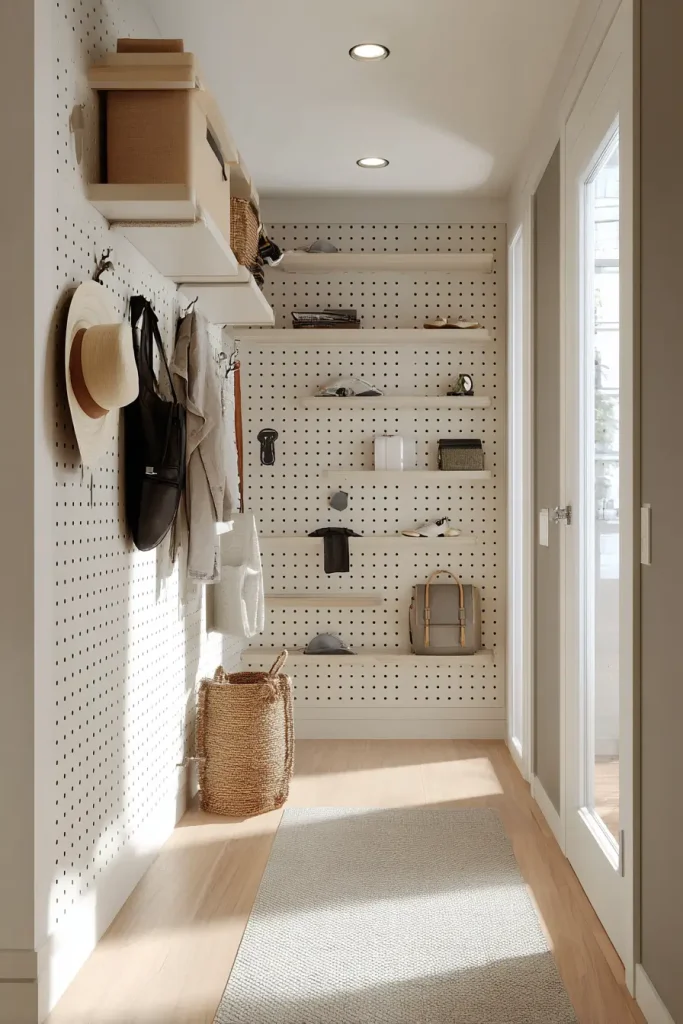
The problem with most hallway storage is that it’s fixed. Once it’s up, it stays as it is. Your needs change but the storage doesn’t.
A pegboard solves this. Every hook, shelf, and basket can be moved, added, or removed as often as you like. It’s the most adaptable storage solution available for a small hallway.
Paint the pegboard the same color as your wall. This makes it blend in rather than stand out as a utility item. The accessories on it become the feature rather than the board itself.
IKEA SKADIS and similar pegboard systems from Amazon start under $50. In 2026, the trend is color-matched painted pegboards replacing the raw wood look. It’s a cleaner, more intentional finish.
Hang bags, hats, keys, mail, and charging cables all in one system. One wall. Everything in one place.
19. Use Scent to Create a First Impression People Remember
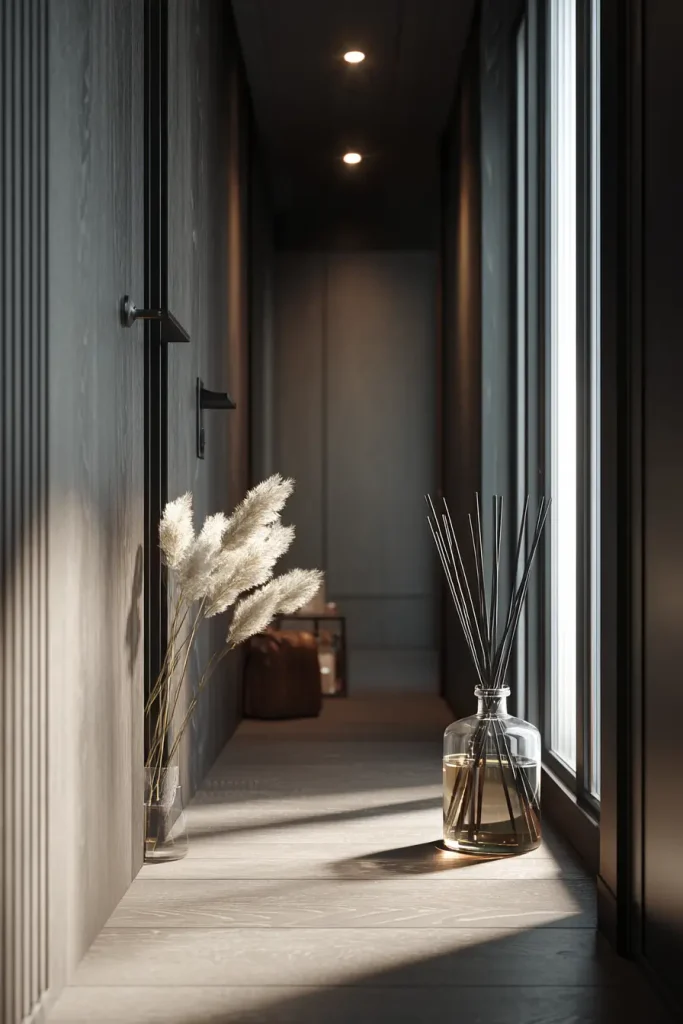
Most hallway makeovers focus on what you see. But first impressions aren’t only visual.
The way your home smells is registered within seconds of walking through the door. A pleasant, subtle scent creates an instant feeling of warmth and welcome.
A reed diffuser, a candle, or a quiet electric diffuser near the door is all you need. Clean linen, light citrus, and eucalyptus are all good choices for entryways. They feel fresh without being overpowering.
Avoid strong, heavy scents at the entry. They can feel suffocating in a small space. Subtle is more sophisticated and more pleasant for guests who may be sensitive to strong fragrances.
This is the cheapest hallway improvement on this list. A good reed diffuser costs under $15 and lasts for weeks. It’s the easiest win here, and it’s the one most people haven’t tried yet.
5 Small Hallway Mistakes That Make Things Worse
Before you spend any money, it’s worth knowing what not to do.
The most common mistake is putting too much in the space. More hooks, more shelves, more baskets, more art. Adding more feels productive, but in a small hallway, it almost always makes things worse. Edit before you add.
The second mistake is harsh lighting. A cold, bright bulb in a narrow corridor feels clinical and unfriendly. Warm white bulbs in the 2700K to 3000K range create a completely different atmosphere for the same cost.
Third, people ignore the ceiling and the floor as design surfaces. Both of them affect how the space is perceived. A lighter ceiling and a patterned or contrasting floor can change how a hallway feels without touching the walls at all.
Fourth, functional furniture that doesn’t match the rest of the space is a common problem. A coat rack from one era next to a console table from another creates visual confusion. Pick a style and stick to it throughout.
Fifth and finally, the back of the front door is almost always wasted. It can hold a mirror, hooks, a shoe organizer, or a small shelf. That surface costs nothing extra to use.
How Much Should You Budget for a Small Hallway Makeover?
Budget always comes up. And that’s fair. Here’s a simple breakdown.
At the lowest level, from nothing to $100, you can do a lot with paint, a second-hand mirror, and repositioning what you already have. Facebook Marketplace and charity shops regularly have console tables, mirrors, and small benches at a fraction of retail price. Painting the walls and ceiling costs very little and makes one of the biggest visible changes.
In the middle range, from $100 to $400, you can add a runner rug, proper wall hooks, a floating shelf system, and a slim console or storage bench. This tier covers most of the ideas in this list and creates a genuinely well-designed space.
At the investment level, from $400 upward, you’re looking at a new light fixture, a glass panel door, or custom built-in storage. These changes have the biggest visual impact but aren’t necessary for most hallways.
If you have to prioritize, start with lighting and a mirror. These two changes affect how the whole space feels. Add furniture second. Decor and accessories come last.
Your Hallway Can Look Good. Start With One Thing.
You don’t need to do all 19 ideas at once. You don’t need a big budget or a full weekend free.
Pick one thing from this list and do it this week. A mirror. A set of hooks. A runner rug. One change creates momentum. And momentum leads to the rest.
Small hallways can look stylish, feel organized, and leave a real impression. Whether you have a narrow Victorian corridor or a tiny apartment entry, these small hallway ideas give you a clear path forward in 2026.
The first impression your home makes is in your hands. Start with the hallway.
Meta Description: Transform your entryway with 19 small hallway ideas, mirrors, storage, lighting and color tips that make a big first impression in 2026.

- 17 Bedroom Ideas for Couples in Small Apartments - March 13, 2026
- 18 Kitchen Ideas for Families Who Cook Every Single Day - March 13, 2026
- 18 Small Bathroom Ideas for Renters With No Damage Solutions - March 13, 2026