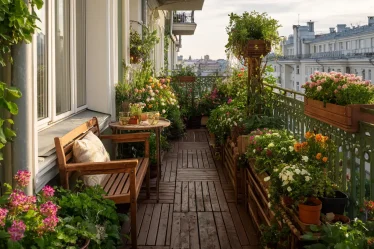
Introduction
Your garden is not a waiting room. It is a living room you have not decorated yet.
Most outdoor spaces sit empty for months. A forgotten chair here. A cracked pot there. No plan, no comfort, no real reason to go outside and stay.
And that is a waste. Because your outdoor space can feel just as good as any room inside your home. You do not need a big budget. You do not need a contractor. You just need a starting point.
This guide gives you 16 specific, practical garden decor ideas that work in 2026. Whether you have a small balcony, a concrete patio, or a full backyard, these ideas apply to you. By the end, you will know exactly what to buy, what to build, and what to do first.
Let us start with the one decision that makes everything else easier.
1. Define Your Outdoor Zone Like You Would an Indoor Room
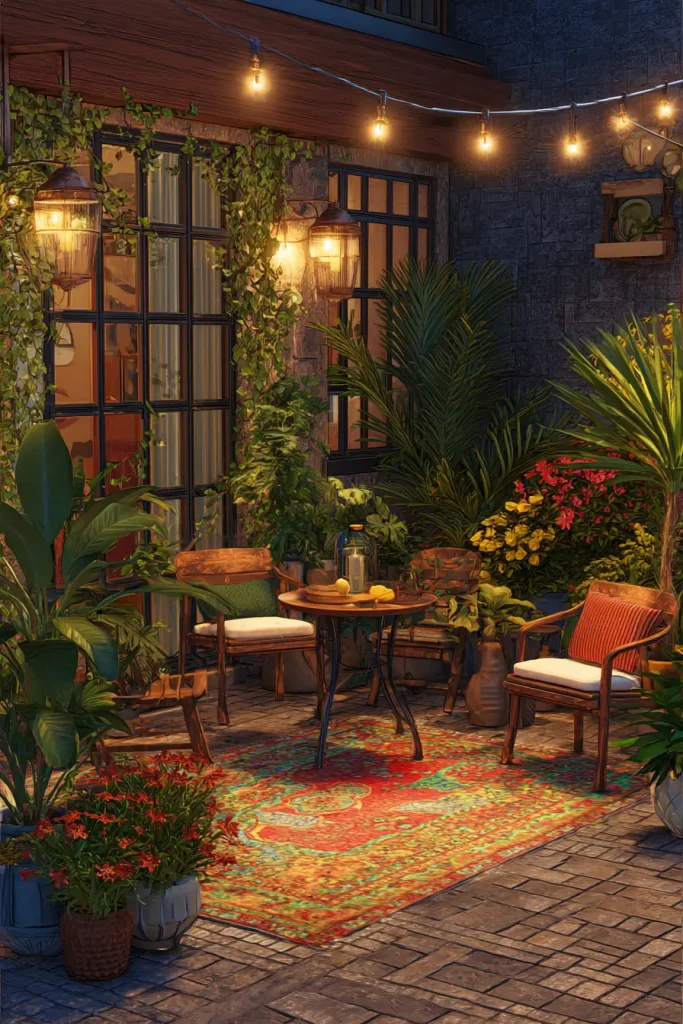
Most patios fail because nobody decided what they were for.
Inside your home, every room has a job. The kitchen is for cooking. The living room is for relaxing. But outside? Most people just push a table and a few chairs into a corner and call it done. That is why it never feels like a real space.
The fix is simple. Decide what your outdoor space is for before you buy a single thing.
Think about how you actually want to use it. Do you want to eat outside? Read? Entertain friends? Have a space for your kids to play while you sit nearby? Each of those needs a different setup.
If your space is big enough, split it into two zones. A dining zone and a lounge zone work well together. Use an outdoor rug to mark where each zone starts and ends, the same way a wall separates rooms indoors.
A 10 by 12 foot patio, for example, can hold a small dining table for four on one side and two lounge chairs with a side table on the other. That is two rooms in one small space.
The American Society of Landscape Architects listed outdoor living as a top residential design priority in their 2024 survey, and the main reason people invest in it is simple: they want more usable space without moving or building.
Your outdoor zone does not need to be fancy. It needs to be planned.
Once you know what the space is for, every decor decision after this becomes much easier.
2. Anchor Every Seating Area With an Outdoor Rug
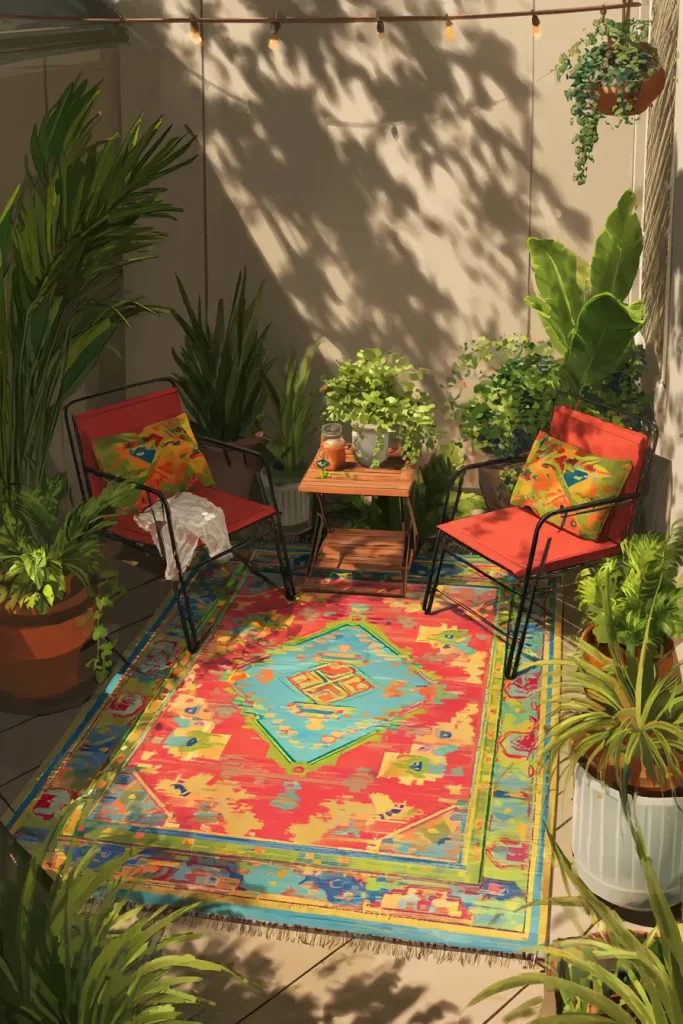
The single fastest way to make an outdoor space feel designed is to put a rug under it.
This sounds too simple. But it works every time. A rug tells the eye that this is a deliberate space, not just furniture sitting on concrete or grass. It pulls everything together the same way a rug does in a living room.
The most common mistake people make is buying a rug that is too small. Go bigger than you think you need. For a four chair dining set, an 8 by 10 foot rug is the minimum. The legs of all the chairs should sit on the rug, even when pulled out.
For materials, stick to polypropylene or recycled PET plastic. Both handle rain, sun, and foot traffic without falling apart. They are also easy to hose down when they get dirty.
For small spaces, choose a rug with a light, simple pattern. Too much pattern in a small space feels busy. For larger spaces, you can go bolder with color or texture.
Houzz and Wayfair both reported outdoor rugs as one of the most searched outdoor decor items throughout 2024 and 2025. That trend has continued into 2026 because the impact is obvious and the price point is low.
Quick tip: If you want a layered, relaxed look, place a smaller patterned rug on top of a larger neutral one. It adds depth without adding clutter.
A rug is not a luxury. It is the foundation of your outdoor room.
3. Use Outdoor Curtains to Create Walls Without Building Them
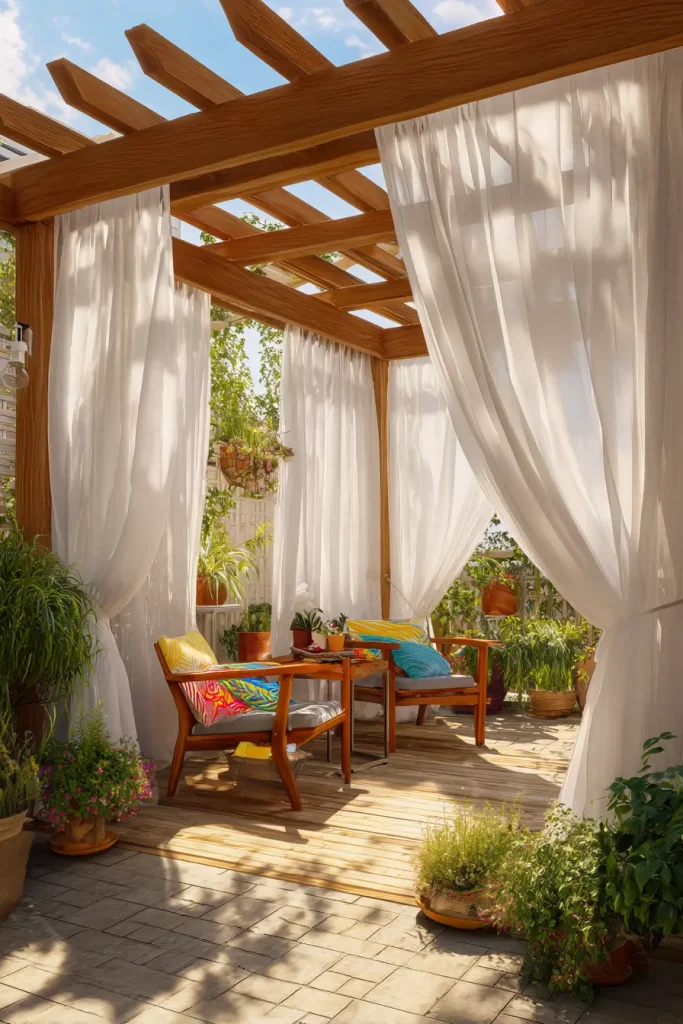
What makes a room feel like a room? Walls.
You cannot build walls in your garden without a permit and a contractor. But you can hang curtains, and the effect is surprisingly close.
Outdoor curtains do three things at once. They create the visual boundary of a room. They block wind and sun. And they give you privacy without a fence.
The best fabrics for outdoor curtains are solution-dyed acrylic and polyester blends made for outdoor use. Sunbrella is the most trusted brand name in outdoor fabric. Their material is rated to withstand UV exposure three times longer than standard outdoor fabric, which means your curtains will not fade or crack after one summer.
For hanging, you have a few options. If you have a pergola, you can slide the curtains onto the beams using curtain rings. If you do not have a pergola, tension rods between two posts or a simple wall bracket with a rod work well. Sail hooks mounted into a wooden fence post also work for a more casual look.
For daytime, hang sheer white or cream curtains. They filter light without blocking it. For evenings, layer a heavier panel behind them for privacy and warmth.
Pergola curtain setups have been one of the most saved DIY outdoor ideas on Pinterest consistently through 2024 and 2025. They are popular because they look expensive and are not.
One curtain panel on the most exposed side of your patio can transform how the space feels. Start with one side and see what it does.
4. Bring in Lighting That Works at Night, Not Just at Dusk
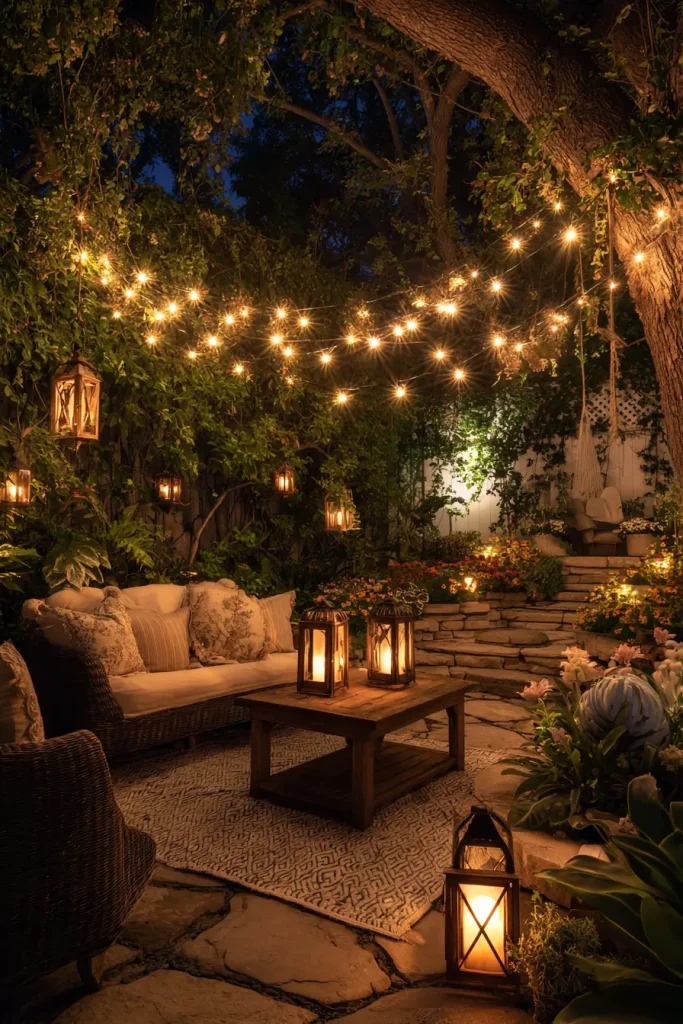
If your outdoor space is only usable before 8pm, you are losing half your time with it.
Lighting is what keeps you outside after the sun goes down. And most outdoor spaces have none, or just one harsh overhead bulb that makes everything look like a parking lot.
Good outdoor lighting works in three layers.
The first layer is ambient light. This is the overall glow that fills the space. String lights strung above a dining area or lounge zone are the easiest and most effective version of this. Use warm white bulbs only. Anything cool or bright reads as clinical, not cozy.
The second layer is task lighting. Lanterns on a table, a floor lamp near a reading chair, or candle holders on a surface. This is the light you actually use when eating or reading.
The third layer is accent lighting. Small spotlights pointed up at a tree or shrub. Path lights along a walkway. These add depth and make the space feel larger at night.
For power, solar lights work well for accent and path lighting where access to an outlet is inconvenient. For string lights, a plug-in setup is more reliable and brighter.
In 2026, smart outdoor lighting is more accessible than ever. Brands like Govee and Philips Hue now make weatherproof outdoor bulbs and strips that connect to your phone or smart home system, so you can adjust the brightness and color without going outside.
Warm white only. Three layers. That is all you need to remember.
5. Choose Furniture That Looks Indoor But Lives Outdoor
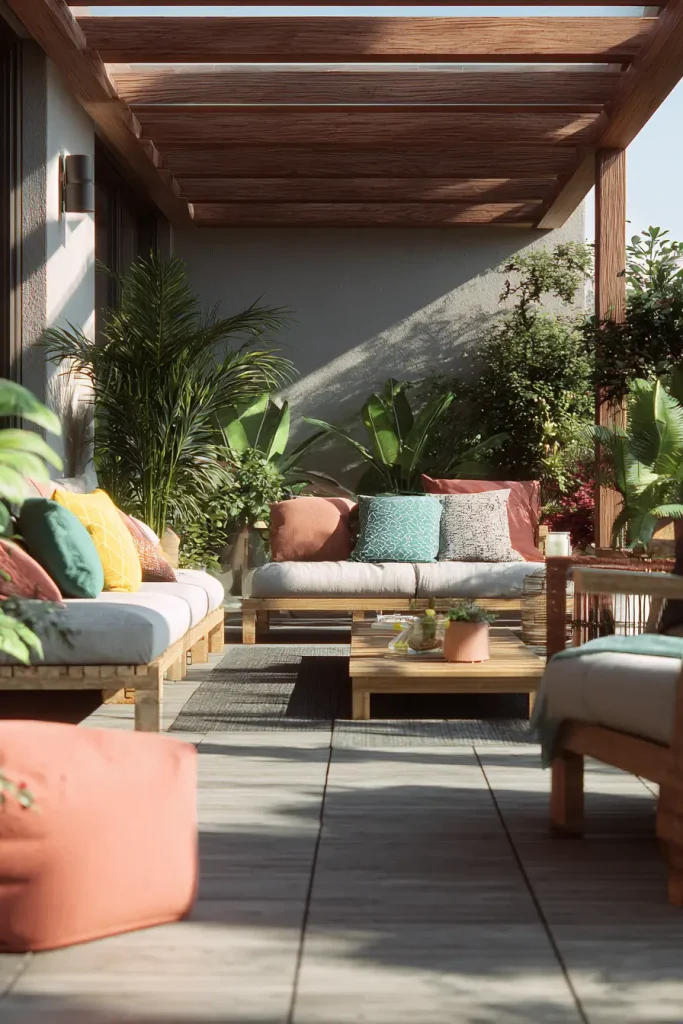
The biggest shift in outdoor furniture in recent years is that it no longer looks like outdoor furniture.
The best pieces today look like they belong in your living room. Cushioned sofas, low-profile coffee tables, sectional seating. But they are built from materials that handle weather, UV rays, and temperature changes without cracking or rotting.
Here are the materials worth buying in 2026. Teak is still the gold standard. It is heavy, beautiful, and when you oil it once a year it can last 50 years or more. Powder-coated aluminum is lighter, rust-proof, and comes in dozens of colors. Resin wicker looks like natural wicker but does not break down in rain. HDPE lumber, which is made from recycled plastic, is growing fast because it requires almost zero maintenance and comes in wood-style finishes.
The trend right now is mixing materials. Metal legs with cushioned seating. Teak tops with aluminum frames. It creates a layered look that feels less catalog and more curated.
One practical note on cushions: bring them inside or store them in a weatherproof deck box when it rains. Even the best outdoor fabric lasts longer when it is not constantly wet. A simple storage ottoman with a hollow inside works well for smaller cushions.
You do not need to replace all your furniture at once. Start with a sofa or two lounge chairs and build from there.
6. Add a Coffee Table or Side Table to Every Seating Grouping
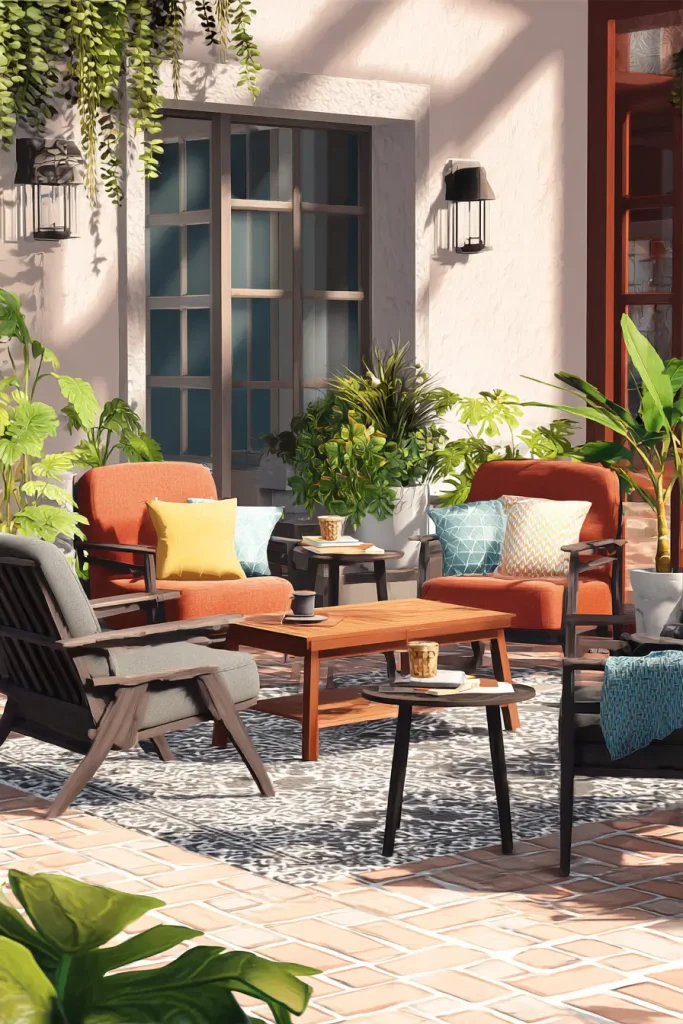
Here is something most people skip and then regret: surfaces.
If you sit outside and there is nowhere to put your drink, your book, or your phone, you will go back inside within 20 minutes. A surface is what keeps you outside. It is also what signals to your brain that this is a real room and not just a place to pass through.
Every seating grouping needs at least one table. A lounge chair without a side table is just a chair sitting in a yard. Add a table and it becomes a reading spot.
Height matters. A coffee table in front of a sofa should sit at knee height. A side table next to a chair should sit at armrest height. Get this wrong and everything feels awkward.
You do not need to spend a lot. A wooden cable spool from a local hardware supplier makes an excellent round coffee table and costs almost nothing. A concrete side table, which is trending in 2026 garden aesthetics, can be bought for under $40 or cast in a mold at home using basic concrete mix.
For a seasonal look, style the tabletop the way you would style an indoor coffee table. A small potted plant, a candle, a stack of weatherproof coasters. It takes five minutes and makes the space feel finished.
Every room has surfaces. Give your outdoor room the same respect.
7. Layer Throw Pillows and Outdoor Blankets for Comfort
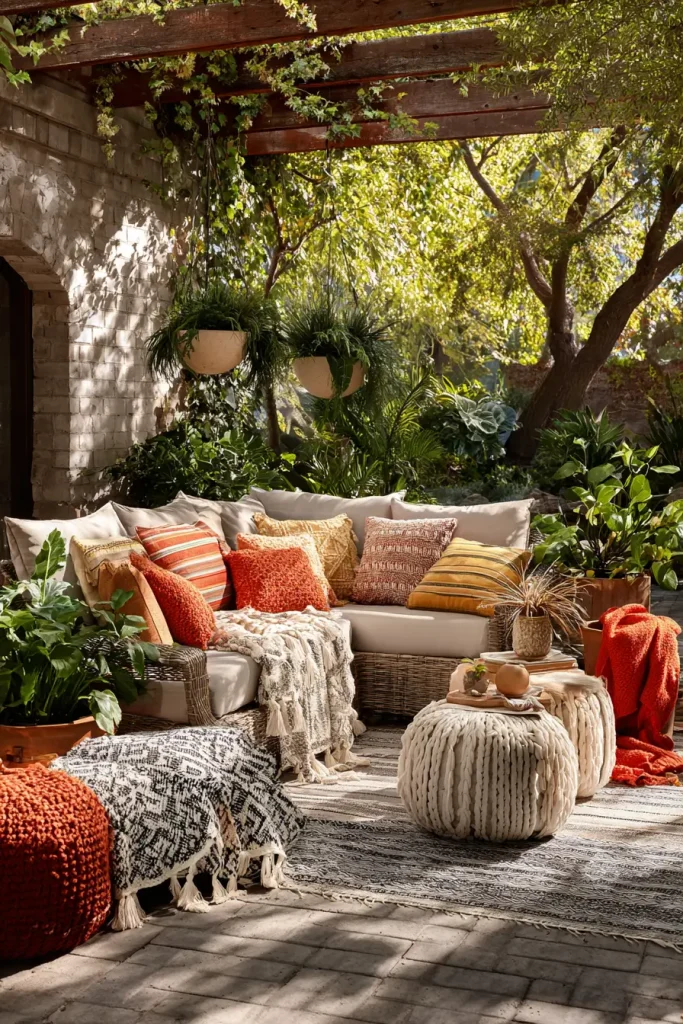
Cold chairs keep people inside. Soft seating brings them out.
Pillows and blankets are the cheapest way to add comfort and color to your outdoor space. They are also the easiest thing to swap out when seasons change or you want a new look.
For outdoor use, the fill matters as much as the cover. Look for cushions and pillows filled with polyester fiberfill or foam with drainage holes built in. These dry out quickly after rain instead of staying wet and getting moldy.
For covers, Sunbrella-grade fabric is the best. Quick-dry polyester blends are a solid budget option. Avoid anything with cotton or linen unless you plan to bring them inside after every use.
When it comes to patterns, start with your rug or your largest cushion and match from there. You do not need all your pillows to match exactly. Mix one solid, one stripe, and one pattern in the same color family and it will look intentional.
For blankets, a chunky knit or fleece throw draped over the arm of a sofa adds texture and makes cool evenings outside possible. Store blankets in a weatherproof basket near the seating area so they are always within reach.
Changing your pillow covers is the fastest seasonal refresh you can do. Swap to warm tones in autumn and bright tones in spring without replacing anything else.
Soft outdoor spaces get used. Bare ones do not.
8. Install a Focal Point, Because Every Room Needs One
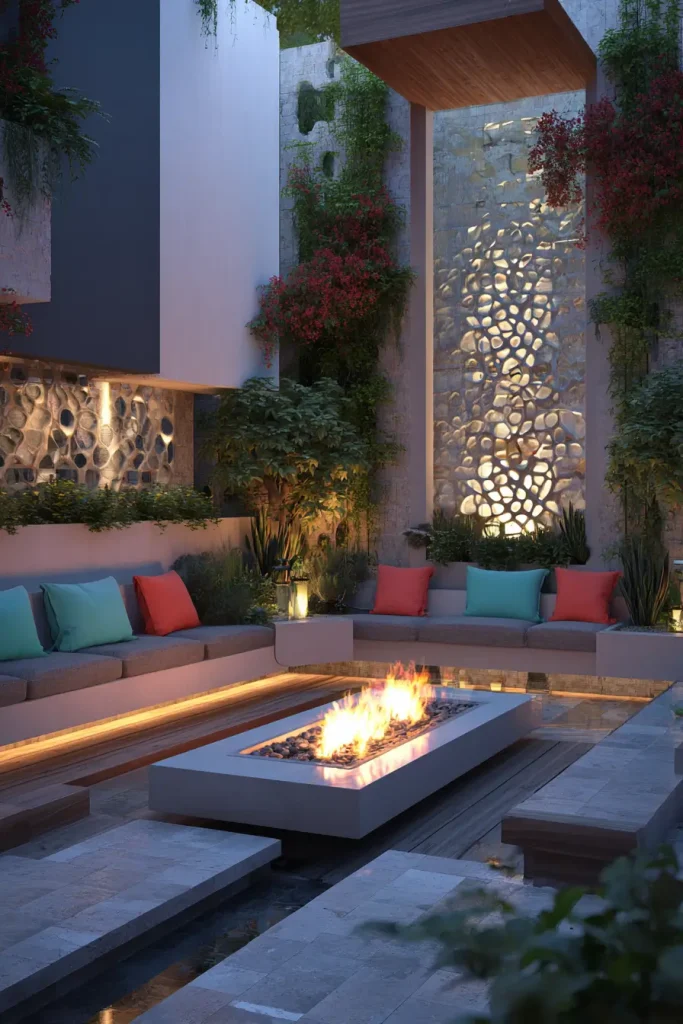
Walk into a well-designed room and your eye immediately goes somewhere. A fireplace. A piece of art. A large plant. That thing your eye lands on is the focal point.
Most outdoor spaces have none. And that is why they feel unfinished even when they are full of furniture.
A focal point does not have to be expensive. It just has to be the clear visual anchor of the space.
For smaller spaces under 150 square feet, choose one vertical focal point. A large ceramic urn, a wall-mounted metal sculpture, or a vertical plant wall all work well. Height draws the eye upward and makes a small space feel bigger.
For medium spaces between 150 and 300 square feet, pair a vertical element with a horizontal one. A trellis on the back fence combined with a fire pit table in the center of the seating area gives the eye two things to settle on.
For large spaces over 300 square feet, zone your focal points. Each zone should have its own anchor so the space does not feel like an open field.
Fire pit tables are one of the fastest growing categories in outdoor furniture. The Hearth, Patio and Barbecue Association reported a 30 percent increase in residential fire pit sales between 2021 and 2024, and that growth has continued into 2026. They work as both a furniture piece and a gathering point.
A budget trick borrowed from French garden design: mount a round mirror on a fence or wall. It reflects light and plants and visually doubles the size of a small garden.
Pick one thing. Make it the star.
9. Use Plants as Decor, Not Just as Gardening
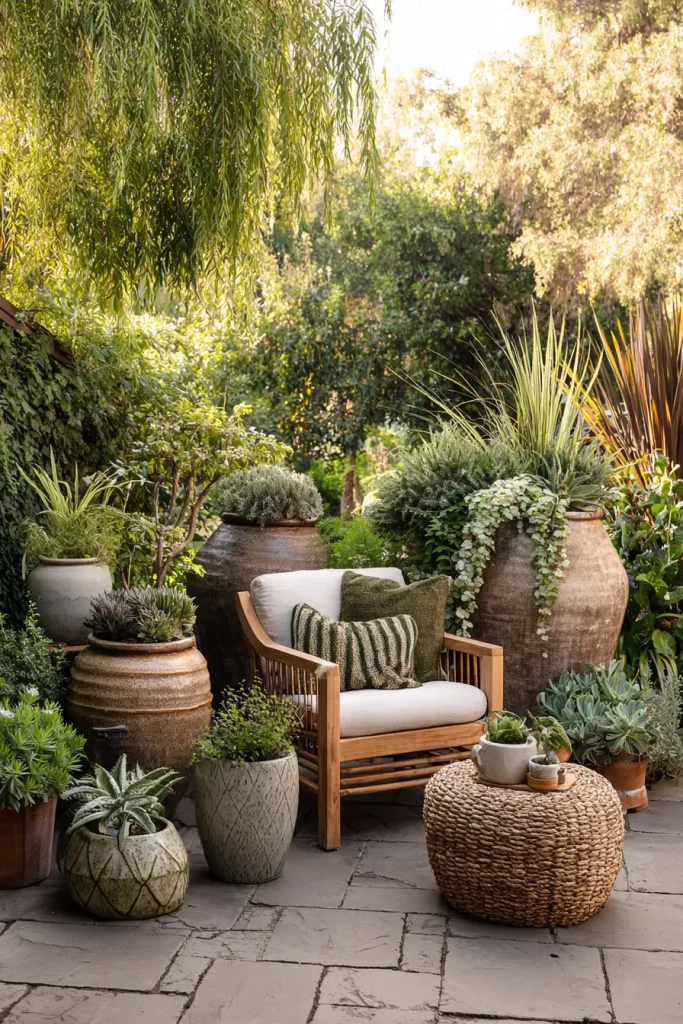
Plants are not just for gardeners. They are one of the most powerful design tools you have.
The difference between a garden full of plants and a garden that feels designed comes down to how the plants are arranged. Random pots scattered around look like a plant store. Intentional groupings look like a room.
Use the thriller, filler, spiller method for any container planting. The thriller is the tall, dramatic plant in the center or back. Lavender, ornamental grass, or a tall succulent works well. The filler is the medium plant that fills in around it. The spiller is the trailing plant that drapes over the edge of the pot. Put these three together and any pot looks expensive.
Vary the heights of your containers. A short pot next to a medium pot next to a tall pot creates visual rhythm. All the same height looks flat.
For natural room dividers, tall ornamental grasses and bamboo in planters are highly effective. They create privacy, add movement in the wind, and look intentional. They also work in rented spaces because they are not permanent.
Hang planters from a pergola or fence to use vertical space. Wall-mounted planters arranged in a grid pattern on a bare fence wall are a clean, modern look that is very easy to achieve.
Low-maintenance plants that look intentional: boxwood, lavender, succulents, ornamental grass, and sweet potato vine for a spiller. None of these require expert care.
Plants make a garden feel alive. Use them like furniture.
10. Build Vertical Interest With Walls, Trellises, and Structures
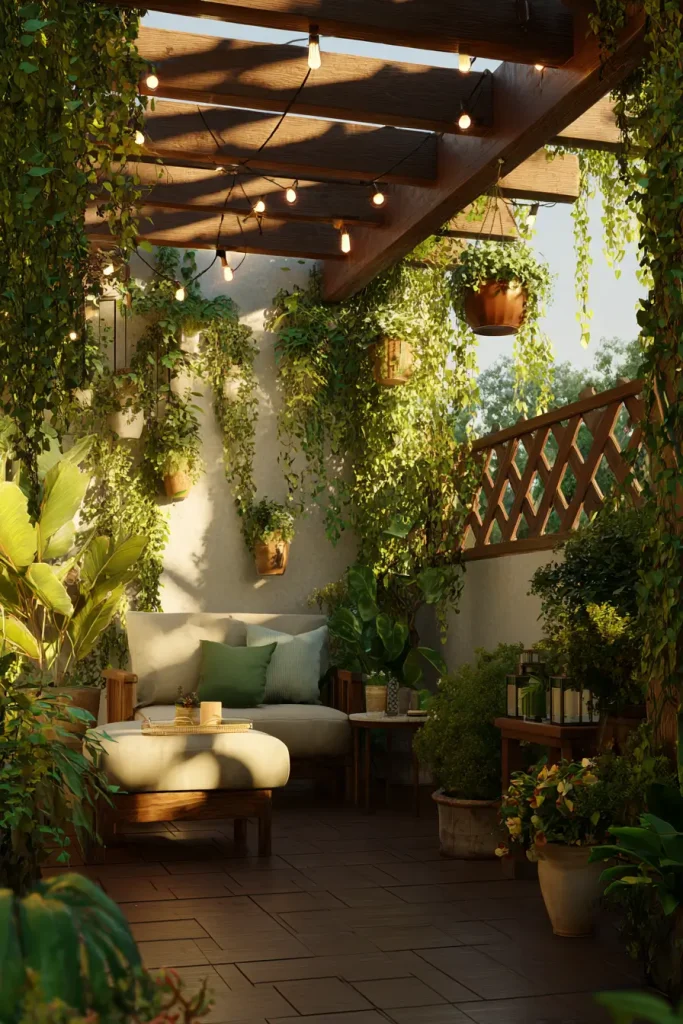
Most people decorate the floor of their outdoor space and ignore everything above it.
That is a missed opportunity. Vertical space is free real estate.
A bare fence or wall is a blank canvas. A trellis panel attached to it with climbing plants like clematis or climbing hydrangea creates a living wall that changes through the seasons. You can build a basic trellis panel from lumber and mesh wire for under $40 and it takes an afternoon to install.
For renters or people who cannot attach things to walls, vertical pallet gardens are a free-standing solution. A wooden pallet stood upright with small pots fixed into each slot holds herbs, succulents, or trailing plants without a single screw going into a wall.
Outdoor wall art is underused. Metal sculptures, weather-resistant canvas prints, and macrame wall hangings all hold up outdoors in covered spaces. Even a set of ceramic wall plates in a simple pattern adds character to a bare fence.
A pergola or shade sail creates the single most important vertical element: a ceiling. Rooms have ceilings. Once you add overhead structure, even an open pergola frame draped with string lights, the outdoor space immediately reads as a room.
Google Trends data shows that searches for pergola installation increased by over 70 percent between 2020 and 2024. That number has stayed elevated through 2025 because people have seen what a difference it makes.
Look up. There is a whole dimension of your space you have not used yet.
11. Build a Dining Setup That Makes You Want to Eat Outside
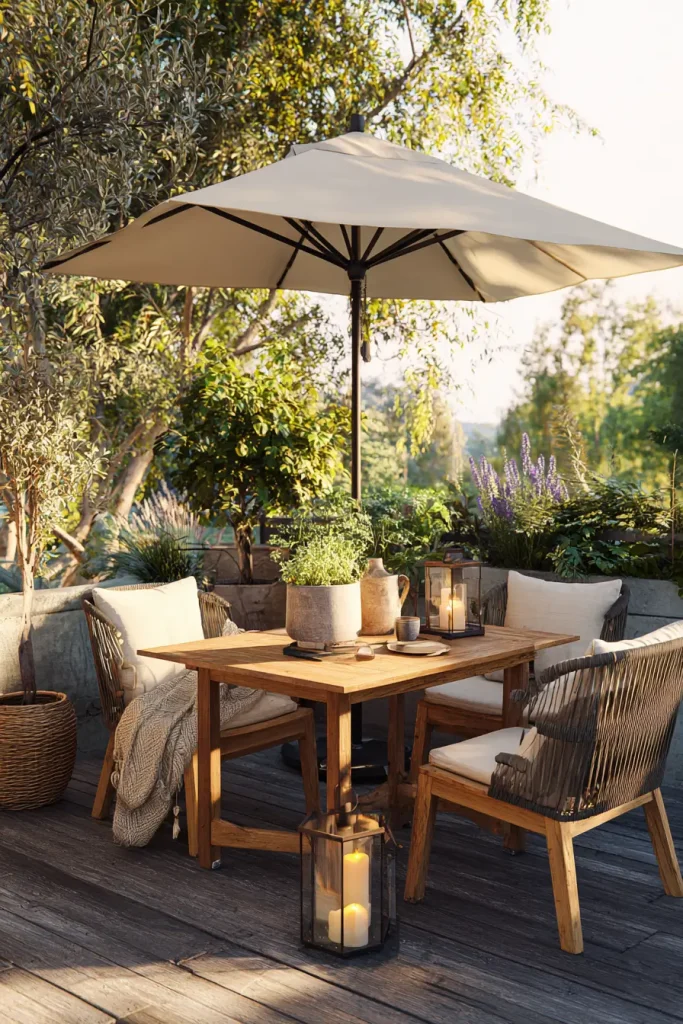
There is a big difference between a table in the yard and an outdoor dining room.
The table-in-the-yard version has mismatched chairs, no shade, and nothing on the table. You use it twice a summer. The outdoor dining room version has the right size table, comfortable seating, something overhead for shade, and a surface that is styled so that sitting down feels like an event.
Here is how to get there.
Measure your space before you buy a table. A dining table for four needs at least a 10 by 10 foot footprint to allow chairs to pull out and people to walk around. Going too big is just as problematic as going too small.
Add shade. Eating in full sun at midday is not enjoyable. A market umbrella that tilts is the simplest solution. A pergola is better if you want something permanent. A shade sail gives a modern look and covers more area per dollar than an umbrella.
Style the table the way you would an indoor dining table. Outdoor placemats, a small potted plant or cut flowers in a simple vessel, LED pillar candles for evenings. These take five minutes to set up and completely change how the space feels.
The goal is to make alfresco eating feel easy, not like a production. When everything is already set up and ready, you will eat outside more often.
Shade first. Then table size. Then styling.
12. Add a Bar Cart or an Outdoor Kitchen Element
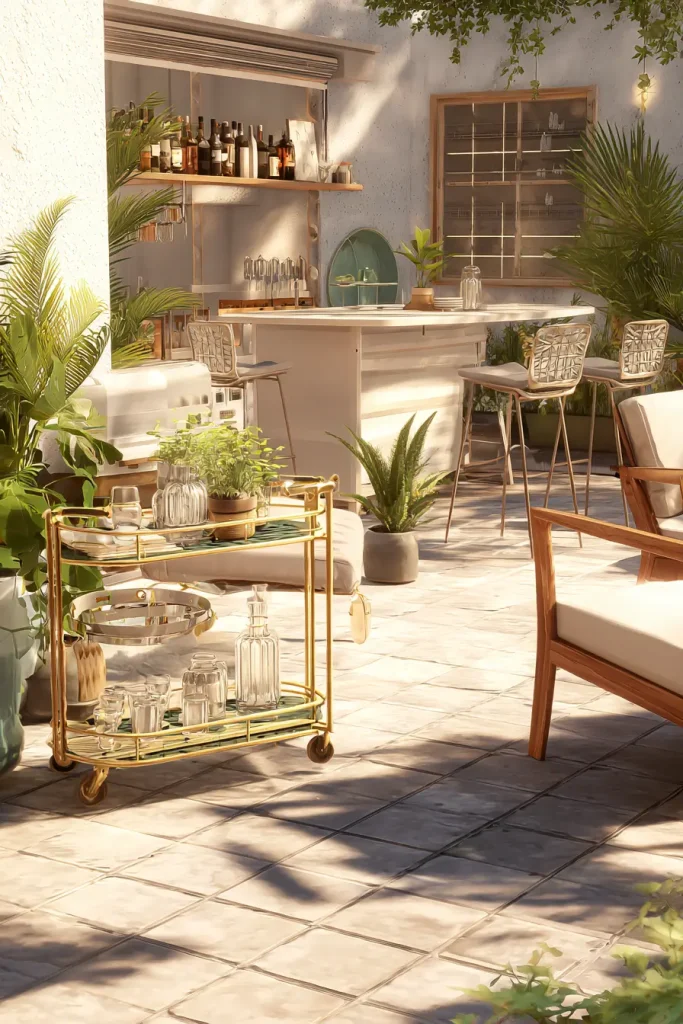
Nothing says “this space is for living, not just looking” like a place to make a drink.
A bar cart is one of the highest-impact, lowest-effort additions you can make to an outdoor space. It signals immediately that this is a social area. It gives guests something to interact with. And it keeps everything you need for entertaining in one place.
You do not need to buy an outdoor-specific bar cart. A metal shelving unit from a hardware store, spray-painted in a matte color and sealed, works just as well. IKEA outdoor carts are another popular option that can be customized easily.
Style the cart with intent. A few pieces of glassware, a small potted plant, a candle, folded napkins, and a bottle or two. Keep the top surface clear enough to actually use. Do not crowd it.
For a step up, a small outdoor kitchen element changes how you use the space entirely. A weatherproof prep station with a mini fridge underneath makes outdoor cooking practical. A standalone pizza oven, which is trending hard in 2026 outdoor entertaining, becomes both a functional tool and a focal point.
The outdoor bar cart trend with built-in ice bucket compartments is growing in 2026 for summer entertaining, and it is a useful feature worth looking for if you host regularly.
You do not need a full outdoor kitchen to make your space feel like it is built for living. A single cart does most of the work.
13. Pick a Color Palette and Stick to It
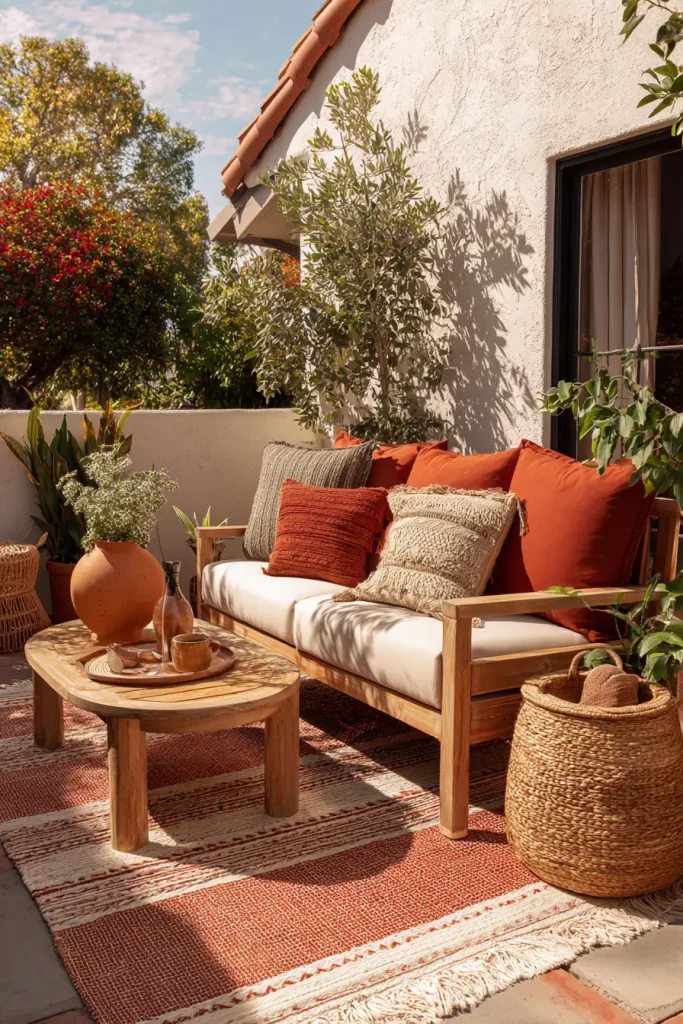
The reason most outdoor spaces look random is that nobody picked a color scheme.
Every piece got chosen separately. A blue umbrella here. An orange pot there. Brown wicker chairs and a gray table. No piece is wrong on its own. Together, they feel chaotic.
The fix is easy. Before you buy anything new, pick two or three colors and commit to them.
In 2026, the outdoor color trends moving through design media are: earthy terracotta, sage green, warm cream and sand neutrals, and dusty blue. These all work well with natural materials like wood, stone, and concrete.
Start with one fixed piece you already own or plan to buy first. If you buy a terracotta outdoor rug, pull that color through your cushion covers, pots, and even your curtain color. Add sage green through plants and one or two accent pieces. Use cream or natural wood as your neutral base.
White and cream are especially useful in shaded spaces. They reflect light and make dark corners feel brighter without adding another color to the mix.
Seasonal swaps are easy once you have a base palette. In summer, add warm coral or bright yellow through a few cushion covers or a new planter. In autumn, pull in deeper rust and brown tones. The foundation stays the same. Only the accent pieces change.
Spend ten minutes on a Pinterest board before you buy anything. Pull images you like and look for the color that keeps showing up. That is your palette.
14. Add Scent to Your Outdoor Space
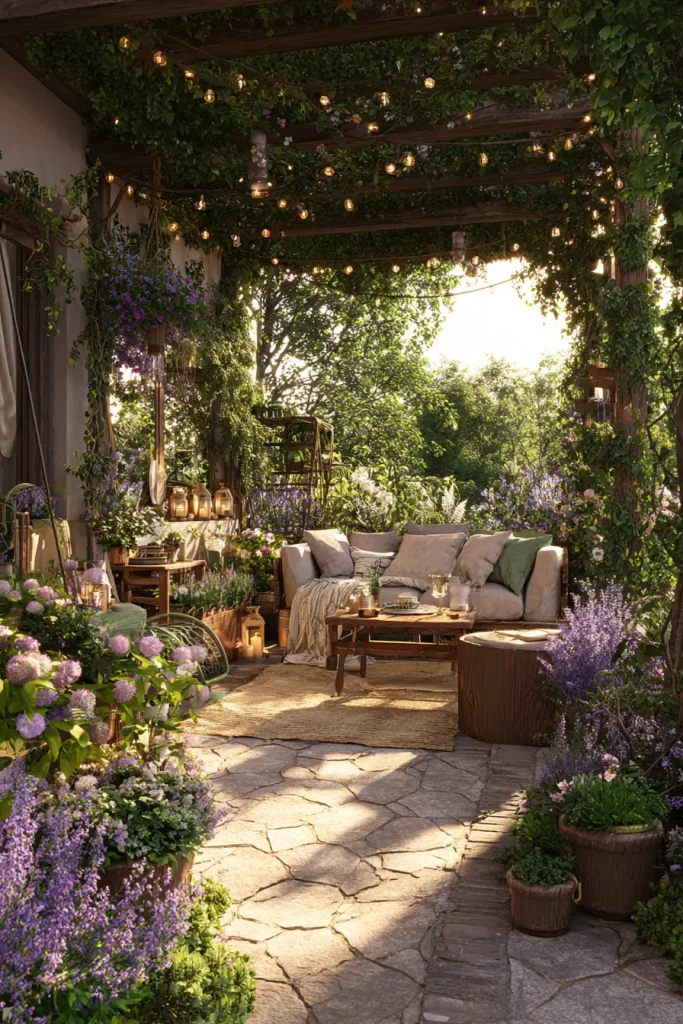
Scent is the most overlooked part of outdoor design. And it is completely free if you use plants.
The spaces that feel truly special are the ones that hit you in more than one sense. You sit down, you feel the soft cushion, you see the layered lights, and then the smell of lavender or jasmine drifts past you. That combination of sensory details is what makes a space feel immersive rather than just decorated.
Planting for fragrance is not complicated. Lavender is the most practical choice. It smells good, repels some insects, thrives in sun, and is almost impossible to kill once established. Rosemary is similar. Sweet alyssum is a low-growing plant with a honey-like scent and works perfectly as a spiller in container plantings. Jasmine is the showstopper for evening fragrance. Plant it in a pot near your seating area and train it up a trellis.
One practical rule: plant fragrant plants upwind of your seating area. Check which direction the prevailing breeze comes from in your garden and put the fragrant plants on that side. The scent will drift toward you naturally.
For evenings, citronella candles and lanterns are a dual-use tool. They add fragrance and help keep mosquitoes away. They are not a perfect solution for heavy insect pressure, but they add meaningfully to the sensory atmosphere.
Scent costs almost nothing to add. And it makes your outdoor space feel like somewhere you actually want to be.
15. Create Privacy Without Building a Fence
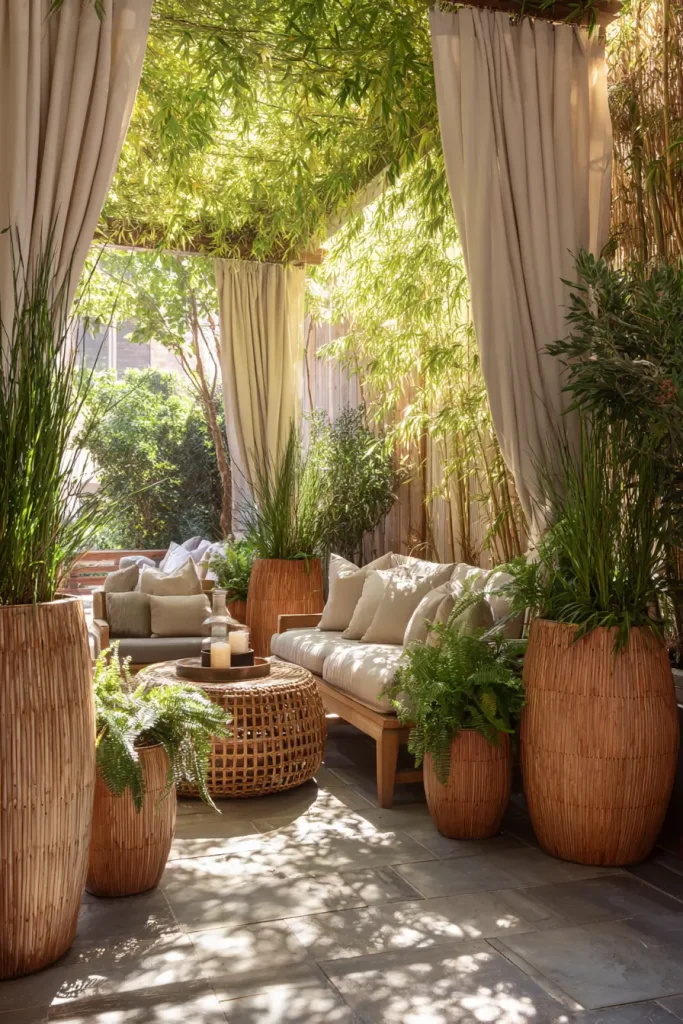
An exposed outdoor space never feels like a room. It feels like a stage.
If you can see your neighbors clearly and they can see you, you will not relax. Privacy is not a luxury in outdoor design. It is a basic requirement for the space to feel comfortable.
You do not need to build a fence to get it.
Tall planters with bamboo or ornamental grass placed along the open edge of a patio create a natural screen that looks intentional and grows denser over time. A row of three or four large planters at six to seven feet tall blocks sightlines without a single post in the ground.
Bamboo screening panels are another option. They come in rolls and can be attached to an existing fence or free-standing post system. They are cheap, look natural, and reduce wind and noise as well as visibility.
For renters or people who move frequently, fabric privacy screens on a freestanding frame are the most flexible option. Some fold up completely and can be moved or taken to a new home.
For a layered approach, combine a row of tall plants along the back with outdoor curtains on the sides. This is the most room-like result because it mimics walls on three sides while leaving one side open.
Privacy first. Then you can relax enough to enjoy everything else you have built.
16. Add Personal Touches That Make It Feel Like Yours
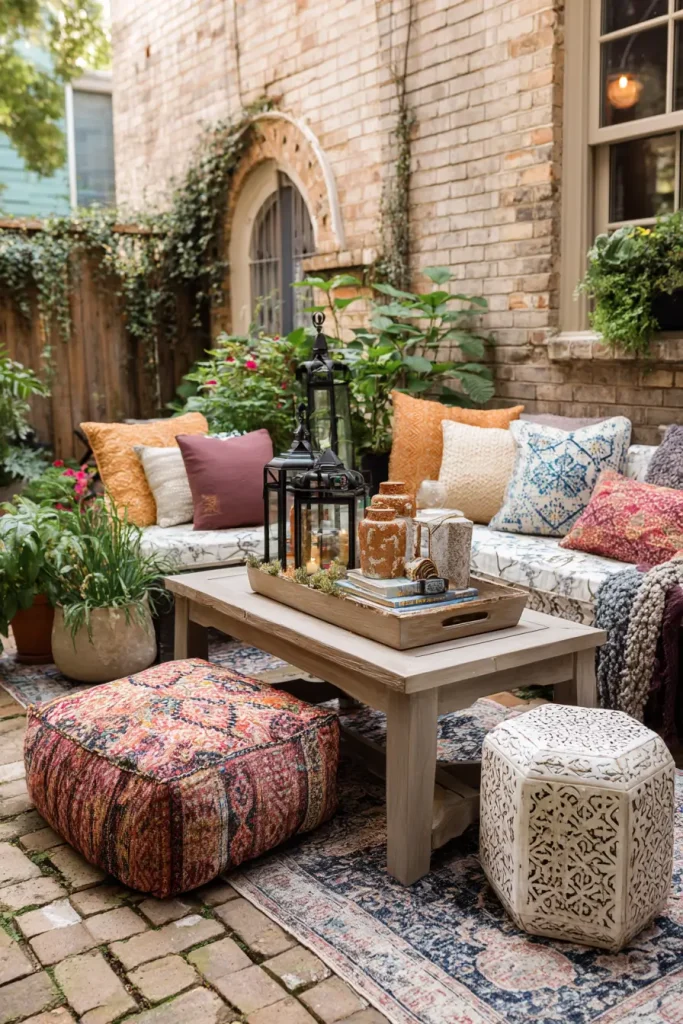
A well-designed outdoor space that has no personality still feels like a hotel lobby.
The final step is the most personal one. Add things that are yours.
That might be a small ceramic sculpture you made at a pottery class. A lantern you bought on a trip. A set of mismatched vintage garden stools that you love. A chalk menu board on the fence that you write the evening’s menu on when you have people over. A tray of paperback books that live outside because you read on the patio every morning.
These things cost very little. But they are the difference between a space that looks finished in a photo and a space that actually feels lived in.
Use the 80/20 rule as a guide. Eighty percent of the space should be the solid, foundational pieces: furniture, rug, lighting, plants. Twenty percent should be the personality pieces that reflect you specifically.
For seasonal refreshes, swap only the personality layer. Change the cushion covers. Bring in a new candle scent. Add a small pumpkin grouping in autumn or a pot of spring bulbs in early March. The bones of the space stay. Only the details change.
The truth is that the spaces we actually use are the ones that feel like ours. Not a magazine shoot. Not a showroom. Yours.
Start with the bones. Finish with yourself.
Conclusion
You do not need a big budget or a landscaper to make your outdoor space feel like a real room.
You need a plan and a starting point.
If you only do two things from this list, start with an outdoor rug and string lights. Those two changes alone will make your space feel more intentional than almost anything else you could do in an afternoon.
From there, add a zone, a focal point, some privacy, and a few personal touches. Take it one section at a time. Each step builds on the last.
The best backyard decor ideas for 2026 are not complicated. They are the same principles that make indoor rooms work, applied outside. Comfort, structure, light, color, and a reason to stay.
Your outdoor space is waiting. Go make it into a room.

- 17 Classy Living Room Ideas for a Cozy Elegant Look - April 23, 2026
- 16 Dark Moody Living Room Ideas That Feel Rich and Warm - April 22, 2026
- 14 Elegant Bedroom Trends for 2026 You’ll Love - April 22, 2026