

That Weird Angled Ceiling? It Might Be Your Room’s Best Feature
You moved in. You looked up. And your first thought was probably: “What do I do with this?”
A sloped ceiling feels like a problem. Furniture doesn’t fit right. The room looks off. Every decorating tip you find assumes a flat ceiling. So you’re stuck.
Here’s the truth: sloped ceilings are one of the most character-rich features a bedroom can have. Designers actually charge more to create that feel artificially in new builds. You already have it.
This guide gives you 18 specific ideas that work in real rooms with real sloped ceilings. Not vague inspiration. Actual things you can do, most of them without hiring anyone.
You’ll find ideas for furniture placement, lighting, paint, storage, and decor. Some cost nothing. Some take a weekend. A few need a contractor. Every single one is something real people are doing in 2026. o refine your design, take a look at 18 Low Ceiling Attic Bedroom Ideas for Small Apartments That Maximize Every Inch and discover practical ideas.
Let’s get into it.
Why Sloped Ceilings Are Actually Worth Working With
Before the ideas, let’s fix the mindset.
Most people treat a sloped ceiling like a flaw they have to work around. That’s the wrong way to look at it.
A sloped ceiling creates natural zones in a room. The high side feels open. The low side feels cozy. That contrast is actually hard to recreate in a standard room. Interior designers call this “ceiling variety,” and it makes a space feel more interesting than a flat ceiling ever could.
There’s also the hygge factor. Hygge is the Danish concept of coziness and comfort. Rooms with lower, angled ceilings naturally feel more sheltered. More like a retreat. That’s exactly what a bedroom should feel like.
Attic bedroom conversions are also one of the most searched home improvement projects on Houzz. Pinterest reported a sharp rise in searches for attic bedroom ideas in their 2024 and 2025 trend data. People want this look. You have a head start.
So stop thinking of the slope as a problem. It’s the most interesting thing about your room.
Ideas 1 to 3: How to Place Furniture in a Sloped Ceiling Bedroom
Furniture placement is where most people go wrong first. They try to fight the slope. Instead, work with it.
Idea 1: Put the Bed Under the Lowest Part of the Slope
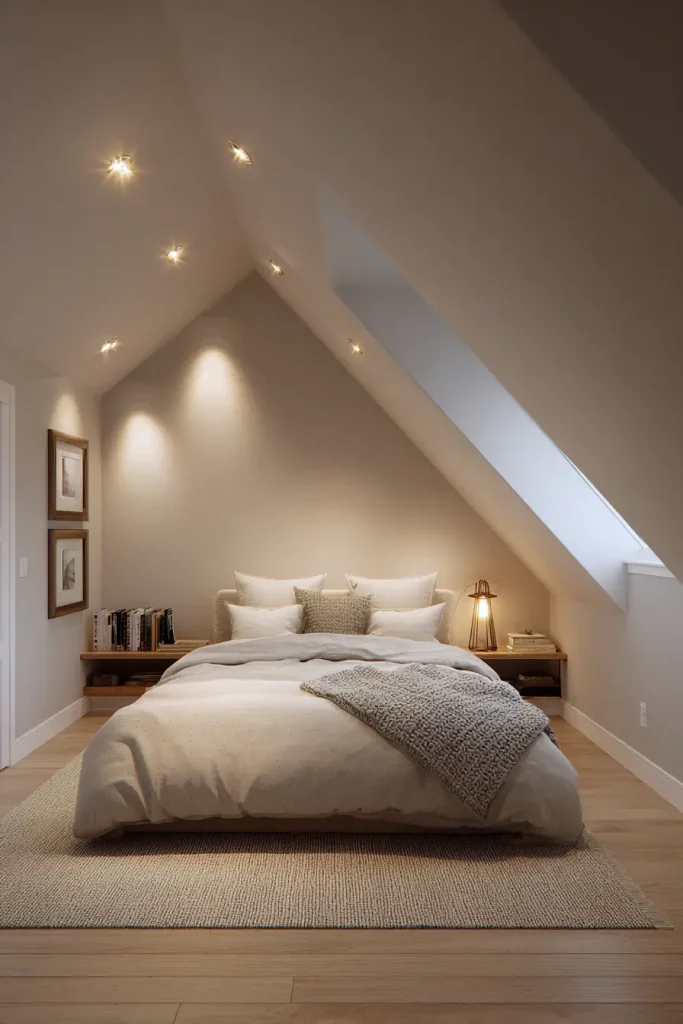
This feels wrong. Most people try to put the bed where there’s the most headroom.
But placing the bed under the lowest section of the slope creates a sleeping nook effect. It feels intentional. It feels cozy. And since you’re lying down when you’re in bed, the low ceiling directly above you doesn’t matter.
Add wood paneling or a simple painted accent behind the headboard and it looks like you planned the whole thing.
Difficulty: No cost, no contractor. Just rearrange.
Works best with: Low profile beds, platform frames, floor mattresses.
Idea 2: Use Low Storage Along the Knee Wall
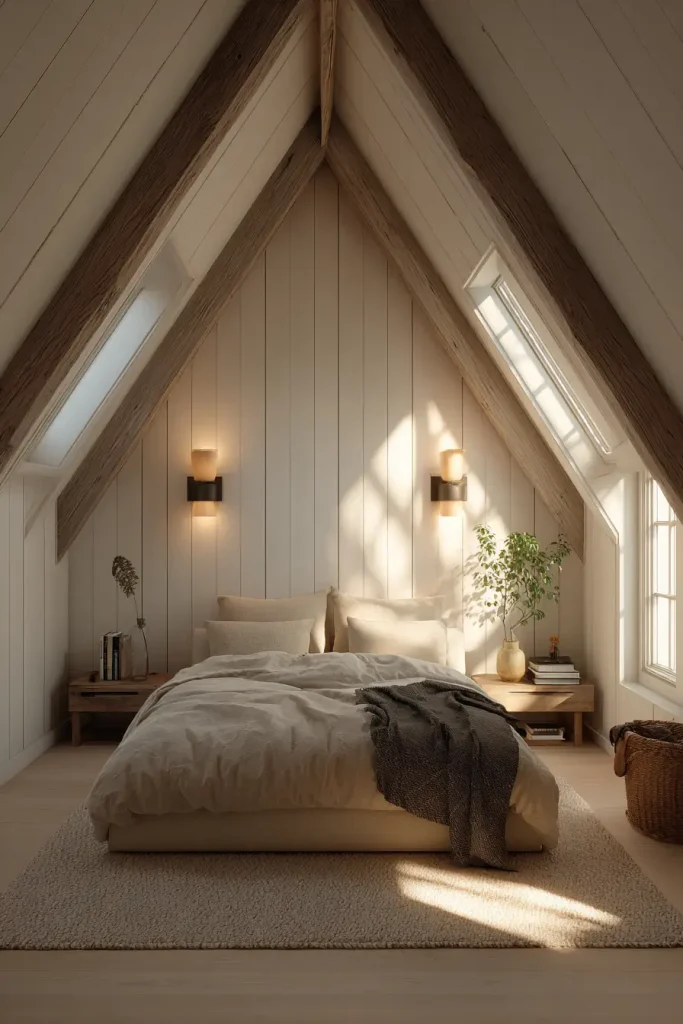
The knee wall is that short vertical section where the slope meets the floor. Most people ignore it completely.
That’s wasted space.
Low drawers, cubbies, or shelves built into the knee wall area turn dead square footage into real storage. IKEA hackers have been doing this with PAX wardrobe components for years. There’s a whole community on ikeahackers.net with photo tutorials.
If you want a cleaner look, a local carpenter can build flush front drawers that blend right into the wall. It looks expensive. It often isn’t.
Difficulty: DIY with IKEA components or hire a carpenter for custom work.
Cost range: $150 to $1,500 depending on size and finish.
Idea 3: Use a Platform Bed with Built-In Storage
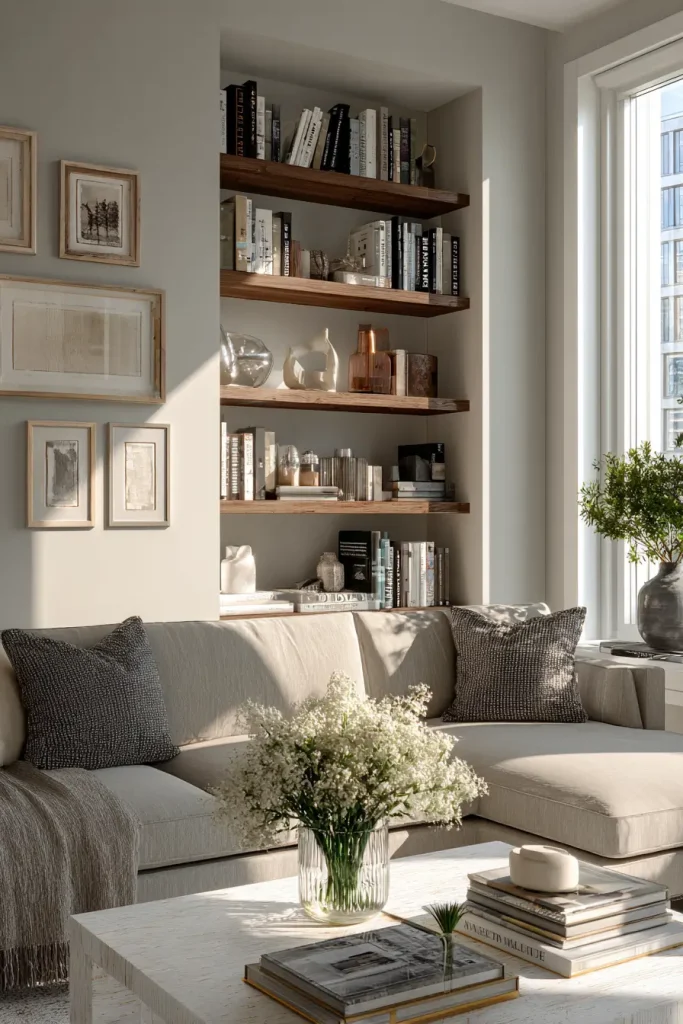
Tall bed frames and sloped ceilings don’t mix. The frame competes with the ceiling line and makes the room look chopped up.
Platform beds sit low to the ground. They don’t fight the angle. And the good ones come with under-bed drawer storage, which is critical in attic rooms where closet space is limited.
IKEA HEMNES is a reliable option at a lower price. West Elm has cleaner, mid-range platform options. If budget isn’t a concern, Room and Board makes some of the best.
Difficulty: Just buy the right bed. No skills needed.
Pro tip: If your current bed frame is too tall, remove the legs. Some frames work perfectly as low platforms without any modification.
Ideas 4 to 6: Lighting That Actually Works with Angled Ceilings
Standard light fixtures assume a flat ceiling. Drop a pendant from a sloped ceiling and it hangs crooked. It looks wrong immediately.
Here’s how to light a sloped ceiling bedroom properly.
Idea 4: Install Recessed Angled Eyeball Lights
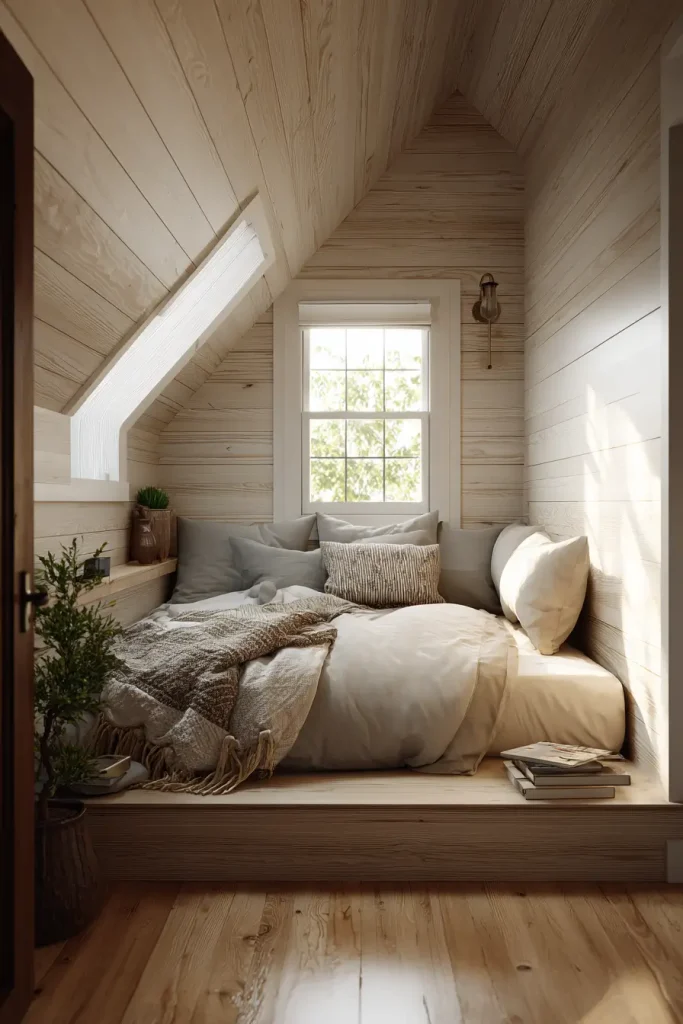
Recessed lights built into the slope itself are the cleanest solution. They follow the angle. They don’t hang down. They throw light exactly where you point them.
The key is using “eyeball” style recessed fixtures. These have a small rotating head inside the housing that lets you aim the beam. You can angle them toward the bed, toward a reading chair, or across the ceiling to add depth.
This is an electrician job. Budget $150 to $250 per fixture installed.
Best brands to look at: Halo, Lutron, Elco Lighting.
Difficulty: Hire an electrician.
Idea 5: Use Wall Sconces as Your Main Light Source
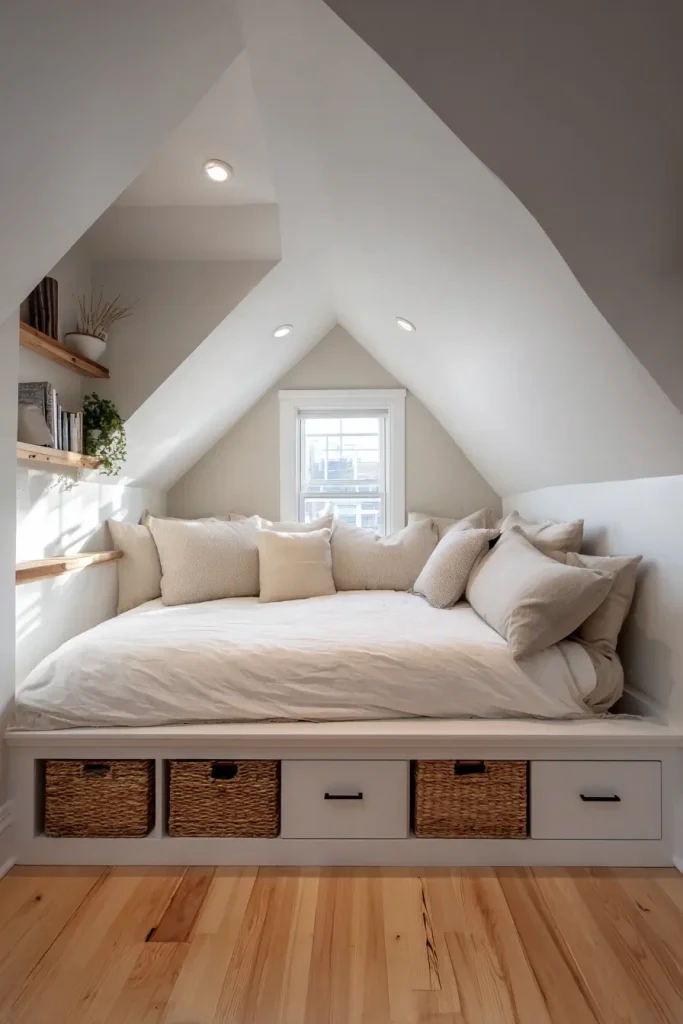
In a sloped ceiling room, wall sconces stop being accent lights. They become your main source of light.
Mount them on either side of the bed at reading height. This keeps the ceiling clear and gives you focused, adjustable light exactly where you need it.
Sconces also free up nightstand space. No bedside lamps means more room for a glass of water, a book, your phone.
Plug-in sconces exist for renters. You don’t need an electrician. Just run the cord along the wall or hide it in a cord cover. For a fresh take, explore 15+ Small Bedroom Ideas for 2026 to bring new life into your space.
Difficulty: Plug-in versions are a simple DIY. Hardwired versions need an electrician.
Good plug-in options: Serena and Lily, CB2, and Amazon’s private label brands all carry affordable plug-in sconces.
Idea 6: Add a Skylight or a Faux Skylight Panel
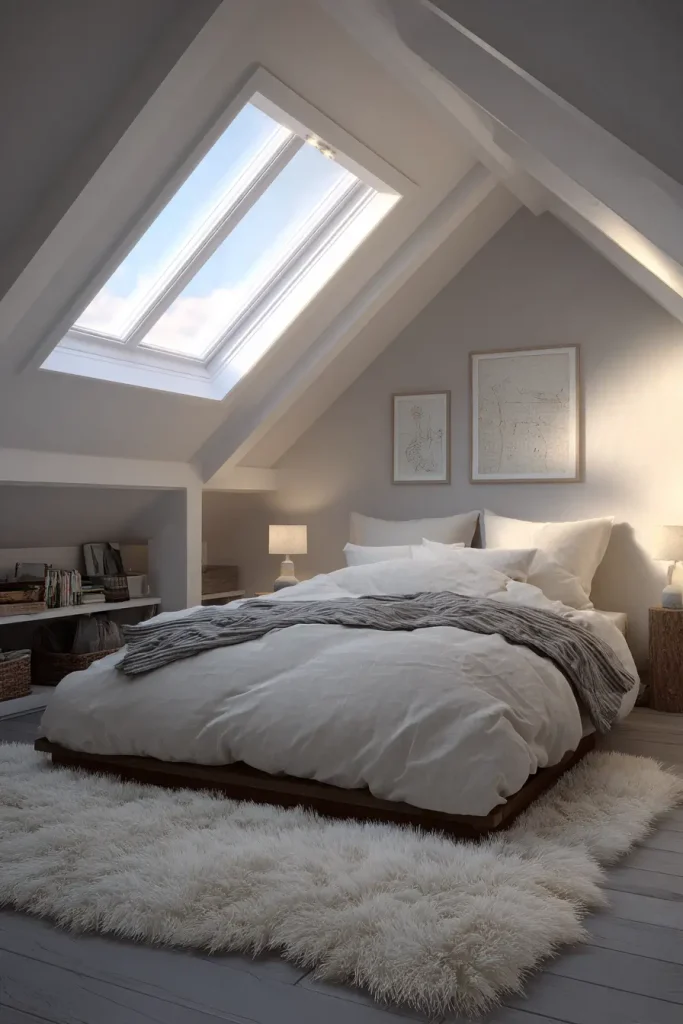
A real skylight is the single biggest upgrade you can make to a sloped ceiling bedroom. VELUX is the most trusted brand. They make fixed skylights, opening skylights, and blackout blind kits for when you want to sleep in.
VELUX’s own research shows that skylights can bring in significantly more natural light than vertical windows of the same size. Natural light regulates your sleep schedule. It wakes you up gently. It makes the room feel twice as big.
If you rent, or if a skylight isn’t in the budget, faux skylight LED panels are a real option now. They mount flush to the ceiling and emit a soft daylight glow. Search “LED skylight panel” on Amazon. They run $80 to $300 depending on size.
They’re not perfect. But they’re surprisingly convincing and they make low ceiling rooms feel less dark.
Difficulty: Real skylight needs a contractor. Faux panels are DIY.
Ideas 7 to 9: Paint and Color That Makes Sloped Rooms Look Right
Paint is the cheapest thing you can change. And it has the biggest visual impact in a sloped ceiling room. Here’s what actually works.
Idea 7: Paint the Slope Darker Than the Walls
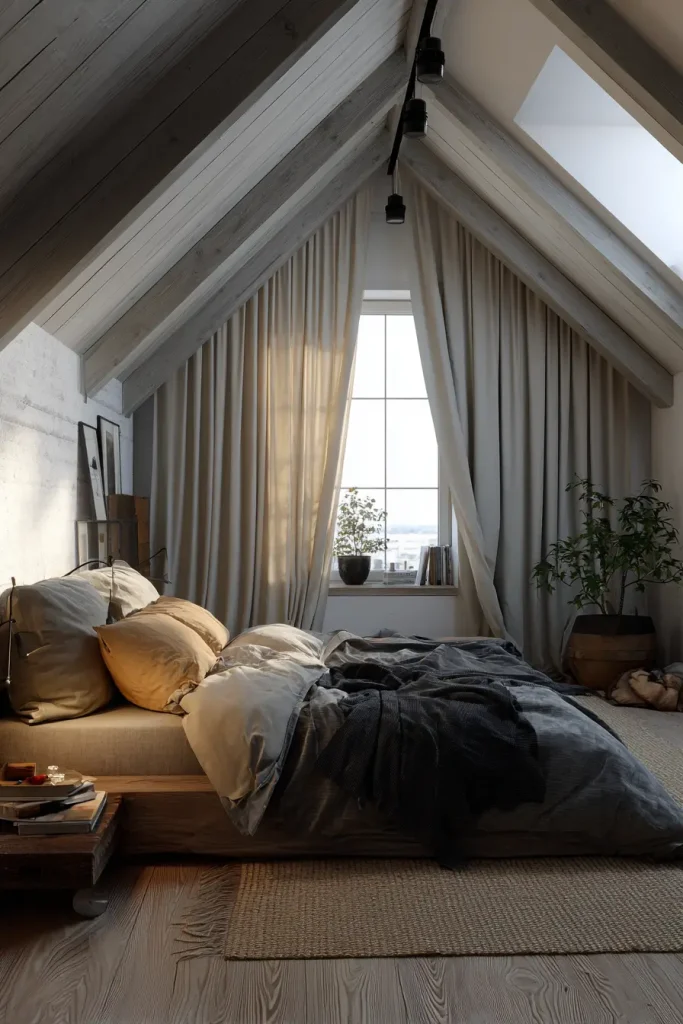
This is counterintuitive. Most people think dark makes a low ceiling feel lower.
It does. But that’s not a bad thing in a bedroom.
A darker ceiling slope creates a cocoon effect. The room feels intimate and warm. It feels designed, not accidental. This trend has been all over TikTok interior accounts since 2024 under the tag “cave ceiling” and it’s still going strong in 2026.
Good colors to try: Farrow and Ball “Moles Breath” (a warm gray), Benjamin Moore “Wrought Iron” (a deep charcoal), or any deep navy or forest green.
Difficulty: Purely DIY. Just tape and paint.
Cost: A gallon of premium paint runs $50 to $90. You likely need less than one gallon for a ceiling slope.
Idea 8: Go All White, Everything
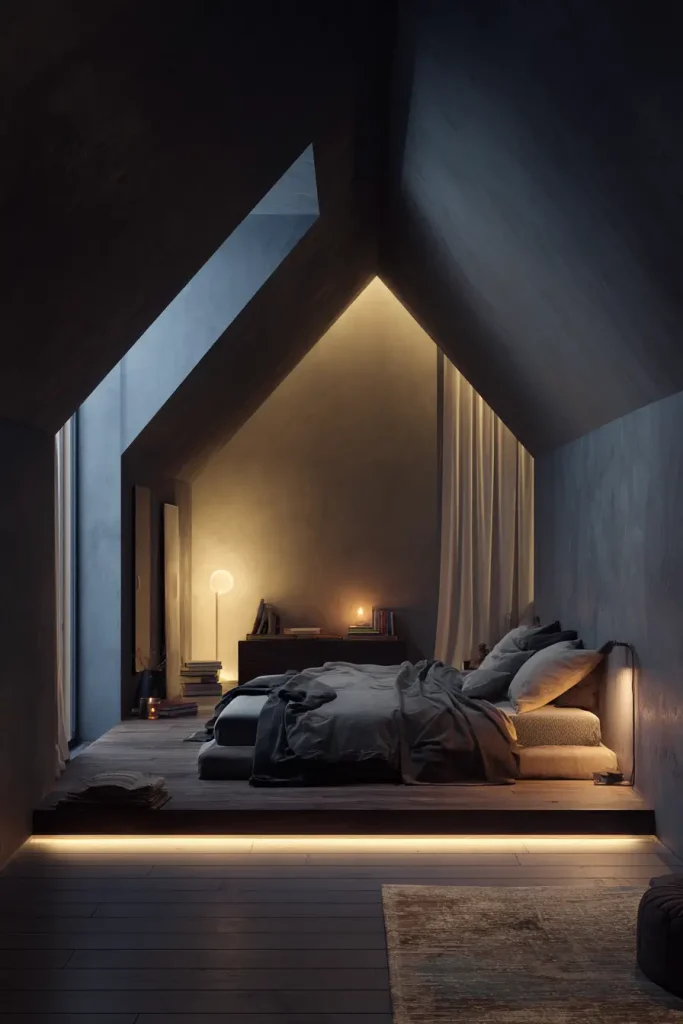
If the room is small and the slope is aggressive, fight visual noise with simplicity.
Paint the walls, ceiling, and trim all the same white. The angles stop reading as separate surfaces. The room just feels like a bright, clean space.
Benjamin Moore “Chantilly Lace” is the most recommended true white for this. It has no yellow or pink undertone. It stays crisp in both natural and artificial light.
This approach works especially well in Scandinavian style rooms. Low furniture, light wood tones, linen bedding, and white everything. Simple and effective.
Difficulty: DIY.
Honest note: All white can feel cold if you don’t add warm textiles. Add a chunky knit throw or a jute rug to bring warmth back in.
Idea 9: Use Wallpaper or Bold Paint on the Flat Gable Wall
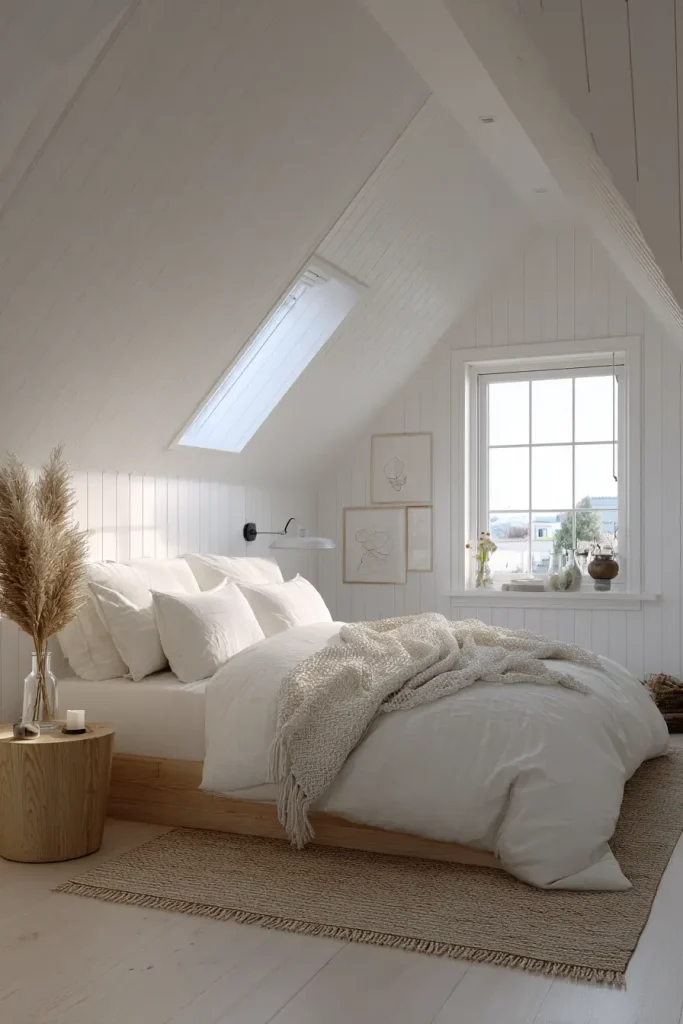
In most sloped ceiling bedrooms, there’s at least one flat vertical wall at either end of the room. This is called the gable wall.
That wall is your statement wall. Put the accent color there.
A bold wallpaper, a deep paint color, or even a large piece of art on the gable wall draws the eye to the flat surface. It pulls attention away from the angled ceiling and gives the room a clear focal point.
This is one of the easiest ways to make a sloped room look pulled together without touching the ceiling at all.
Difficulty: DIY for paint. Wallpaper is DIY with patience, or hire a decorator.
Ideas 10 to 12: Built-In Storage That Uses Every Inch
Sloped ceilings steal usable floor area. You have to get smart about storage. These three ideas recover that space.
Idea 10: Build Bookshelves That Follow the Slope
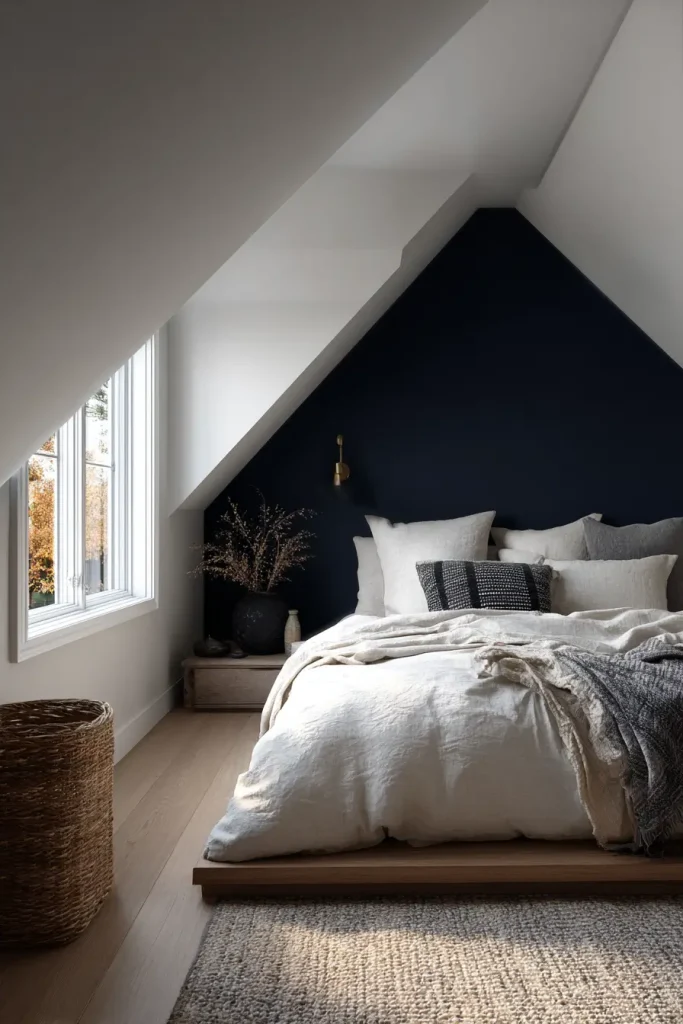
Instead of buying a standard bookshelf and cutting it off at the ceiling, build shelves that step down with the angle.
This looks custom. It looks expensive. And it uses space that would otherwise be dead air.
A good carpenter can build these from scratch. If you’re on a budget, IKEA BILLY shelves can be arranged in a stepped pattern along a sloped wall. It’s not quite as seamless, but it works.
Search “sloped ceiling bookshelf hack” on YouTube. There are full tutorials from people who’ve done this in real homes.
Difficulty: DIY with IKEA components or hire a carpenter.
Cost range: $200 to $2,000 depending on size and material.
Idea 11: Turn a Dormer Into a Window Seat with Storage
If your room has a dormer window (the box-shaped bump-out that creates a vertical window in a sloped roof), you have a gift.
Build a window seat bench in that recess. Lift-top storage underneath. Cushion on top. Add a small curtain on either side and you have a reading nook that people pay designers thousands to create.
This is one of the most searched features in attic bedrooms on Houzz. And it solves two problems at once: storage and seating. If you want more inspiration, How to Make a Small Bedroom Look Twice as Big offers ideas that can elevate your room.
Difficulty: DIY if you’re comfortable with basic carpentry. Hire someone if you’re not.
Honest note: The seat needs to be at least 18 inches deep to be comfortable. Less than that and it’s just decorative.
Idea 12: Install Under-Eave Pull-Out Drawers
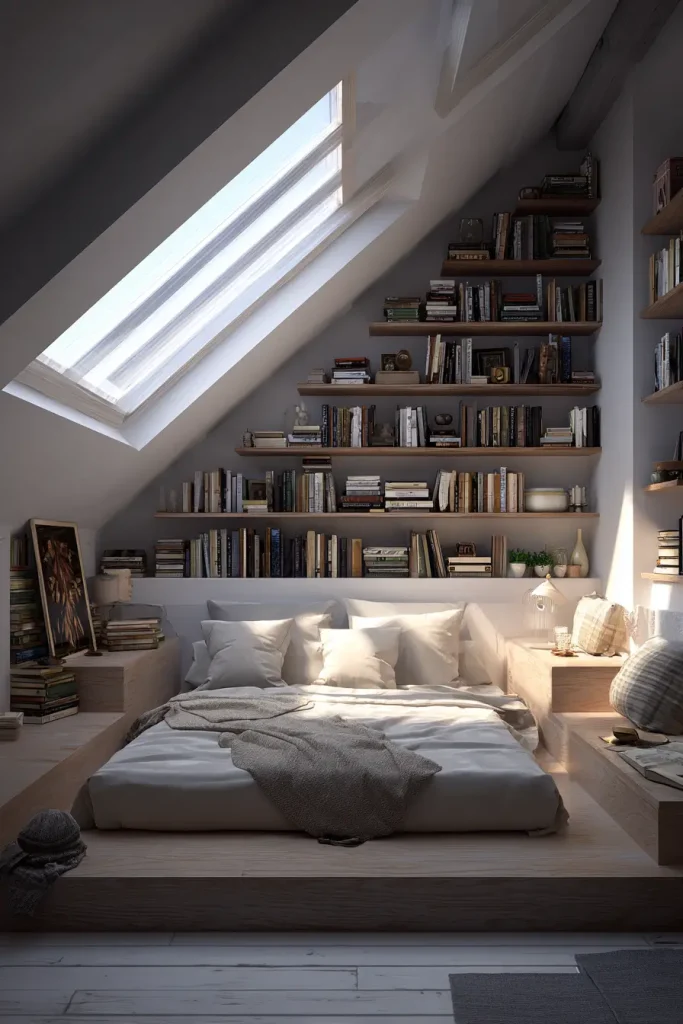
The space behind the knee wall, under the eaves, is dead space in most homes. Insulation and dust. Nothing else.
A carpenter can turn that space into pull-out drawers or cabinet doors. From the outside, they look like flat wall panels. Open them and there’s serious hidden storage.
This works especially well for off-season items, luggage, or bedding storage.
Search for inspiration on Houzz under “eave storage” or “knee wall drawers” to see finished examples.
Difficulty: Needs a contractor or skilled DIYer.
Cost: $500 to $3,000 depending on how much wall space you use.
Ideas 13 to 15: Decor and Textiles That Complement the Slope
You’ve sorted the big stuff. Now let’s talk about the details that make a room feel finished.
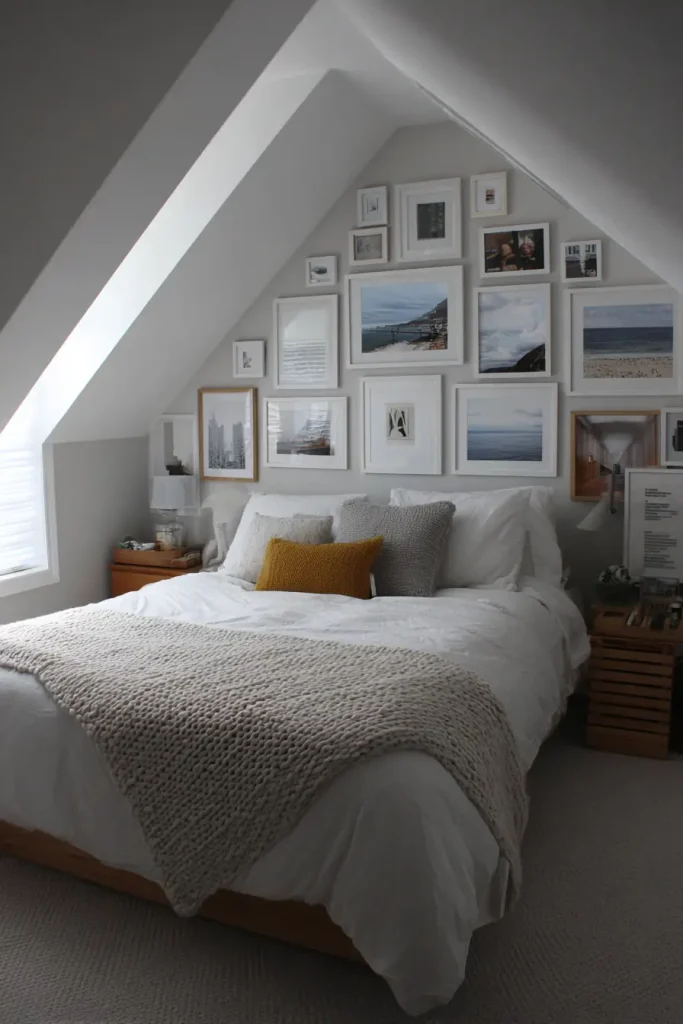
Idea 13: Create a Gallery Wall on the Flat Gable End
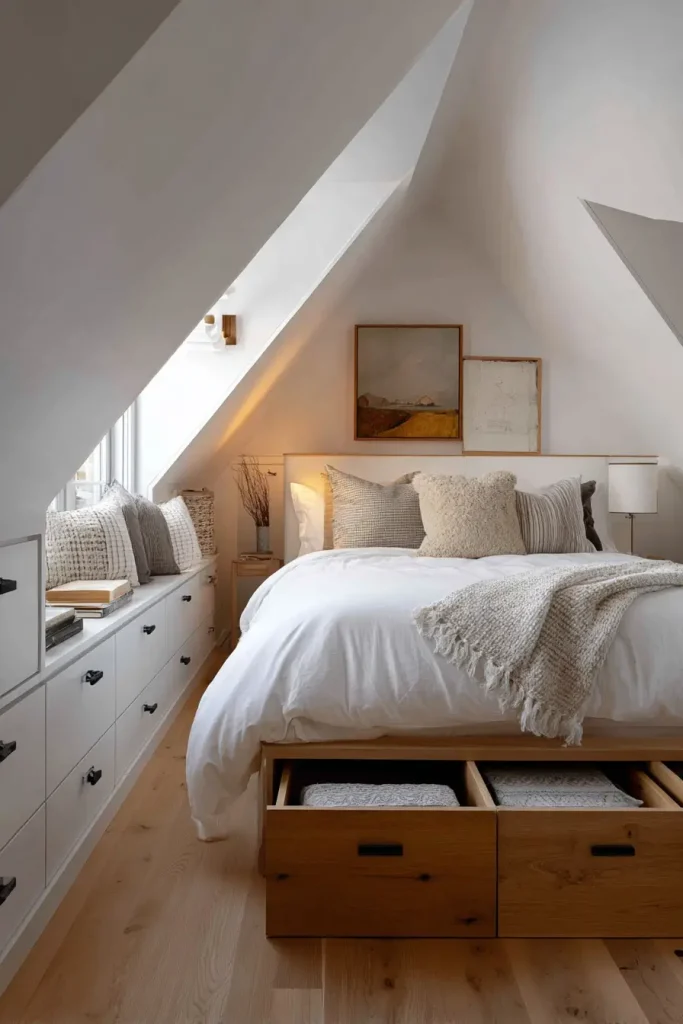
The flat gable wall is your best canvas. Use it.
A gallery wall with framed prints, photos, or art makes this wall a real focal point. Mix frame sizes. Keep a consistent color palette for the frames or the art. Step back and adjust until it feels balanced.
A large single mirror works just as well. It bounces light around the room and makes the space feel bigger.
The one place you should not hang art is on the sloped ceiling surface itself. It’s hard to see, hard to hang properly, and it draws attention to the angle in an awkward way.
Difficulty: Pure DIY.
Cost: Frames from IKEA, Target, or Amazon start at $10. You don’t need expensive art.
Idea 14: Use a Ceiling Track Curtain to Divide the Space
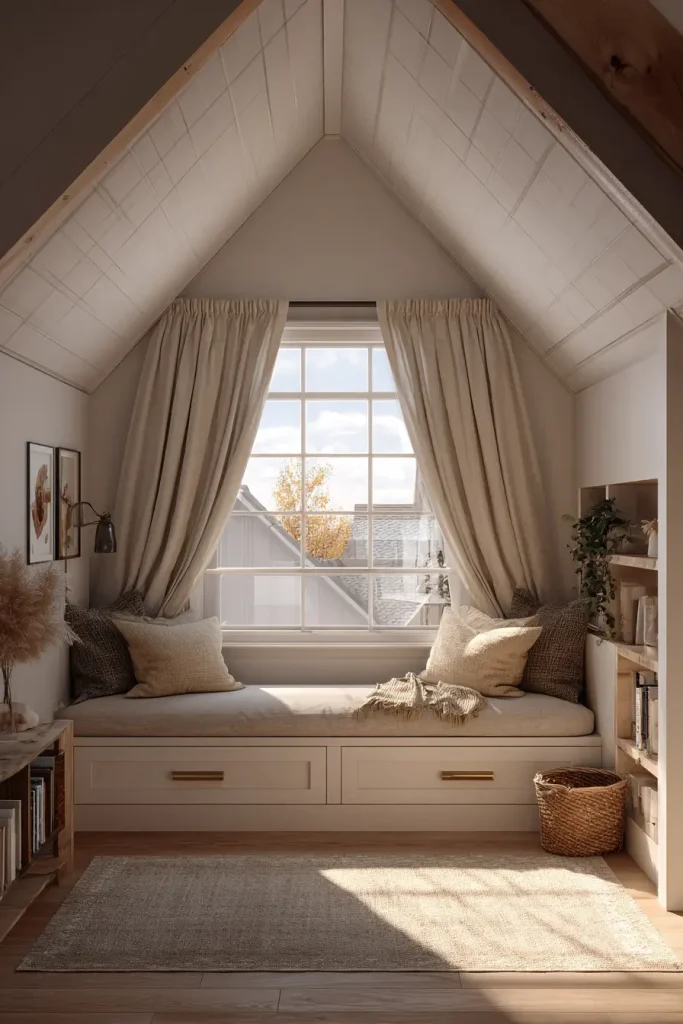
If your sloped ceiling bedroom is also a loft that connects to another area, a ceiling track curtain system can divide the spaces.
These tracks mount directly to the ceiling surface and can follow the slope. The curtains hang straight down from the track. When closed, they create two separate zones. When open, the room feels big and open.
This is a popular fix in studio apartments and converted lofts. IKEA KVARTAL is one option. Silent Gliss makes higher-end track systems for a cleaner look.
Difficulty: DIY for basic track systems.
Idea 15: Treat Exposed Beams Intentionally
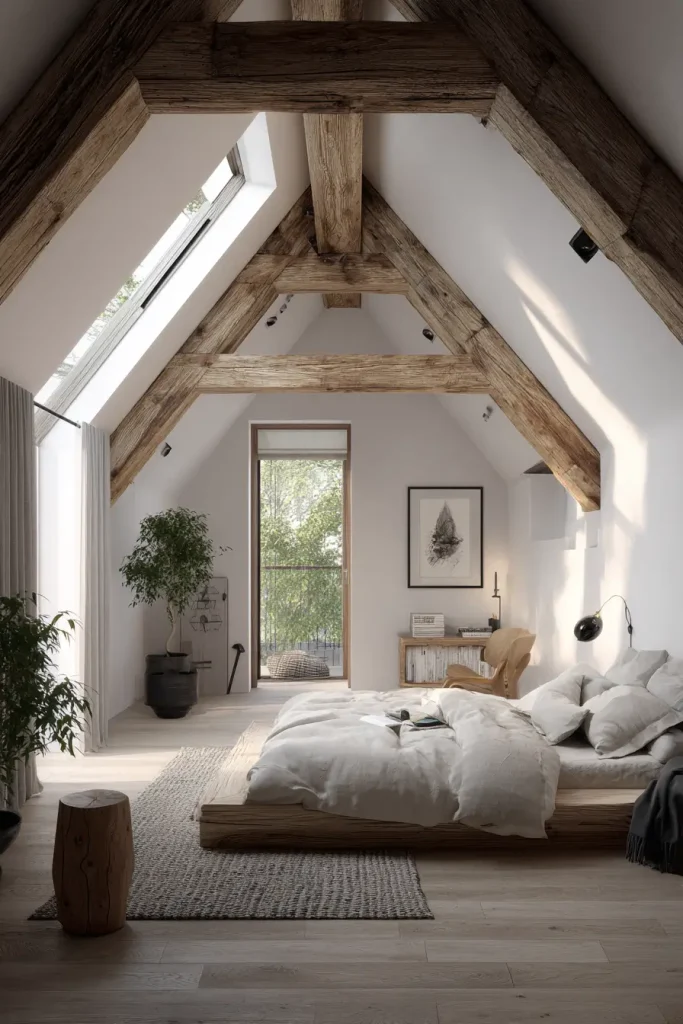
If your sloped ceiling has exposed wood beams, they’re an asset. But they need a decision.
Option one: Leave them natural wood. This gives the room a warm, rustic or Scandi feel. Works well with linen textiles and earth tones.
Option two: Paint them white. This makes the ceiling feel lighter and less heavy. Works well in small rooms that need to feel bigger.
Option three: Paint them the same color as the ceiling. They disappear into the background. The room feels cleaner and more modern.
Pick one and commit. The mistake is doing nothing and letting old stained beams sit there looking like an afterthought.
Difficulty: DIY with a good brush and patience.
Ideas 16 to 18: Design Moves That Make Sloped Rooms Look Intentional
These three ideas take a sloped ceiling bedroom from “it’s fine” to “this is exactly what I wanted.”
Idea 16: Panel the Slope with Shiplap or Wood Boards
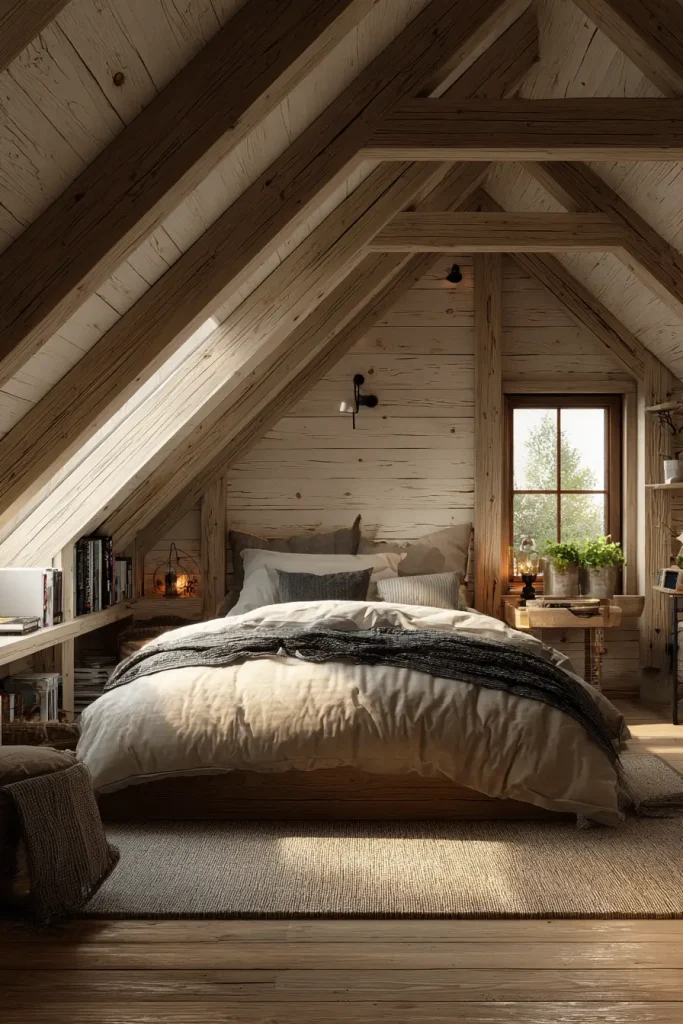
Bare drywall on a sloped ceiling looks unfinished. Adding shiplap or tongue and groove wood boards adds texture and makes the slope feel like a design choice.
White shiplap keeps the room bright and gives it a beach house or Scandinavian feel. Natural wood stain goes warmer and more rustic.
This is a popular DIY project. Shiplap boards from Home Depot or Lowes run about $1 to $3 per linear foot. The install is straightforward with a nail gun and a miter saw.
There are full tutorials on YouTube. Search “shiplap ceiling install attic bedroom” and you’ll find step-by-step guides from real homeowners.
Difficulty: Intermediate DIY. Takes a weekend.
Cost range: $300 to $800 for an average sized room.
Idea 17: Use a Freestanding Canopy Bed Frame
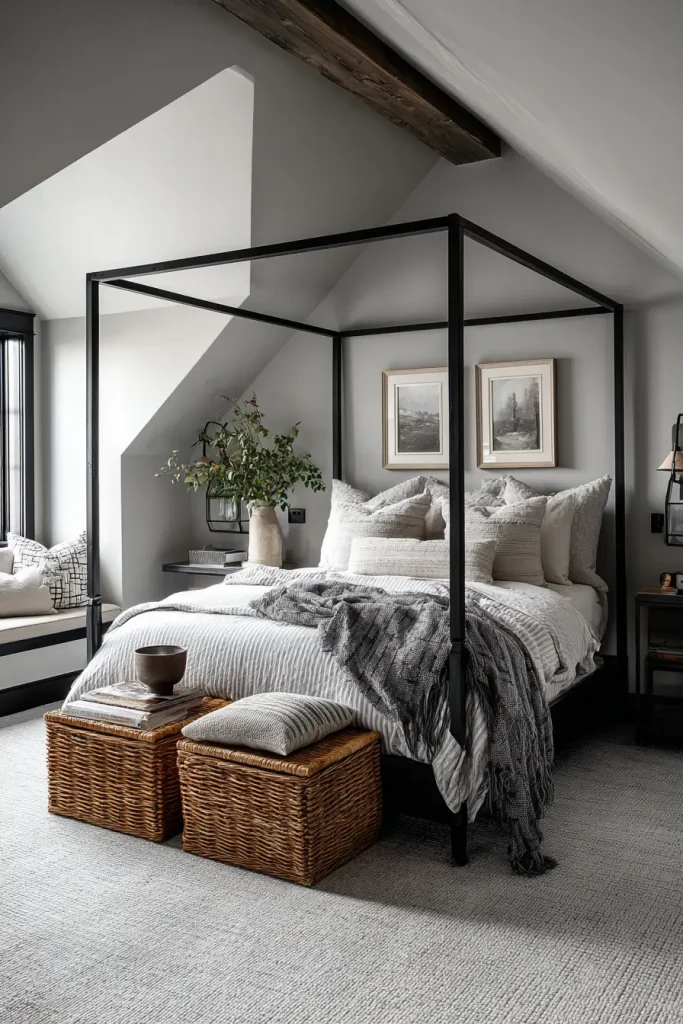
A canopy bed adds height and drama to any room. In a sloped ceiling bedroom, a freestanding four-poster frame does this without needing anything from the ceiling.
The posts create vertical lines that draw the eye up. The canopy fabric frames the bed and makes it feel like its own space within the room.
You don’t need to attach anything to the slope. The frame stands on its own.
This works best when the bed is positioned on the higher side of the room, so the canopy has room to stand at full height.
Difficulty: Assembly only. No installation needed.
Good options to search: CB2, Article, Structube all carry modern canopy frames in the $600 to $1,800 range.
Idea 18: Set Up a Japandi Style Low Floor Layout
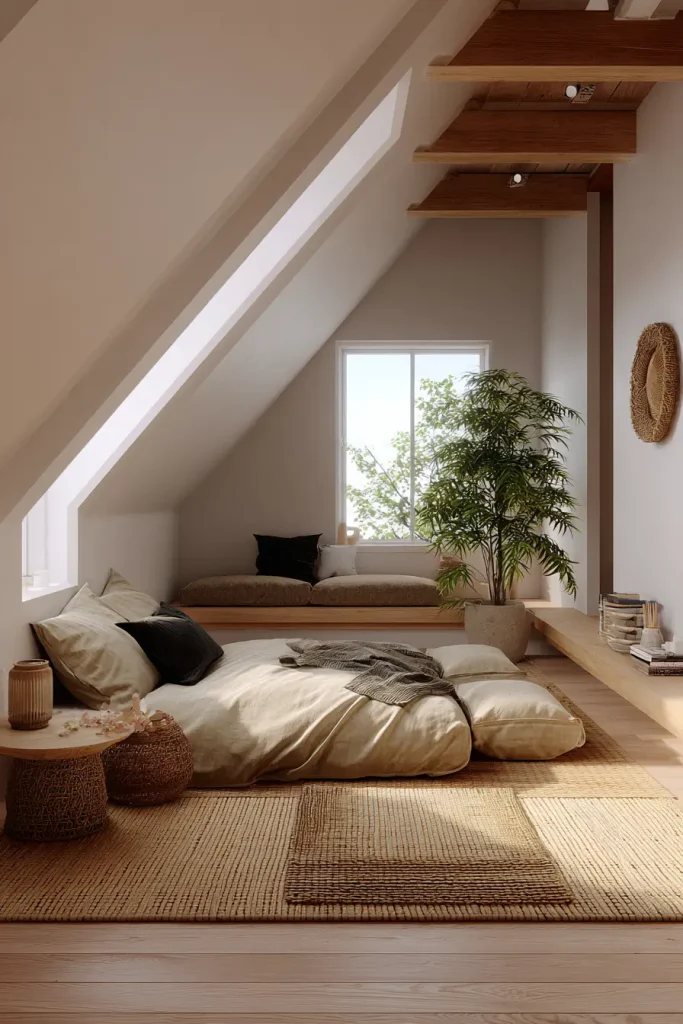
Japandi is a style that blends Japanese minimalism with Scandinavian simplicity. Low furniture, natural materials, very little clutter, and calm neutral colors.
It is almost perfectly suited to sloped ceiling bedrooms.
A low tatami platform or a floor mattress works with the slope instead of fighting it. Low wood side tables, a simple linen duvet, a woven rug, a single plant. That’s the whole setup.
The low ceiling feels intentional because everything else is intentionally low too. The room reads as a calm, curated space.
This is one of the most pinned aesthetic styles for attic bedrooms on Pinterest right now. Search “Japandi attic bedroom” and you’ll see hundreds of real-room examples.
Difficulty: No installation. Just buy the right pieces.
Cost: This can be done on almost any budget. A floor mattress or shikibuton starts at $100.
5 Mistakes to Avoid in Sloped Ceiling Bedrooms
You can do everything right and still mess it up if you make one of these errors.
Mistake 1: Hanging standard pendants without a slope adapter. The light hangs crooked. It looks cheap. Buy a swag ceiling adapter or use wall sconces instead.
Mistake 2: Buying tall furniture. A six-foot wardrobe under a five-foot ceiling point is a problem you can see coming. Measure first.
Mistake 3: High contrast paint when the room is small. White walls and a black ceiling look great in large rooms. In a small attic room, it feels chopped up. Go for tonal contrasts instead: light gray walls, medium gray slope.
Mistake 4: Ignoring the knee wall space. That short wall section is storage you haven’t found yet. Don’t wallpaper over it and move on.
Mistake 5: Overcrowding the room. Sloped rooms need breathing space. Less furniture, not more. Three well chosen pieces beat six crammed ones every time.
Now Pick One and Start
Sloped ceilings are not a design problem. They’re an architectural feature that most rooms don’t have.
The 18 ideas in this guide cover every part of the room: where to put the bed, how to light it, what color to paint it, where to find hidden storage, and how to make the whole thing look like you planned it from the start.
You don’t need to do all 18. Pick two or three that match your budget and your style. Start with the one that costs nothing: move the bed under the slope. See how the room feels.
Then go from there.
If you try any of these ideas, share a photo in the comments. Real before and after photos help other readers more than anything else on this page.
These bedroom ideas with sloped ceiling work in real homes. Yours included.

- 17 Classy Living Room Ideas for a Cozy Elegant Look - April 23, 2026
- 16 Dark Moody Living Room Ideas That Feel Rich and Warm - April 22, 2026
- 14 Elegant Bedroom Trends for 2026 You’ll Love - April 22, 2026

