
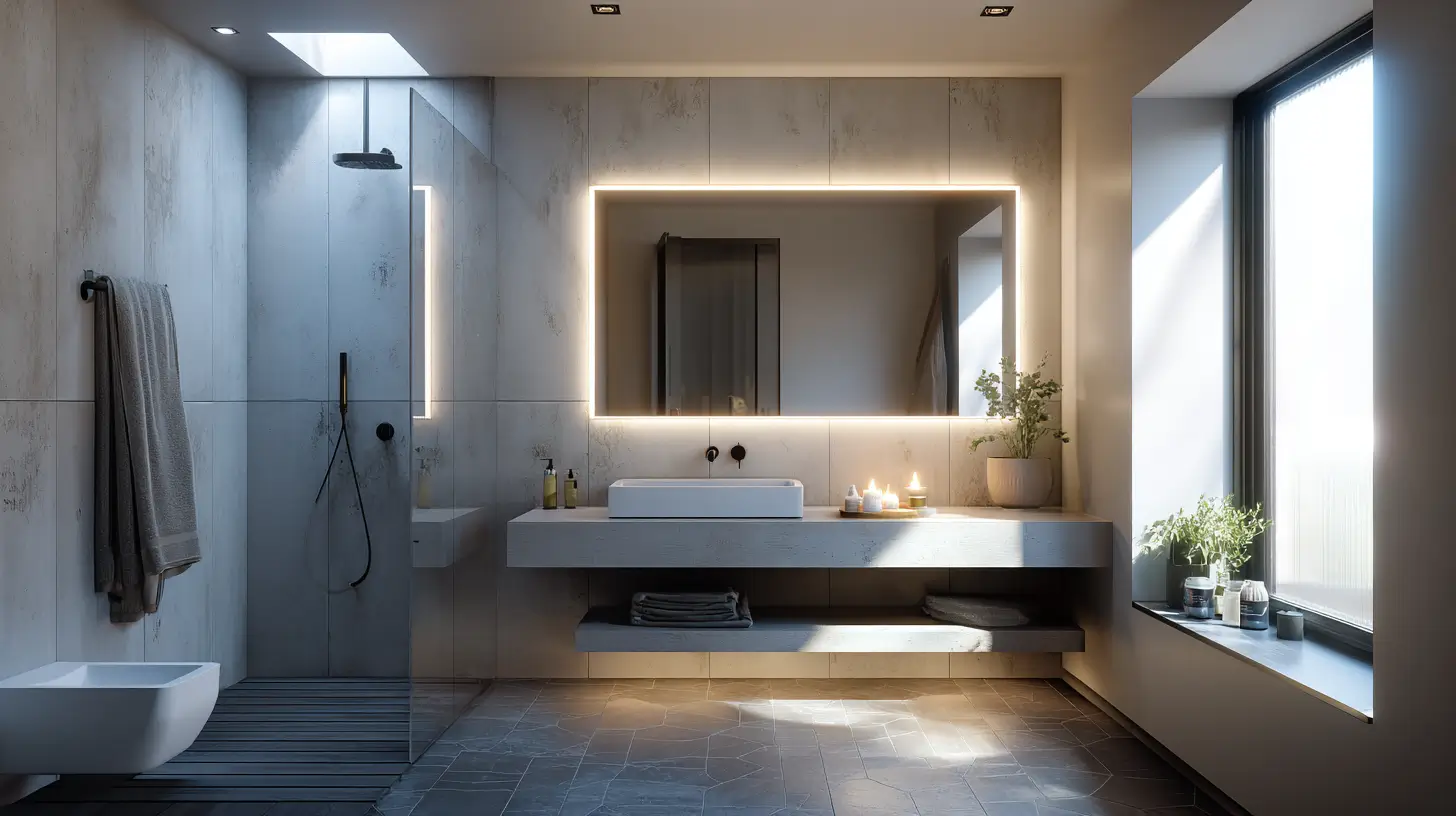
You don’t need a sledgehammer or a $15,000 contractor bill to get the bathroom of your dreams in 2026.
If you’ve been scrolling through Pinterest, you’ve probably seen those stunning marble bathrooms and custom vanities. They look amazing. And you assume they cost a fortune. So you do nothing. Your bathroom stays stuck in 2005, with beige walls, a foggy mirror, and hardware that feels like it belongs in a rental.
Here’s the truth: you can fake a full renovation. It’s about making smart, high-impact swaps where they matter most—and skipping the expensive stuff that doesn’t. This article shares 18 budget bathroom ideas that focus on surface changes, lighting, and small details. You’ll learn how to redirect your money toward things people actually notice, while saving thousands on demolition and labor.
Let’s turn that tired bathroom into a space that feels fresh, modern, and entirely yours—without the gut job.
1. Upgrade Your Lighting for Instant Ambiance

That single frosted glass dome on your ceiling isn’t just ugly. It’s casting shadows under your eyes when you brush your teeth or do makeup. Builder-grade “boob” lights and fluorescent bars are the biggest giveaway that a bathroom hasn’t been touched in years.
The fix is simpler than you think. Swap the overhead bar for sconces flanking the mirror. This eliminates shadows and gives you even, flattering light. In 2026, adding a dimmer is a cheap way to create spa vibes—bright in the morning, soft at night.
Cost: $80–$150 | Time: 2 hours
According to the 2025 Houzz Bathroom Trends Study, 68% of renovating homeowners upgrade lighting, and it ranks as the feature with the highest “satisfaction return” relative to cost. Swapping a $40 builder fixture for a pair of $80 sconces costs about $120 total but changes the entire mood of the room. It’s one of the easiest high-impact low-cost bathroom updates you can make.
2. Paint Your Vanity (Not Your Tiles)

Your vanity is solid wood. It’s structurally fine. It’s just… orange. Or oak. Or that weird honey color from 1998. Ripping it out and buying a new custom vanity starts at $1,500. But you can give it a brand‑new look for $50 in supplies.
Use cabinet paint or Benjamin Moore Advance—they’re formulated for high humidity and won’t peel. In 2026, deep navy, charcoal gray, and “greige” (gray-beige) are replacing stark white. A fresh coat of color makes the vanity look built‑in and expensive.
Cost: $50–$100 | Time: 1 day (plus drying)
This is a true bathroom renovation on a budget move. You keep the structure, change the color, and suddenly the whole room feels updated.
3. The “Peel and Stick” Revolution: Backsplashes & Floors

Peel‑and‑stick isn’t what it used to be. In 2026, brands like Smart Tiles and FloorPops make vinyl tiles with deep embossing and realistic grout lines. You can cover dated linoleum or ugly ceramic tile in an afternoon and get that “gut renovation” look without the dust.
If you’re a renter, these are fully removable. If you own, you can make them permanent by using thin‑set mortar. A standard half‑bath floor costs under $150 to cover.
Cost: $100–$300 | Time: 2–4 hours
The global vinyl flooring market is projected to grow 5.2% in 2026 (Statista), and it’s because DIYers have discovered how foolproof these products have become. This is DIY bathroom transformations at its best.
4. Embrace the “No-Demo” Tile Overlay

What if you could lay new tile directly over the old tile? You can. It’s called tile‑over‑tile, and it uses a special uncoupling membrane like Schluter‑DITRA. The membrane sits between the old and new tile, preventing cracks.
This saves the $2,000–$4,000 you’d spend on demo and haul‑away. Just make sure your existing floor is stable, level, and free of major cracks. If it is, you skip the mess and go straight to the pretty part.
Cost: $300–$800 (materials only) | Time: 1–2 days
Demolition alone eats up 10–15% of a typical renovation budget (HomeAdvisor 2025 data). When you skip it, you’re not just saving money—you’re keeping your sanity. That’s a smart budget bathroom idea.
5. Upgrade Hardware to High-End “Knockoffs”

This is the easiest one‑hour makeover you’ll find. Cabinet pulls, knobs, and towel bars are the jewelry of the bathroom. Swapping them out changes everything.
But don’t just grab any hardware. Look for proportion. Instead of standard 3‑inch pulls, use 12‑inch pulls on drawers. That long, sleek look screams custom. In 2026, unlacquered brass (which develops a natural patina over time), matte black, and brushed nickel are the top finishes.
Cost: $50–$80 (for 20 pulls) | Time: 1 hour
Replacing 20 handles with high‑quality replicas from Amazon or Wayfair typically runs under $80. For that price, you get a room that looks professionally designed. That’s high-impact low-cost bathroom updates done right.
6. Reglaze vs. Replace: The Bathtub Fix

Is your tub stained, chipped, or a color that screams 1970s (avocado green, we’re looking at you)? A new tub installation costs $3,000+. Reglazing costs $300–$600.
Reglazing (also called refinishing) involves sanding, filling, and spraying a new enamel coating. It’s best done by a pro—DIY kits often turn yellow within months. A professional can make your tub look brand‑new in a day.
Cost: $300–$600 | Time: 1 day (professional)
According to Angi/HomeAdvisor, bathtub reglazing has a 300% ROI compared to full replacement when it comes to home resale value. That makes it a no‑brainer for a bathroom renovation on a budget.
7. The Mirror Frame Facelift

Builder‑grade bathrooms almost always have a huge, unframed mirror glued directly to the wall. It’s functional, but it looks cheap. A custom‑framed mirror costs $300–$500. Or you can DIY it for $40.
Buy trim molding (MDF) from any hardware store. Cut 45‑degree angles to fit the mirror’s size, glue or nail the frame directly onto the mirror surface, then paint. In an afternoon, you’ll have a mirror that looks like an antique piece you found at a boutique.
Cost: $40–$60 | Time: 3 hours
This is one of the most satisfying DIY bathroom transformations because it’s so simple yet so dramatic. The mirror becomes a focal point instead of an afterthought.
8. Invest in a “Floating” or Open Vanity

If your vanity is beyond saving—maybe it’s water‑damaged or falling apart—you don’t have to buy a heavy cabinet. In 2026, the trend is “dematerialization”: using less to make the space feel larger.
Replace the vanity with a floating shelf and a vessel sink. Open storage creates the illusion of more floor space. Keep clutter in attractive baskets underneath. It looks architectural, modern, and intentional.
Cost: $200–$600 (shelf + sink) | Time: 1 day
This approach fits perfectly with budget bathroom ideas because you’re spending money on a high‑impact visual element instead of a bulky cabinet that hides the same stuff anyway.
9. Change the Plumbing Fixtures

Faucets and shower heads are the jewelry of the bathroom. If yours is old, tarnished, or drips, it’s time to swap them.
Before you buy, check the configuration: “widespread” (three holes) vs. “centerset” (one hole). It’s an easy DIY if you have basic tools. And while you’re at it, add a water‑saving aerator—it cuts your water bill without sacrificing pressure.
Cost: $70–$200 | Time: 1–2 hours
A modern rainfall shower head costs under $70 and feels like a hotel upgrade. That’s high-impact low-cost bathroom updates that you’ll enjoy every single day.
10. Incorporate “Wet Room” Lites (Shower Curtains)

Glass shower doors are expensive to install and a pain to keep clean. But a plastic shower curtain looks… well, plastic. The trick is to use a fabric curtain—linen or waffle weave—and hang it high.
Install a curved shower rod 8–12 inches from the ceiling. Use a fabric liner inside and the nice curtain outside. The high placement mimics the look of a glass enclosure, and the curved rod adds 4–6 inches of elbow room.
Cost: $50–$100 | Time: 30 minutes
This simple change makes a standard tub feel larger and more luxurious. It’s a clever bathroom renovation on a budget that works in any space.
11. Strategic Tile: Create a “Feature Wall”

Full shower re‑tile costs $2,000–$5,000. But you can get the same wow factor by tiling just one wall—the vanity backsplash, the wall behind the toilet, or the shower niche.
Use a luxury material like Zellige tile (which has a handmade, textured look) or large‑format porcelain. Because you’re using a small quantity, you can afford something special. The rest of the room stays as‑is, and the feature wall becomes the star.
Cost: $200–$400 | Time: 1–2 days
A single 4×6 foot feature wall behind the vanity costs about $300 in materials. That’s a fraction of a full shower re‑tile, but it delivers the same design impact. This is high-impact low-cost bathroom updates with a designer twist.
12. Greenery & Biophilic Elements

Hard surfaces—tile, glass, metal—can feel cold. The 2026 design trend of biophilia brings nature in to soften everything.
Add humidity‑loving plants like orchids, pothos, or snake plants. Swap plastic shower caddies for teak wood or natural stone shelves. A small bamboo stool or a eucalyptus bundle in the shower adds a spa scent and a visual anchor.
Cost: $20–$100 | Time: 15 minutes
Studies in Environmental Psychology (2024) show that adding greenery to bathrooms increases perceived “luxury” by 20% in user surveys. It’s a cheap way to elevate the mood of the room and fits right in with budget bathroom ideas.
13. The Grout Refresh

Clean, white grout lines make old tile look new. Dirty, moldy grout makes new tile look old. You don’t need to re‑tile; you just need to refresh the grout.
Use a grout pen (bleach pen or color sealant) to whiten the lines. If the grout is crumbling, you can re‑grout yourself—it costs pennies compared to new tile. A $10 grout pen can restore a 100‑square‑foot floor in 30 minutes.
Cost: $10–$50 | Time: 30 minutes – 2 hours
This is a classic DIY bathroom transformations project. It’s tedious but incredibly satisfying. The before‑and‑after photos alone will make you feel like a pro.
14. Upgrade the Toilet

A toilet might not be the first thing you think of for style, but a modern, skirted toilet (with no exposed trapway) looks sleek and is easier to clean. It instantly updates the age of the room.
New toilets start around $200. Look for the WaterSense label—it uses less water and saves you money over time. The EPA says replacing a toilet from pre‑1994 saves the average family of four $2,000 in water bills over the toilet’s lifetime.
Cost: $200–$500 | Time: 2–4 hours (or pro installation)
This is a practical bathroom renovation on a budget move that pays for itself in water savings and adds resale appeal.
15. Smart Storage: Floating Shelves

Those over‑the‑toilet cabinets with wire racks or particleboard shelves look clunky. Replace them with natural wood floating shelves.
Open shelving forces you to be selective about what you store—only the nice stuff, like rolled towels, candles, and a small plant. It opens up the sightline and makes the room feel bigger.
Cost: $80–$150 | Time: 1–2 hours
A set of three floating shelves from IKEA (LACK series) costs under $80 and can be installed in an afternoon. It’s an instant upgrade that feels modern and airy. That’s high-impact low-cost bathroom updates at its simplest.
16. Change Out the Medicine Cabinet

A recessed or surface‑mounted medicine cabinet with a frameless mirror adds hidden storage and a polished look. If you can’t recess it (because you’d have to cut into the wall), choose one that’s surface‑mounted but looks like a standalone mirror.
In 2026, “smart” cabinets with built‑in outlets for toothbrushes and electric razors are trending. They hide cords and keep countertops clutter‑free.
Cost: $150–$400 | Time: 2–4 hours
Even a basic upgrade to a sleek, frameless medicine cabinet makes the room feel more intentional. It’s one of those budget bathroom ideas that delivers daily convenience.
17. Don’t Forget the Ceiling

The “fifth wall” is often ignored. Painting the ceiling makes a huge difference. Use a matte finish to hide imperfections, or go bold with a color that complements your walls. A darker ceiling can make the room feel taller by drawing the eye up.
Add a moisture‑rated ceiling medallion around the light fixture. It’s a small architectural detail that adds charm for very little money.
Cost: $30–$100 | Time: 2 hours
A $30 polyurethane medallion adds $300 worth of architectural detail. It’s an unexpected touch that signals “full renovation” without the cost. That’s DIY bathroom transformations with a designer’s eye.
18. Soft Goods: The Final Layer

Towels, bathmats, and shower curtains are the finishing touch. If yours are stained, mismatched, or thin, you’re undermining all your hard work.
Invest in plush, hotel‑quality towels (look for 700+ GSM). Stick to a uniform color palette—monochromatic schemes look expensive. Replace stained bathmats with washable, neutral‑toned rugs.
Cost: $50–$200 | Time: 15 minutes
Switching from mismatched printed towels to a stack of six oversized white towels creates a luxury spa aesthetic instantly. It’s the final step in a successful bathroom renovation on a budget.
Conclusion
A full bathroom renovation isn’t just about money; it’s about strategy. By focusing on surfaces—paint, hardware, lighting, and textiles—instead of structural demolition, you can achieve the look of a $20,000 renovation for under $1,500. The secret is knowing where to spend (lighting, hardware, a feature wall) and where to save (painting instead of replacing, reglazing instead of buying new).
Take a photo of your bathroom right now. Identify the three elements that date it the most—is it the lighting? The vanity knobs? The mirror? Start with those three items from this list this weekend. Small changes, when done intentionally, create massive impact.
These budget bathroom ideas prove that a bathroom renovation on a budget isn’t about cutting corners—it’s about cutting waste.

- 18 Scandinavian Bedroom Ideas That Are Calm & Livable (2026) - March 31, 2026
- 17 Kids Bedroom Ideas That Grow With Them - March 31, 2026
- 17 Industrial Bedroom Ideas for Urban Apartment Dwellers - March 31, 2026


