

Your landlord owns the walls. But that doesn’t mean they get to own your style.
Most renters live in spaces that look exactly like they did on move-in day. Beige walls. Cheap blinds. A couch pushed against the wall. It feels like a waiting room, not a home.
And the worst part? You’re paying good money to live there.
The problem isn’t that you can’t decorate. The problem is you don’t want to lose your security deposit. One wrong nail hole, one coat of paint, one fixture swap gone wrong, and your landlord keeps hundreds of dollars that are rightfully yours.
So you do nothing. And the space stays ugly.
This guide gives you 19 living room ideas for renters that require zero permanent changes. No drilling. No painting. No lease violations. Every single idea is removable, affordable, and works in a real apartment in 2026.
Let’s get into it.
Why Renter-Friendly Decorating Matters More Right Now
Renting is not a short-term thing for most people anymore.
Over 44 million U.S. households rent their homes, according to U.S. Census Bureau data. Many renters stay in the same apartment for three to five years. That’s a long time to stare at a space you don’t like.
The average security deposit runs one to two months’ rent. In cities like New York, San Francisco, or Chicago, that’s $2,000 to $4,000 sitting on the line. No wonder renters are afraid to touch anything.
But here’s what’s changed. The market for renter-friendly products has exploded. Removable wallpaper. Damage-free hooks. Peel-and-stick tiles. Plug-in lighting. These products exist specifically because millions of renters needed them.
You now have more options than any renter did five years ago. And none of them require your landlord’s permission.
Read This Before You Touch Anything
This section will save you money. Read it first.
Step 1: Read your lease. Look for the word “alterations.” Most leases say you cannot make permanent alterations without written permission. Temporary changes are usually fine. Know exactly what your lease says before you start.
Step 2: Take photos before you decorate. Walk through every room. Photograph every wall, floor, and fixture. Store the photos in a timestamped Google Drive or iCloud folder. This protects you if your landlord claims damage you didn’t cause.
Step 3: Know the difference between damage and normal wear and tear. A small scuff on the wall is normal wear and tear. A six-inch hole from a shelf bracket is damage. Courts and landlords treat these very differently.
Step 4: Keep all original fixtures. If you swap out a light switch cover or a curtain rod, put the original in a labeled zip-lock bag. Store it in a closet. Put it back before you move out.
Step 5: Test products on a hidden patch first. Before you cover an entire wall with peel-and-stick wallpaper, test a small piece behind a door or furniture. Leave it for 48 hours. Then remove it. If the wall paint comes off with it, stop. That product won’t work on your walls.
Follow these five steps and every idea below becomes low-risk.
1. Use Removable Wallpaper on One Accent Wall

One wall is all you need.
Peel-and-stick wallpaper has come a long way. The early versions peeled off too easily or left sticky residue behind. Current products from brands like Tempaper and Chasing Paper hold firmly and remove cleanly from smooth painted drywall.
Pick one wall. The wall behind your sofa or TV works best. Apply a bold pattern, a soft texture, or a color that the rest of the room doesn’t have. That single wall changes how the whole room feels.
A few things to know before you buy. Removable wallpaper works well on smooth, flat, painted walls. It does not work well on textured walls like orange peel or knockdown finishes. Measure your wall carefully and buy 10% more than you need. Use a squeegee or credit card to smooth out bubbles as you go.
Cost runs from $25 to $80 per roll depending on the brand and pattern. One accent wall in a standard apartment living room usually takes two to three rolls.
Bottom line: One patterned wall gives your living room a focal point. It takes a few hours and costs under $150.
2. Change Your Lighting Without Touching a Single Wire

Lighting is the fastest way to change how a room feels. And most renters never touch it.
The overhead light in most apartments is harsh and unflattering. You cannot remove the fixture. But you can add lights around it.
Start with floor lamps. A tall arc lamp next to a sofa changes the feel of a room completely. It creates a warm pool of light that makes the space feel cozy instead of clinical. IKEA, Target, and Amazon all carry good options at every price point.
Plug-in pendant lights are another strong option. These hang from the ceiling using an adhesive hook and plug directly into a wall outlet. The cord runs along the wall or ceiling and can be hidden with a cord cover. No electrician. No drilling into the ceiling box.
For behind shelves or the back of your sofa, LED light strips work well. Govee and Philips Hue both make strips that attach with adhesive backing and can be controlled from your phone. Warm white at 2700K to 3000K gives the best cozy effect.
The goal is layered lighting. You want ambient light for the whole room, task light for reading or working, and accent light for shelves and art. Three light sources in one room transforms how it looks and feels.
Bottom line: Add two floor lamps and a set of LED strips. Your living room will feel like a different space by tonight.
3. Define Your Space With an Area Rug
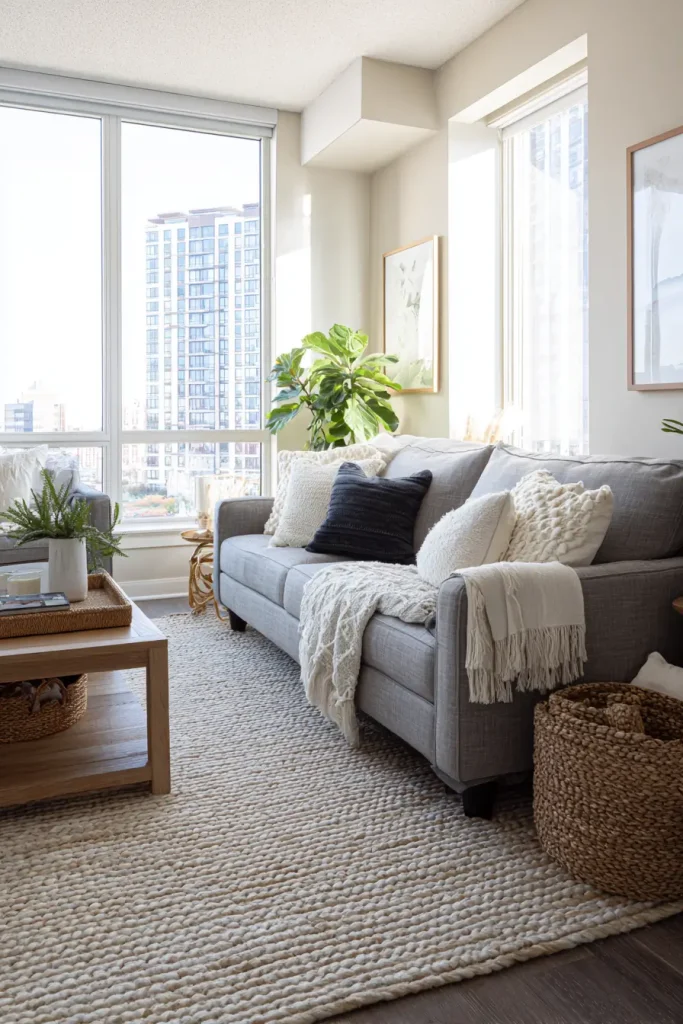
Most apartment living rooms have one thing in common. The furniture floats.
When there’s no rug, chairs and sofas look like they’ve been scattered around the room with no plan. A rug fixes this. It anchors the furniture and creates a clear visual center.
Sizing matters. For a standard living room, an 8×10 rug is usually the right call. All four legs of your sofa should either sit fully on the rug or at least have the front two legs on it. A rug that’s too small looks like a postage stamp. Err on the side of bigger.
Use a non-slip rug pad underneath. It grips the floor without adhesive and keeps the rug from sliding. When you move out, lift the rug, roll up the pad, and leave zero trace on the floor.
Washable rugs from brands like Ruggable are worth considering if you have pets, kids, or just like being able to clean things properly. The cover zips off and goes in your washing machine.
Layering two rugs is a strong look right now. A large neutral jute or sisal base with a smaller patterned rug on top adds texture and depth without much cost.
Bottom line: A right-sized rug is one purchase that makes your whole living room feel intentional.
4. Hang Art and Photos Without Making Holes

A blank wall is the most common sign of a renter who gave up.
You don’t have to give up. You just need the right hanging tools.
Command Picture Hanging Strips are the standard solution. They use two interlocking adhesive strips that hold frames securely and release cleanly by pulling a tab straight down. The large strips hold up to 16 pounds per pair. That covers most framed art, mirrors, and shelves.
Before you hang anything, check the weight. Write it on a sticky note on the back of the frame. Match it to the weight rating on the Command package. This is where people go wrong. They assume any strip will hold any frame. It won’t.
For a gallery wall, plan the layout on the floor first. Arrange your frames the way you want them to look on the wall. Take a photo. Then transfer the layout to the wall using the strips.
Canvas prints work well for large wall areas. They’re lighter than framed pieces and easier to hang with adhesive solutions. Fabric wall hangings and tapestries can be hung with a single tension rod mounted on two adhesive hooks.
Bottom line: Plan your layout on the floor, check your weight limits, and use the pull-down tab to remove strips cleanly every time.
5. Hang Curtains That Make Your Ceiling Look Taller

Here’s a trick designers use in every small room. Hang your curtains as high as possible and as wide as possible.
Most renters hang curtains just above the window frame. This makes the window look small and the ceiling look low. Instead, mount your curtain rod two to four inches below the ceiling. Let the curtains fall all the way to the floor. The vertical line draws your eye up. The ceiling looks higher. The room looks bigger.
You don’t need to drill for this. Adhesive curtain rod hooks hold tension rods on smooth painted walls. For heavier curtains, look for the 3M Command Adjustable Roller Hook, which holds up to 5 pounds. Tension rods work well inside window frames for lightweight sheers.
Go wider too. Extend your curtain rod 8 to 12 inches past each side of the window frame. This lets more light in when the curtains are open and makes the window look bigger.
Layer sheers underneath with a heavier curtain panel on top. The sheers let in soft light during the day. The heavier panels block light at night. Both hang on the same rod.
Bottom line: High, wide curtains are one of the cheapest ways to make a small living room look bigger.
6. Add a Freestanding Bookshelf for Storage and Style

You do not need to anchor a bookshelf to the wall to use it.
Most freestanding shelves are stable on their own, especially if you place them against a wall and load the bottom shelves first. If you want extra safety, anti-tip furniture straps anchor to your baseboard with screws. Baseboards are usually not covered in security deposit clauses because small screw holes in a baseboard are considered normal wear and tear. Check your lease to be sure.
Beyond storage, a bookshelf is one of the best styling surfaces in a room. The rule is simple. Fill one third with books, one third with decor objects, and leave one third empty. Empty space is not wasted space. It makes everything around it look more intentional.
Use the top of the shelf for tall plants or art. Use the middle shelves for books and objects you love. Use the bottom shelf for baskets that hide cables, extra blankets, and things you use regularly.
IKEA’s KALLAX and BILLY shelves are the most popular choices because they’re affordable and available in multiple sizes. If your budget is higher, CB2 and West Elm both make shelves that look more custom.
Bottom line: A bookshelf is furniture, storage, and decor rolled into one. Style it with the thirds rule and it becomes a real feature in the room.
7. Use Mirrors to Make the Room Feel Twice as Big

A large mirror does two things. It bounces light around the room. And it makes the space feel bigger than it is.
The easiest way to use a mirror as a renter is to lean it. A large floor mirror leaned against a wall needs no hanging hardware at all. Place it opposite your biggest window and it will double the light in the room.
If you want to hang a smaller mirror, Command strips handle most mirrors under 20 pounds. Check the weight first.
Mirror groupings work well on a console table or sideboard. Three or five small mirrors of different shapes arranged together create a collected, intentional look. You’re not hanging anything. You’re just styling a surface.
Mirrored side tables, decorative trays, and coffee table styling pieces add the same light-bouncing effect on a smaller scale.
One safety note. If you lean a large floor mirror, secure the bottom with a small rubber furniture gripper so it can’t slide. If you have kids or pets, consider anchoring it to the wall baseboard with a furniture safety strap.
Bottom line: One leaning floor mirror opposite a window is free styling that makes any living room feel more open and bright.
8. Replace Hardware on Your Own Furniture

This one is small. But the effect is bigger than you’d expect.
You cannot change the hardware on your landlord’s cabinets or fixtures. But you can absolutely change the hardware on your own furniture.
Take the drawer pulls off a basic IKEA dresser or sideboard. Put on new brass pulls or matte black knobs. That one swap can make a $150 piece of furniture look like it cost $500.
Brass, matte black, and handmade ceramic pulls are the strongest looks right now. Etsy has hundreds of small makers selling handmade hardware that you won’t find in any big box store. D. Lawless Hardware carries a wide range at good prices.
The cost is low. Most pulls run $3 to $15 each. A dresser with six drawers might cost you $30 to $60 total to upgrade. Keep the original hardware in a small bag. Swap it back before you move.
This works on coffee tables with legs, bookshelves with doors, sideboards, media consoles, anything you own that has removable hardware.
Bottom line: New hardware on your own furniture is the cheapest high-impact upgrade in this entire list.
9. Layer Textiles to Add Warmth Fast

Nothing makes a room feel cold faster than a bare sofa and an empty floor.
Textiles fix this. Throw blankets, cushion covers, and a good rug can change the temperature of a room visually, even if the thermostat says nothing changed.
For your sofa, use what designers call the sofa formula. Two large square pillows at the back. Two medium pillows in front of those. One lumbar pillow across the front center. That’s five pillows total. It looks full and styled without being chaotic.
Buy one good pillow insert and multiple covers. Covers swap out easily with velcro or zipper closures. Change them by season or whenever you want a fresh look. This saves a lot of money compared to buying complete pillows every time.
For texture, mix fabrics. Velvet next to linen next to a chunky knit works because the textures contrast each other. Stick to three colors maximum across all your pillows and throws. More than three and the sofa starts to look cluttered.
Add a large throw blanket draped over one arm of the sofa. It adds softness and gives you something to actually grab when you’re cold.
Bottom line: Five pillows on a sofa and one throw blanket costs less than $100 and makes any living room feel put-together.
10. Bring in Plants Without Hanging a Single Hook

Plants are one of the fastest, cheapest ways to add life to a room.
You don’t need to hang anything. Floor plants do all the work.
A large fiddle leaf fig, bird of paradise, or monstera placed in the corner of a living room adds height, color, and texture. These plants grow to four to six feet tall. They fill empty corners that no piece of furniture could fill as naturally.
For smaller spaces, use a tiered plant stand. Stack three to five small plants at different heights. This creates a visual moment without taking up much floor space.
If your apartment doesn’t get much natural light, stick with pothos, snake plants, or ZZ plants. These three handle low light and irregular watering better than almost any other houseplant. They are genuinely hard to kill.
Faux plants have improved a lot in the last few years. If you travel often or know you won’t keep up with watering, a high-quality faux plant from Afloral or IKEA is a completely reasonable choice. From a normal distance, good faux plants are indistinguishable from real ones.
Bottom line: One large floor plant in an empty corner transforms a room more than any piece of decor at the same price.
11. Anchor the Room With a Coffee Table or Ottoman

A living room without a coffee table or ottoman feels unfinished.
The coffee table is the center of the seating area. It tells your eye where the “room” is. Without it, your sofa and chairs look like they’re drifting.
For small living rooms, nesting tables are a smart choice. They stack together when not in use and pull apart when you need more surface space. They take up less room than a standard coffee table and are easy to move.
A storage ottoman is another strong option. It works as a footrest, extra seating, and hidden storage all at once. Stuff blankets, remotes, and charging cables inside. Style the top with a tray so it functions like a coffee table surface.
When you style any coffee table surface, use the rule of three plus one. A small tray. A stack of two or three books. One candle or small plant. One object that means something to you. That’s it. Keep it simple.
Rattan coffee tables and boucle ottomans are both strong looks in 2026. But honestly, a well-styled thrift store find works just as well.
Bottom line: A coffee table or ottoman anchors your seating area and gives the room a visual center. Style the surface simply and it becomes a feature.
12. Create a TV Area That Doesn’t Look Like an Afterthought

Most renters set up a TV on a cheap stand and leave the rest to chance. The result is a black screen staring at you from across a blank wall.
You can do better without touching the wall.
Start with the stand itself. A low sideboard or floor-standing media console gives your TV a proper base. It also gives you storage for remotes, game controllers, cables, and anything else that tends to pile up.
The biggest issue with most TV setups is cords. A single cable management box sits on the floor behind your console and hides the power strip and all loose cables inside one clean box. Cord covers can be attached with peel-and-stick backing along the baseboard to hide any remaining wires. Most are paintable and can match your wall color.
Style around the TV to reduce its visual dominance. Place a plant on one side. Add a framed piece of art on the other. Put objects of different heights on your console. When the TV is off, it should look like a styled vignette, not just a screen on a stand.
Bottom line: A proper media console, hidden cables, and styled objects around the TV turns your screen into a focal point instead of an eyesore.
13. Use Room Dividers to Give Your Space Structure

This matters most in studio apartments and open-plan living rooms.
When your living space, sleeping area, and dining space are all one room, it can feel chaotic. Nothing tells you where one zone ends and another begins.
Room dividers fix this without touching a wall.
A freestanding folding screen placed behind your sofa creates a clear boundary between the living area and the rest of the room. Rattan and bamboo screens are widely available right now and bring warmth and texture to a space.
A bookshelf can also act as a room divider. Place an open-backed KALLAX or similar shelf perpendicular to your sofa. It separates spaces while still letting light through. Both sides of the shelf can be styled for the zone it faces.
Curtain panels on a ceiling-mounted tension rod work well for separating a sleeping area from a living area in a studio. The curtains slide open during the day and close at night. The rod uses adhesive ceiling hooks with no drilling.
Bottom line: A divider gives each zone of your home a sense of purpose. It makes a one-room apartment feel like it has multiple spaces.
14. Upgrade Your Window Treatments for Instant Polish

The blinds that came with your apartment are probably ugly.
Most rental blinds are cheap plastic horizontals that bend, break, and let in light from every angle. You can improve this without touching what’s already installed.
The cleanest renter-safe upgrade is an inside-mount shade. This fits inside your window frame and attaches with small screws into the window frame itself, not the wall. Window frame holes are usually not considered lease damage. Check your lease to confirm.
Woven wood shades, bamboo roll-ups, and Roman shades all come in inside-mount versions. Sites like Blinds.com and SelectBlinds let you cut to custom sizes for around $20 to $80 per window.
If even that feels like too much, use a tension rod inside the window frame to hang a lightweight curtain panel. No adhesive. No screws. Comes down in seconds.
Privacy window film is another strong option for ground-floor apartments. Peel-and-stick film creates a frosted or patterned glass effect that blocks views from outside while still letting light in. It peels off cleanly without residue when you leave.
Bottom line: Better window treatments change the feel of your entire living room. Inside-mount shades are the easiest and most polished renter option.
15. Decorate Vertically to Use the Space You’re Ignoring

Most renters decorate horizontally. Everything sits at eye level or below.
The space above your head is completely empty. And that’s a missed opportunity.
Vertical elements make ceilings feel higher and rooms feel bigger. This is a well-known rule in interior design, and it works in any apartment.
The simplest vertical move is curtains. Hang them as close to the ceiling as possible. Let them fall to the floor. That long vertical line draws your eye upward.
Tall bookshelves are the next best move. A bookcase that reaches six or seven feet tall does more for a small room than three short bookcases lined up along the floor.
Tall floor plants work the same way. A seven-foot fiddle leaf fig in the corner adds vertical presence that no piece of furniture can replicate.
When you arrange objects on shelves, work in varying heights. Tall vase next to short stack of books next to medium plant. The up-and-down movement keeps your eye moving and makes the shelf interesting.
Bottom line: Look up. You have three to four feet of unused visual space above your furniture. Use it and your room will instantly feel bigger.
16. Replace Your Sofa Throw Pillows With a Seasonal System

This one costs less than $50 and keeps your room feeling fresh year round.
Buy good quality pillow inserts once. Then buy multiple sets of covers.
Spring and summer: light linen or cotton covers in soft greens, blues, and warm whites. Fall and winter: chunky knit or velvet covers in terracotta, rust, and deep olive. Swap the covers, not the inserts. Store the off-season covers in a flat bag under your sofa or in a closet.
This system costs less than buying complete new pillows every season. A set of five pillow covers runs $30 to $60 on Amazon, Etsy, or Society6. The inserts last for years.
The same logic applies to throw blankets. A lightweight cotton throw sits on your sofa in summer. A heavy knit blanket takes its place in winter. That one swap changes the mood of your room more than most people expect.
Bottom line: Buy inserts once, buy covers often. A seasonal pillow swap is the cheapest way to keep a rented living room feeling current.
17. Use Scent to Make Your Space Feel Like Home

This is the most overlooked idea on this list.
Scent affects how a space feels before you even consciously notice it. A room that smells like fresh linen, warm wood, or citrus feels more like home than one that doesn’t smell like anything.
Candles are the most popular option because they also function as decor. Group three candles of different heights on a tray. Put them on your coffee table or console. When they’re lit, they add warmth to the room. When they’re not lit, they still add visual texture.
Reed diffusers are better for consistent all-day scent. They work passively and don’t require you to light anything. A good reed diffuser in a 100 to 150 square foot room lasts six to eight weeks.
Wax melts and plug-in diffusers are the safest options if your lease prohibits open flames, which some do.
Match your scent to your space. Earthy and woody scents work with warm, neutral color palettes. Fresh and citrus scents work with lighter, more minimal spaces.
Bottom line: A candle and a reed diffuser together cost under $40 and change how your apartment feels the moment you walk in the door.
18. Add Color to Your Room Without Painting a Single Wall

Your landlord owns the paint color. You don’t have to love it.
Most rental apartments have the same walls. Off-white. Warm beige. Sometimes a builder gray. These colors aren’t bad. They’re just neutral. And you can work with neutral.
The trick is to build a color palette around what’s already there. Pick two or three colors you want to live with. Bring them in through your rug, curtains, pillows, and art. The walls become a background, not the main event.
Use the 60-30-10 rule. 60% of your room stays neutral (walls, sofa, large rug). 30% is your secondary color (curtains, accent chair, bookshelf objects). 10% is your accent color (throw pillows, one piece of art, a plant pot).
If your walls are an ugly color you can’t change, a large piece of art or a removable wallpaper accent wall covers a significant portion of it. Your eye goes to what’s colorful and interesting, not what’s behind it.
Earthy tones are the strongest trend in rental spaces right now. Terracotta, warm olive, dusty rose, and aged wood tones work well together and pair naturally with beige or white walls.
Bottom line: Color lives in your furniture and textiles, not your walls. Build a clear palette and your apartment will feel intentional even if the paint never changes.
19. Style Every Surface With a Simple Formula
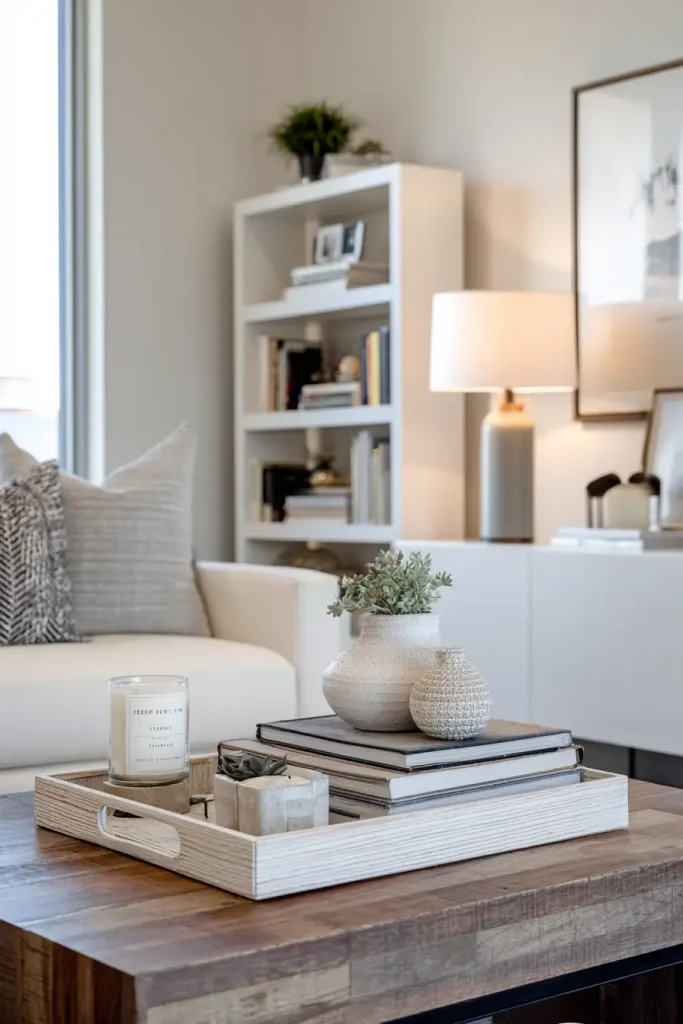
Decorating isn’t random. There’s a pattern behind rooms that look good.
Every styled surface in a good-looking home follows a version of the same formula. Vary the height. Mix textures. Leave some empty space.
For a bookshelf: books stacked vertically next to books stacked horizontally, a small plant, one framed photo, one object that’s interesting. Space between groups so nothing looks crammed.
For a coffee table: a tray to contain the surface. Two or three books stacked. One candle or small plant. One personal object. That’s it.
For a console or sideboard: one tall item on one side (lamp or tall plant). One medium item in the middle (vase, stack of books). One small item on the other side (candle, small bowl). Empty space on either end.
This formula works on every surface in your home. It’s not about having expensive things. It’s about arrangement.
The final thing most renters miss is editing. Styled surfaces look good because things were removed, not added. Take one thing off any surface you think looks cluttered. It will almost always look better.
Bottom line: Good styling is mostly editing. Use the vary-heights-mix-textures-leave-space formula on every surface and your rented living room will look designed on purpose.
Your Living Room Can Feel Like Home This Weekend
Renting doesn’t mean settling for a space that feels generic.
You just went through 19 ideas that require no drilling, no painting, and no landlord conversation. Every single one is removable. Most are affordable. All of them work in a real apartment in 2026.
You don’t need to do all 19. Pick two or three that solve your biggest frustrations right now. Start with a rug, some curtains hung high, and a floor lamp. Those three changes alone will make your living room feel like a different room.
Your security deposit stays safe. Your landlord stays happy. And your living room finally looks like somewhere you actually want to spend time.
These living room ideas for renters prove one thing clearly. Temporary doesn’t have to mean boring.

- 18 Small Bathroom Ideas for Renters With No Damage Solutions - March 13, 2026
- 19 Mudroom Ideas That Are So Organized You’ll Actually Want to Come Home - March 13, 2026
- 19 Small Hallway Ideas That Make a Big First Impression - March 13, 2026

