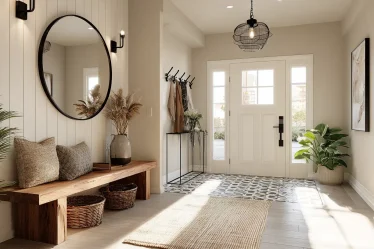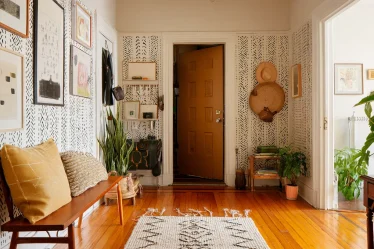
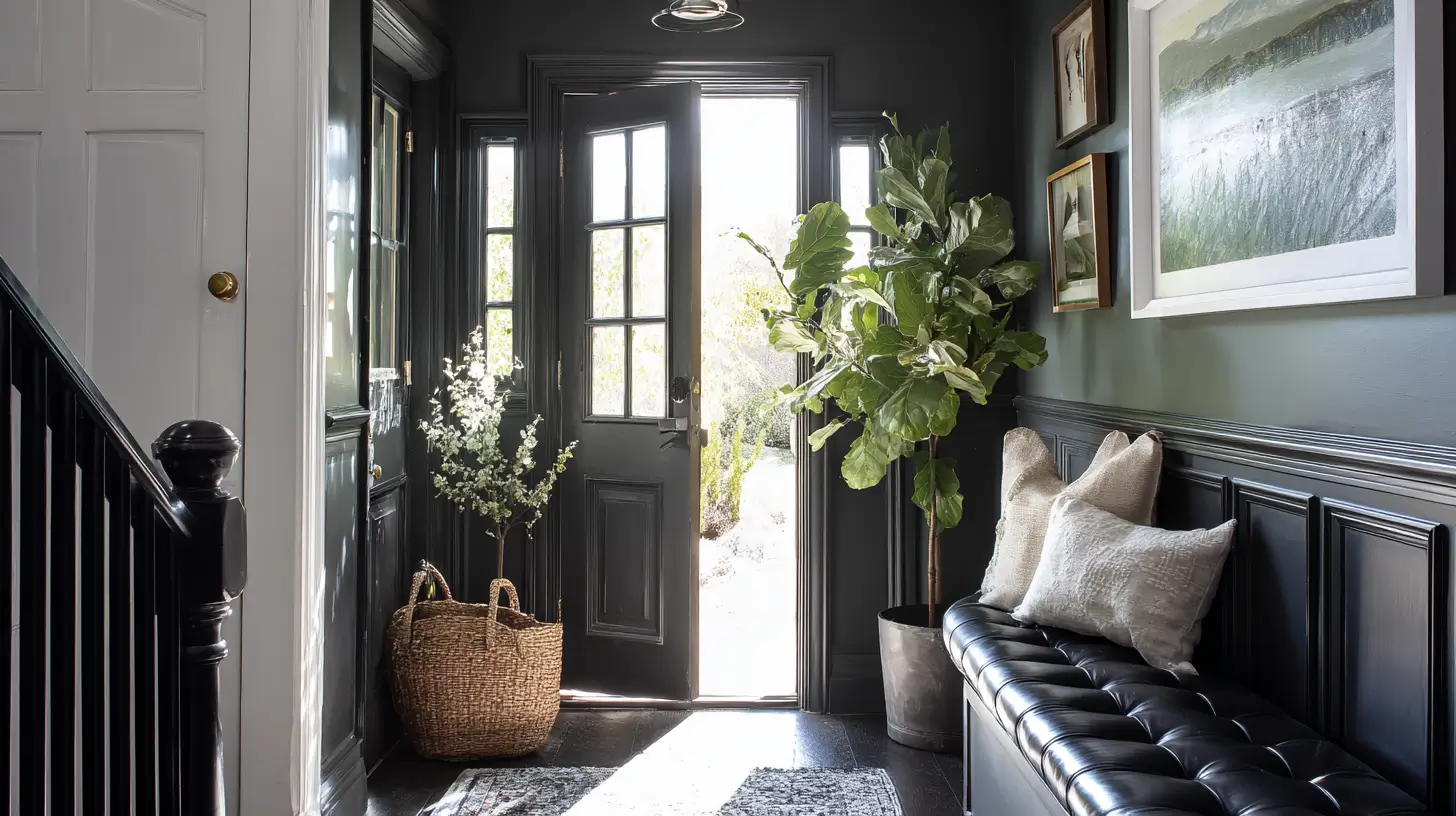
Your Entryway Is Stressing You Out. Here’s How to Fix It.
You walk through the front door after a long day. Shoes are everywhere. Coats are piled on one hook. Keys are missing again. And the space looks like nobody planned it.
That’s the small entryway problem. Not that it’s small. But that it feels like an afterthought.
Here’s the truth: most tiny entryways fail for one reason. People either ignore them completely or shove too much furniture in and hope for the best. Neither works.
But a small entryway does not need a renovation. It does not need a big budget. It needs a plan.
In this guide, you’ll get 19 specific ideas that make a tiny entryway look like someone actually thought about it. Some cost under $20. Some take one afternoon. All of them work in real homes, not just magazine photos.
Pick two or three that match your space. Start there.
Why Small Entryways Look Bad (And What to Fix First)
Before you buy anything, you need to know what’s actually going wrong.
Most small entryways fail for three reasons. First, the furniture is too big for the space. A full coat rack that works in a wide hallway looks like a wall in a narrow one. Second, there’s no system. Stuff lands wherever it lands. Third, there’s no visual anchor. Nothing tells your eye where to look, so the whole space feels chaotic.
Every entryway, no matter how small, needs three things:
A landing zone. Somewhere specific for keys, bags, and shoes to go. A visual anchor. One thing that makes the space feel designed. A mirror, a piece of art, or a bold color. A storage solution. Something that hides or organizes the everyday stuff.
You don’t need all 19 ideas on this list. You need those three things handled. Everything else is extra.
The average new U.S. home entryway is under 20 square feet. That’s smaller than most bathrooms. So stop comparing your space to the homes you see on Pinterest. Work with what you have.
Quick tip: Before you shop, measure your entryway. Write down the width, depth, and ceiling height. You’ll use those numbers more than once.
1. Go Vertical and Reclaim Space You Forgot You Had
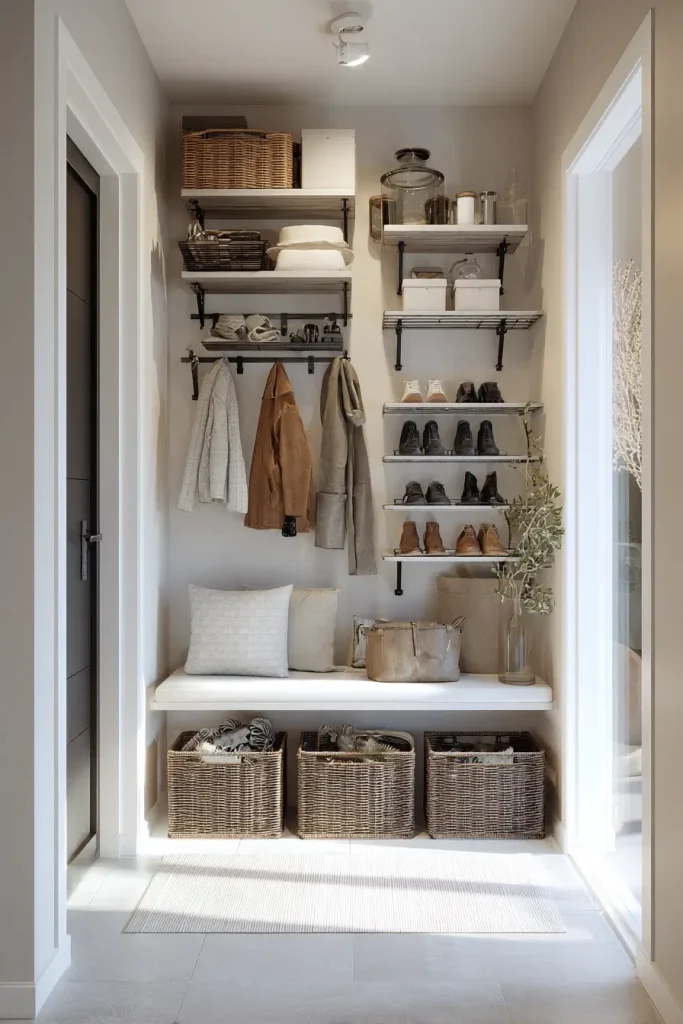
Most people think about floor space. Designers think about wall space.
In a small entryway, the floor is almost always limited. But the wall? That goes all the way up to the ceiling. And most people use about 18 inches of it.
Going vertical means stacking your storage up the wall instead of spreading it across the floor. Hooks at the top. A shelf in the middle. A basket or bench at the bottom. That single wall can now hold coats, bags, shoes, and a few decorative items without taking up any floor space at all.
Wall mounted coat racks beat freestanding ones every time in tight spaces. A freestanding rack has feet that eat floor space and a top that looks messy fast. A wall mounted option disappears into the wall and keeps the floor clear.
A great real world example: a 24 inch wide apartment entryway using a floor to ceiling IKEA HEMNES shoe cabinet plus two floating shelves above it. Everything has a place. The floor stays open. The space feels twice as big.
Designer rule: vertical storage can give you three times more usable space per square foot compared to floor only storage. That’s not a small upgrade. That’s a completely different entryway.
Start here if your entryway is under 3 feet wide. Going vertical is the single best move you can make.
2. Add a Mirror and Watch the Space Open Up
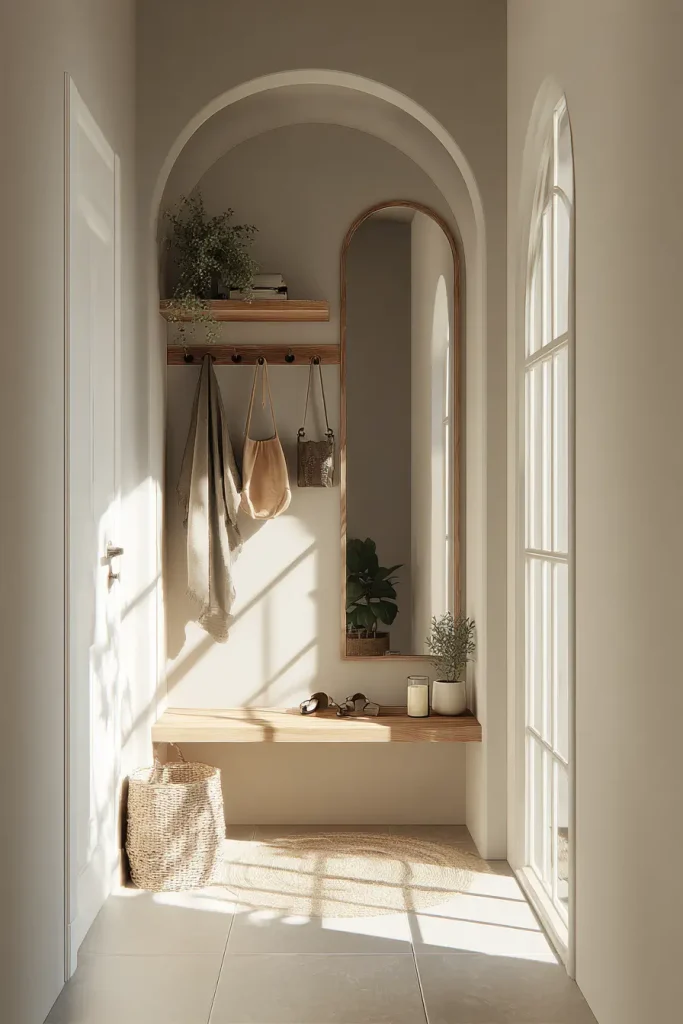
A mirror is the highest return item you can put in a small entryway. Full stop.
Here’s why it works. A mirror reflects light and creates the illusion of depth. Your eye sees the reflection and reads it as more space. A well placed mirror in a 4 foot wide entryway can make the space feel noticeably wider without changing a single thing about the actual room.
Placement matters more than size. Put the mirror opposite your light source or opposite the front door. That position gives you the most reflection and the most visual depth.
The shapes that work best in narrow spaces are tall vertical mirrors, arched mirrors, and leaner mirrors. Wide horizontal mirrors cut a small space in half visually. Avoid those.
You can also make a mirror functional. Add a small shelf above it for a plant or candle. Add hooks below it for bags or keys. Now it’s doing three jobs at once.
One thing to skip: multiple small mirrors arranged in a cluster. That approach looks busy and actually makes a small space feel more cramped, not less.
A simple arched mirror with a narrow wood shelf beneath it is one of the most popular small entryway combinations right now. It looks intentional. It’s practical. And it works in almost any style of home.
3. Pick a Console Table That Actually Fits
Most entryway tables are too deep. They stick out into the walkway and make a narrow space feel like an obstacle course.
The rule is simple: entryway furniture should be no deeper than 12 to 14 inches. Anything deeper than that starts working against you.
A console table, a floating shelf, and a narrow credenza all serve similar purposes. But they work differently depending on your space. A console table with legs feels lighter and less heavy than a solid cabinet. If your space feels boxed in, legs are the better choice. A floating shelf is the most minimal option and works best in the narrowest spaces. A narrow credenza gives you hidden storage but needs at least 30 inches of wall width to not look squeezed.
What goes on the table matters too. Use what designers call the three item rule: one functional piece, one decorative piece, and one bit of greenery. A small tray for keys counts as functional. A candle counts as decorative. A small plant or cutting in a vase counts as greenery. That combination looks styled without looking cluttered.
Budget option: IKEA LACK shelf at 11 inches deep. Mid range option: West Elm’s Narrow Entry Table at 12 inches deep. Both work. The LACK is about $15. The West Elm piece runs closer to $200. Neither is wrong depending on your budget.
4. Use a Bench to Solve the Shoe Problem and the Seating Problem at Once
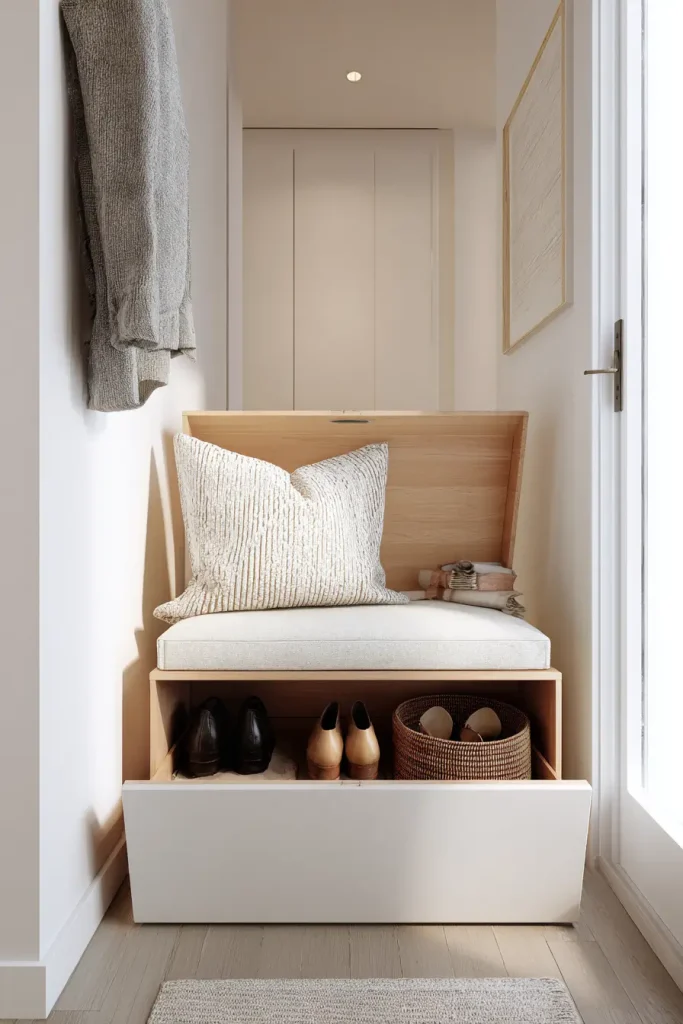
If you have 18 or more inches of floor space, a bench is the smartest single piece of furniture you can add.
Here’s why. A bench gives you somewhere to sit while putting on shoes. That sounds small, but it matters every single morning. It also creates a visual anchor at floor level, which makes the space feel more like a real room.
A storage bench does double duty. The seat lifts up and you get a compartment that can hold 4 to 6 pairs of shoes. That’s your whole shoe pile, hidden, in one clean piece of furniture.
If you don’t have room for a floor bench, look at wall mounted fold down benches. These mount flat against the wall and fold out when you need them. They take up almost no space when folded up. Some versions start under $80. They’re one of the best options for entryways under 5 feet wide.
To make a bench look styled and not like a waiting room, add a cushion with some texture, a small basket underneath, and one throw pillow if the space allows. That’s it. Don’t overcomplicate it.
The IKEA KALLAX bench hack is worth knowing about. Two KALLAX units placed side by side with a plywood seat and a cushion on top creates a built in looking bench with cubby storage underneath. Total cost is usually between $150 and $300 depending on materials.
5. Fix the Lighting and the Space Will Feel Bigger Instantly
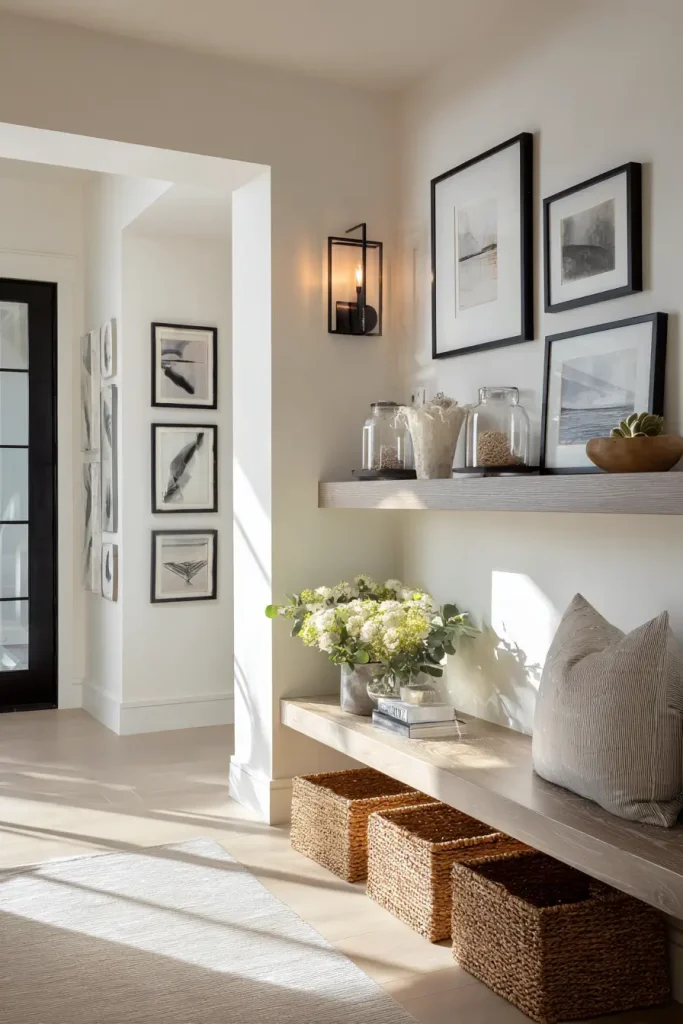
Dark entryways feel small. Bright entryways feel open. This is one of the easiest fixes on this list.
If your entryway gets little or no natural light, artificial lighting does the work. You want two types if possible: overhead light for general brightness, and accent lighting to add warmth and dimension.
The good news for renters: you don’t need to wire anything. Plug in wall sconces are widely available and require zero installation. You plug them in, hang the cord behind furniture or along the wall, and you have proper wall lighting. Brands like CB2 and West Elm sell plug in sconces. So does Amazon. You can find good options for $30 to $120.
Bulb color matters. Warm white bulbs in the 2700K to 3000K range create a welcoming, cozy feel. Cool white or daylight bulbs (5000K and above) feel harsh in an entryway. Stick with warm.
One underrated trick: battery powered LED puck lights mounted under floating shelves. They add a soft glow at mid height, which makes the space feel layered and intentional. A set of three costs about $15 to $25.
Research in environmental psychology consistently shows that people rate brighter spaces as larger. That’s not an opinion. It’s a documented effect. Better lighting is one of the cheapest ways to make your entryway feel bigger.
6. Solve the Shoe Pile Once and for All
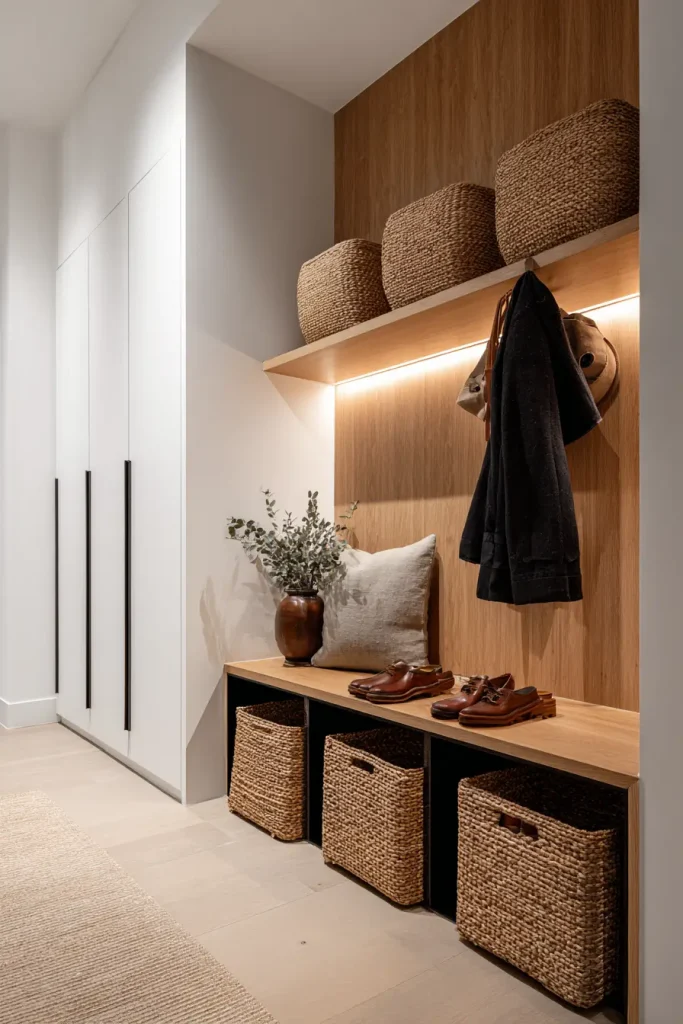
The shoe pile is the number one entryway problem in most homes. And most people solve it wrong.
They buy a big open shoe rack and put it by the door. Now instead of a pile, you have a displayed collection of shoes. It still looks messy. It just looks more organized mess.
The better approach is hidden shoe storage. A slim shoe cabinet with doors keeps everything out of sight. The IKEA HEMNES shoe cabinet is 13 inches deep, 35 inches wide, and holds up to 8 pairs of shoes. It looks like a piece of furniture, not a shoe closet.
If a full cabinet doesn’t fit, use under bench storage. Rattan baskets slid under a bench hold 2 to 4 pairs each, look decorative, and are easy to pull out. They blend into the decor instead of sticking out.
The habit matters as much as the storage. Keep only current season shoes at the door. Everything else goes in a closet or bedroom. That one rule keeps the entryway from overflowing no matter what storage you use.
Over the door organizers work for apartments where every inch counts. They hang on the back of the front door and hold several pairs without using any wall or floor space.
Quick tip: If you live with multiple people, give each person their own basket or cubby. Named storage stops the pile from forming because everyone knows exactly where their stuff goes.
7. Paint the Entryway a Distinct Color to Make It Feel Like a Real Room
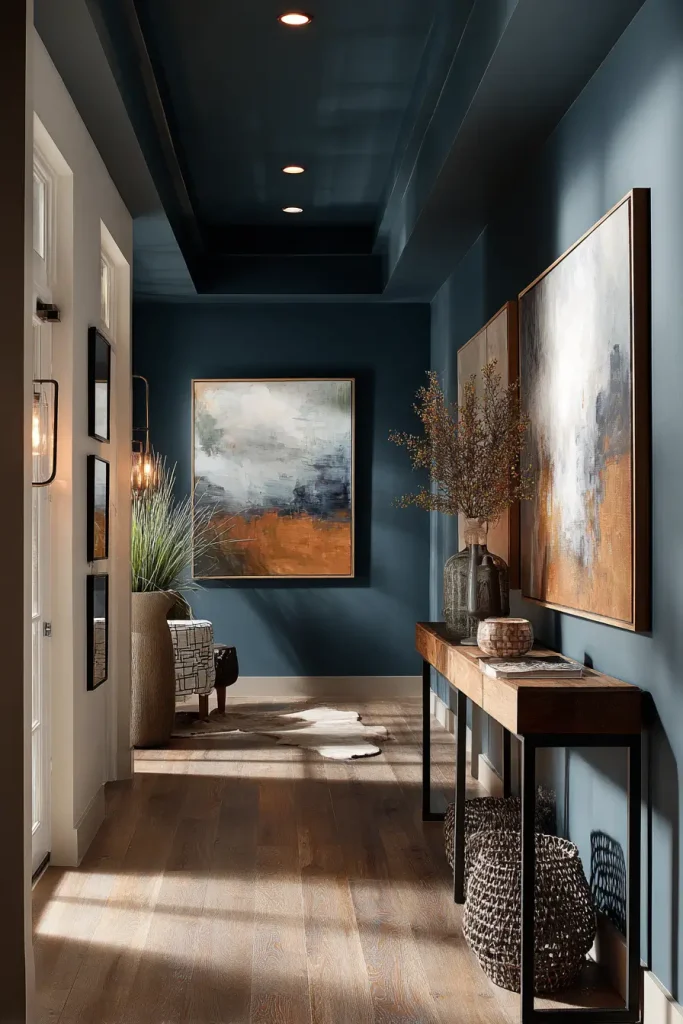
Paint is one of the cheapest design upgrades you can make. And the entryway is the best place in your home to be bold with color.
Here’s the thinking. When a small hallway is the same color as every other room, it disappears. It reads as a transition, not a destination. Give it its own color and suddenly it feels intentional. Like someone decided this space matters.
Dark colors work surprisingly well in small entryways. Deep navy, forest green, warm terracotta, charcoal. These are consistently cited in 2025 and 2026 design forecasts as strong entryway choices. They create a cocooning effect that reads as cozy instead of cramped when done right.
Painting the ceiling the same color as the walls is a technique designers use to make ceilings feel higher. When the walls and ceiling are all one shade, your eye moves upward instead of stopping at the crown molding.
If you rent or want something less permanent, test a single accent wall first. One dark wall behind your console table or bench anchors the space and gives you the visual contrast you’re looking for without committing to the full room.
Benjamin Moore’s 2025 Color of the Year (Cinnamon Slate) and Sherwin Williams’ 2026 palette both lean into warm, rich tones that translate well to small entryways. Look those up for specific shade inspiration.
8. Put Down a Rug and Watch the Space Come Together
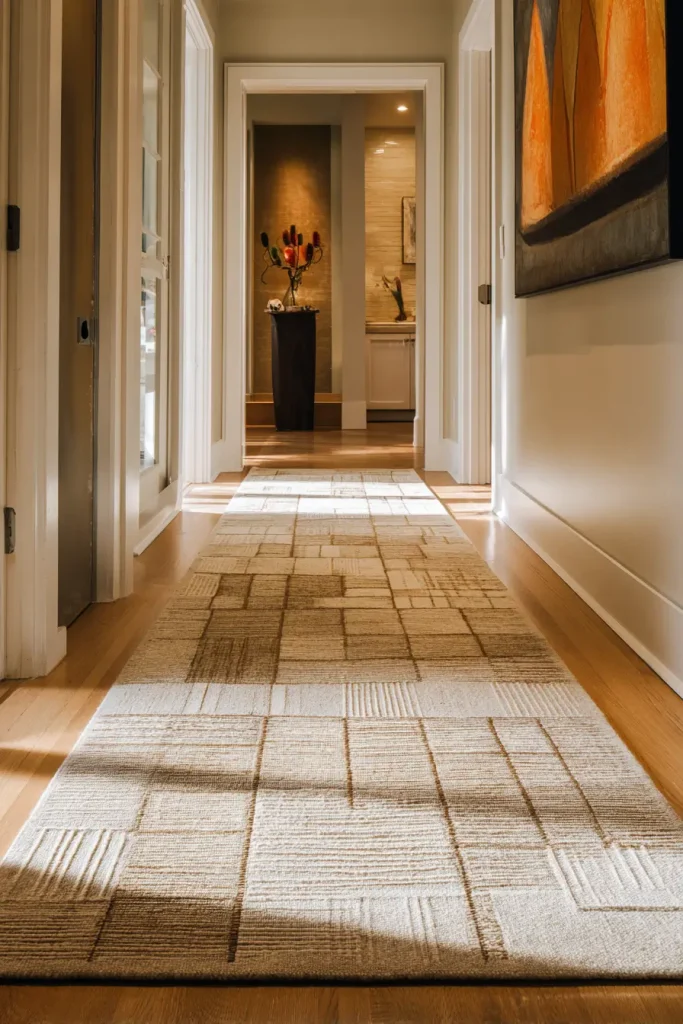
A rug is one of those things that seems optional until you see the difference it makes. Then it feels essential.
In a small entryway, a rug does two things. It defines the space as its own zone, separate from the rest of the room. And it adds texture, color, and warmth that make the space feel finished.
The right size for most small entryways is a 2×3 foot rug or a 3×5 foot rug. Go bigger if your space allows. Leave 4 to 6 inches of floor visible on all sides so the rug doesn’t look like it’s trying to cover everything.
Flat weave rugs are the practical choice for entryways. Kilim style and dhurrie rugs lay flat, don’t curl at the edges, and handle foot traffic better than plush pile rugs. They’re also easier to clean, which matters because the entryway is one of the dirtiest spots in your home.
Pattern can create the illusion of more space. A horizontal stripe makes a narrow hallway feel wider. A vertical stripe makes a short entryway feel longer. A bold geometric adds energy and visual interest without adding clutter.
Skip very light colored rugs near the front door. They show dirt fast and need constant cleaning. Go for medium tones or patterns that hide wear.
9. Replace Basic Hooks With Statement Hooks That Look Designed
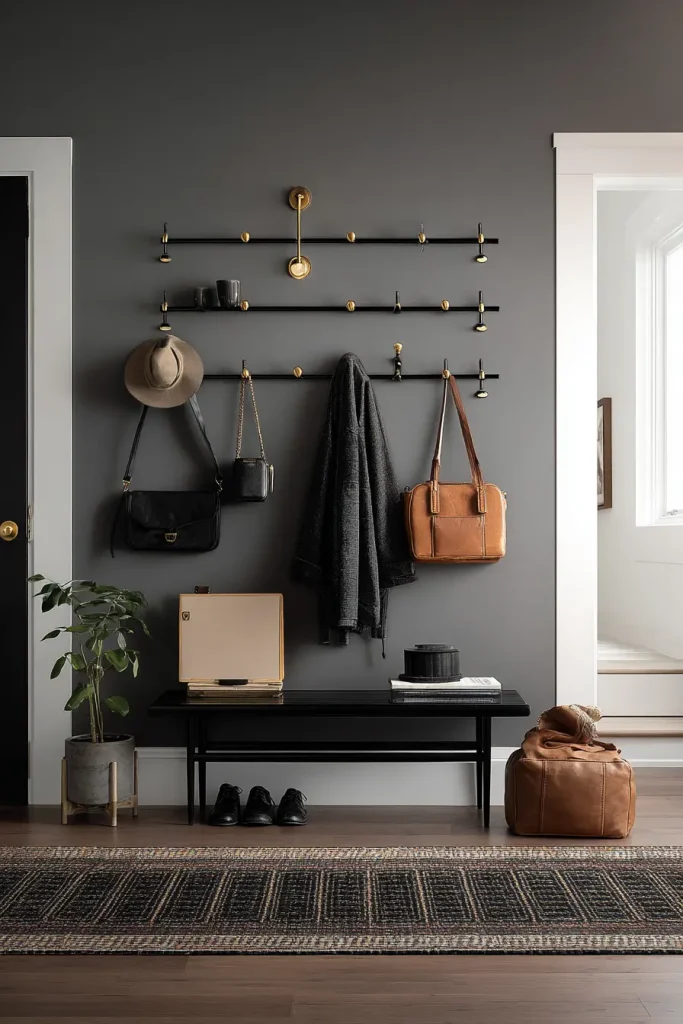
Most homes have one of two hook situations. Either there are no hooks at all, or there are cheap plastic over the door hooks that look temporary even years later.
Neither is the move.
Statement hooks are one of the easiest and most affordable upgrades you can make. Swapping out basic hooks for ones made of brass, matte black, or ceramic takes about 10 minutes and costs anywhere from $15 to $60 for a set. The difference in how the wall looks is immediate.
Hook rail systems look cleaner than individual hooks and are easier to install. You hang one rail and the hooks are evenly spaced automatically. A 36 inch matte black hook rail with 5 hooks installed at 60 inches from the floor can hold coats, bags, and dog leashes without looking cluttered.
Shaker style peg rails are having a major moment right now. Pinterest data from 2024 shows that searches for shaker peg rails are up 67% year over year. They work in almost every design style: farmhouse, modern, transitional, and minimal.
If you have kids, install hooks at two heights. Adult hooks at 60 to 66 inches. Kid hooks at 42 to 48 inches. Everyone can reach their own stuff and nothing piles up on the floor.
Target’s Studio McGee line, CB2, and Rejuvenation all carry good hook options at different price points.
10. Add a Floating Shelf for Storage and a Place to Display Something You Actually Like
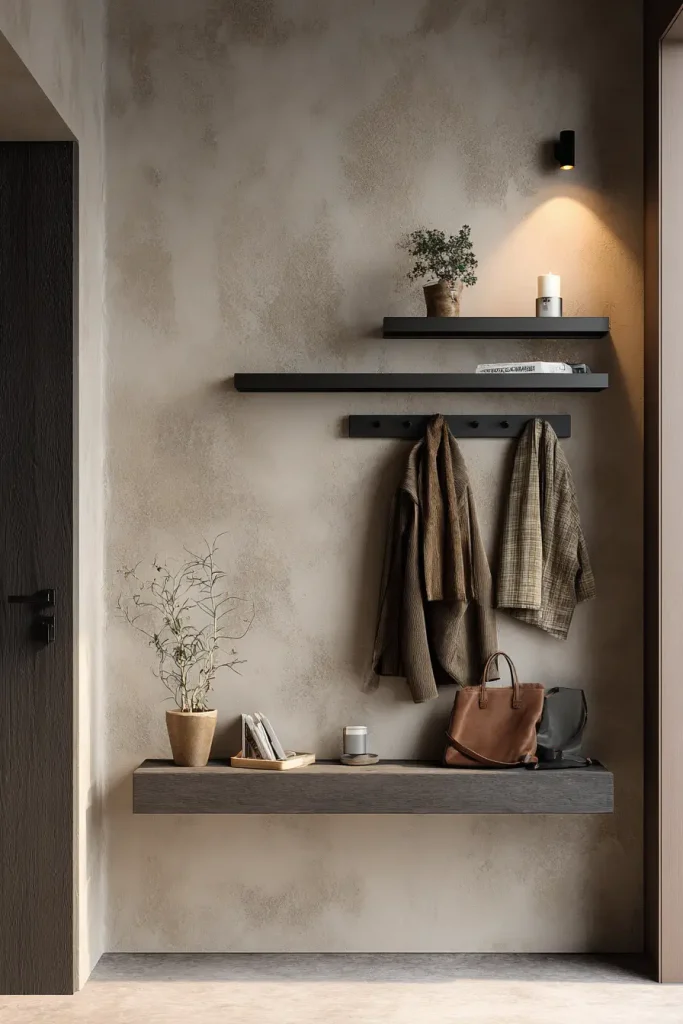
A single floating shelf can transform a bare entryway wall into a styled space. That’s not an exaggeration.
The key is putting the right things on it. An entryway shelf should hold a small tray for keys, one plant or small greenery, a candle, and maybe one personal object. That’s it. If you put more than that, it starts to look like a cluttered surface, not a styled shelf.
Keep shelf depth at 8 to 10 inches. That’s enough to hold everything you need and doesn’t stick far enough out to block movement in a narrow hallway.
When you install, find wall studs for secure mounting. If you can’t hit a stud, use proper drywall anchors rated for the weight you’re planning to put on the shelf. Floating shelves that pull away from the wall are a safety hazard and look terrible.
Interior stylists use the rule of leaving 30 to 40 percent of shelf space empty. That open space is what makes a shelf look styled instead of stuffed. It sounds counterintuitive but it works.
Two staggered shelves at different heights work better in a small entryway than one long shelf. The visual variation makes the wall more interesting. Put hooks beneath the lower shelf and now your shelf setup is also your coat storage.
IKEA BERGSHULT and LACK shelves are consistently among the most searched shelf options for entryways. Both are affordable, minimal, and easy to install.
11. Use Wallpaper or Wall Panels to Make a Big Statement in a Small Space
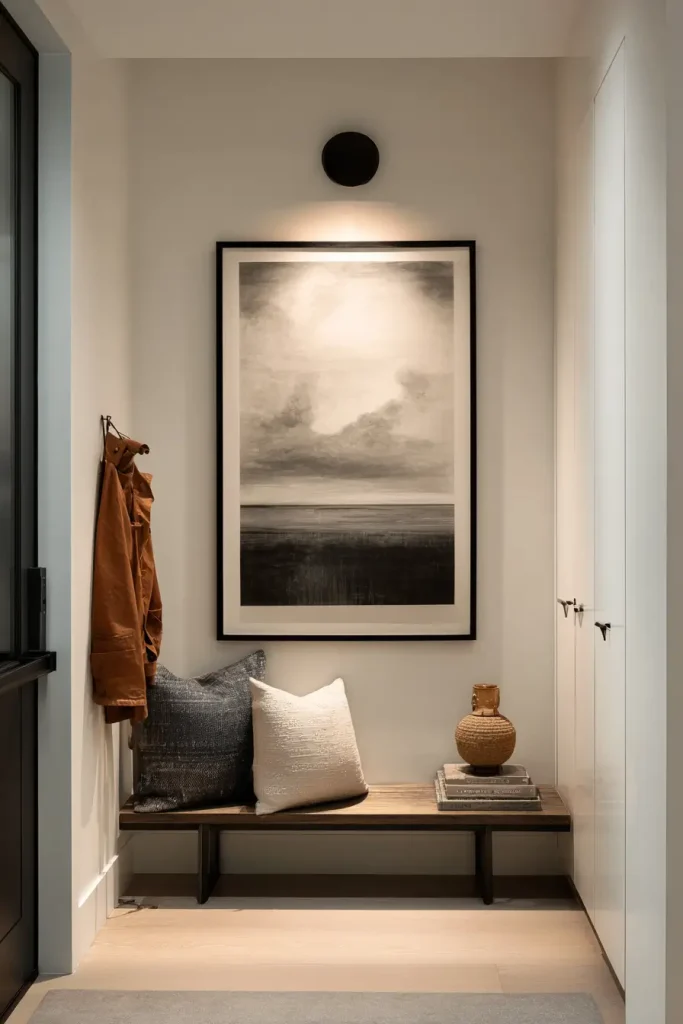
The entryway is the best room in your home to try something bold with wallpaper. Here’s why. It’s a small area, so you’re not committing to covering 400 square feet. If you don’t love it, it’s easy and inexpensive to change.
Peel and stick wallpaper has gotten very good. Brands like Tempaper, Chasing Paper, and NuWallpaper make options that go up without a paste, come down without damaging walls, and look close to traditional wallpaper when done right. Tempaper reported 200% sales growth after 2020, and that popularity has continued through 2024 and into 2026.
In a narrow hallway, choose vertical pattern wallpaper. Stripes, tall botanical prints, or vertical geometric patterns all draw the eye upward. That makes the ceiling feel higher and the space feel less closed in.
If wallpaper feels like too much, consider board and batten. It’s a wall treatment made from wood strips installed in a grid pattern on the lower half of the wall. It looks custom and architectural. As a DIY project, the materials typically run $150 to $400 depending on wall size. It’s paintable, so you can match any color.
Shiplap and fluted wall panels are also popular right now and work well in entryways as accent treatments. All of these options are DIY friendly if you’re comfortable with a nail gun and a miter saw.
12. Create a Built In Look Without Paying for a Real Built In
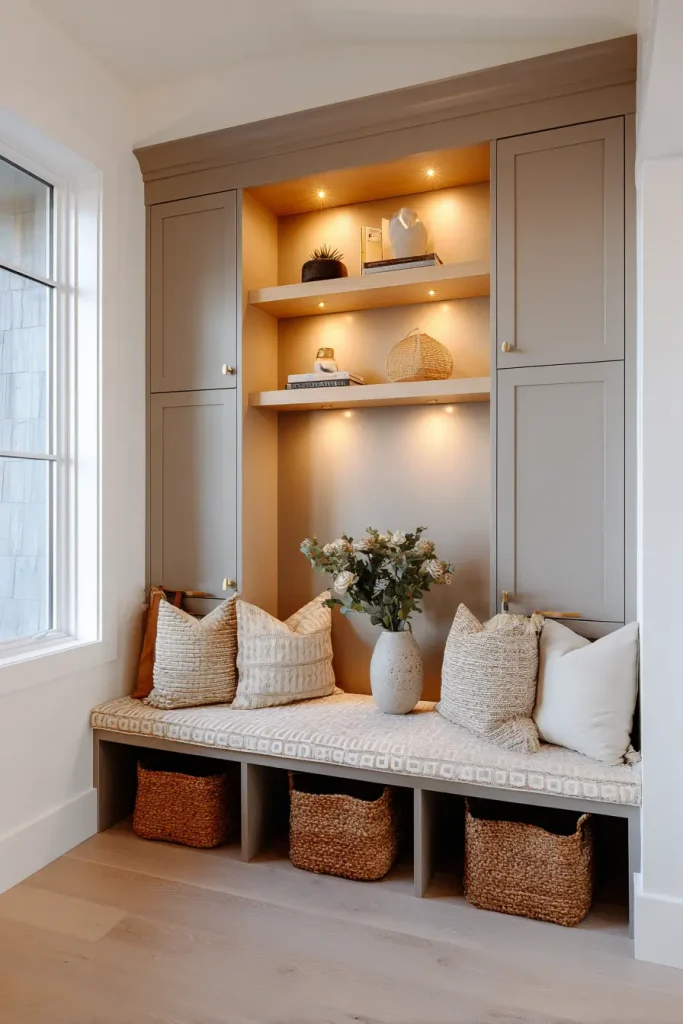
A custom mudroom built in costs between $1,500 and $8,000 depending on size, materials, and your location. That’s a lot of money for an entryway.
The good news: you can get 80% of the look for 10 to 20% of the cost using IKEA units and a few finishing touches.
The IKEA KALLAX is the most commonly used unit for this. Place two KALLAX units side by side. Add a plywood seat across the top, padded with foam and fabric. Install crown molding along the top edge to connect everything visually. Paint the whole thing one color, including the wall behind it. It looks like it was built into the house.
IKEA PAX wardrobe units work well for entryways that need hanging storage. SEKTION kitchen cabinets can be repurposed as entryway storage with doors that hide everything inside.
The detail that makes the difference is the finishing work. Adding trim, painting everything the same color as the surrounding wall, and installing proper hardware upgrades the look from “IKEA hack” to “did you have that built?” The transformation happens in those final details.
Total cost for a KALLAX based built in bench with storage: roughly $300 to $800 depending on size and materials. That’s compared to $1,500 to $8,000 for the real thing.
YouTube has dozens of detailed tutorials for KALLAX entryway builds. Search “KALLAX entryway bench” and you’ll find step by step guides with exact materials lists.
13. Add a Plant and Make the Space Feel Alive
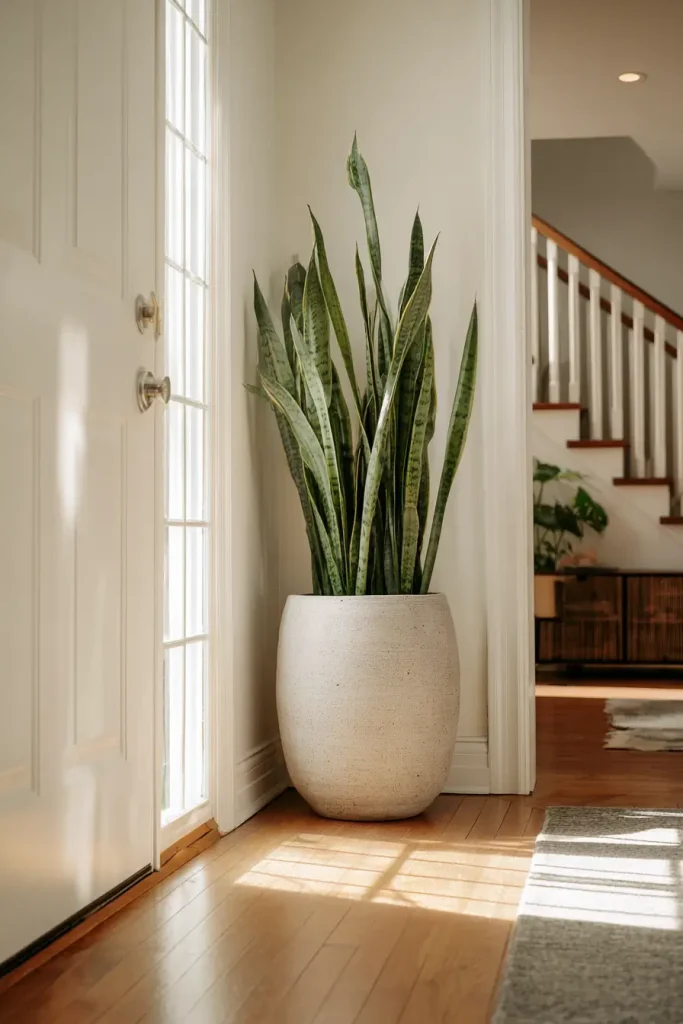
A plant does something in an entryway that no piece of furniture can do. It signals life. It makes the space feel like someone actively cares about it.
You don’t need a big plant. You need the right plant.
Most entryways get limited natural light, which means you need plants that are fine with low light conditions. The best options in 2026 for low light entryways are: pothos, ZZ plant, snake plant, cast iron plant, and peace lily. All five are low maintenance, hard to kill, and available at most garden centers and grocery stores for $10 to $40.
Snake plants are especially good because they grow tall and narrow. A single snake plant in a tall pot fills vertical space and adds visual height without spreading out across the floor.
If floor space is truly at a premium, use a hanging plant in a ceiling hook, or a narrow plant stand with a footprint under 12 inches. Both options bring in greenery without blocking the walkway.
One statement plant in a good quality pot looks better than three small plants in basic nursery containers. Upgrade the pot. It makes the whole plant look more considered.
14. Hang Art That Fits the Space and Looks Like You Chose It on Purpose
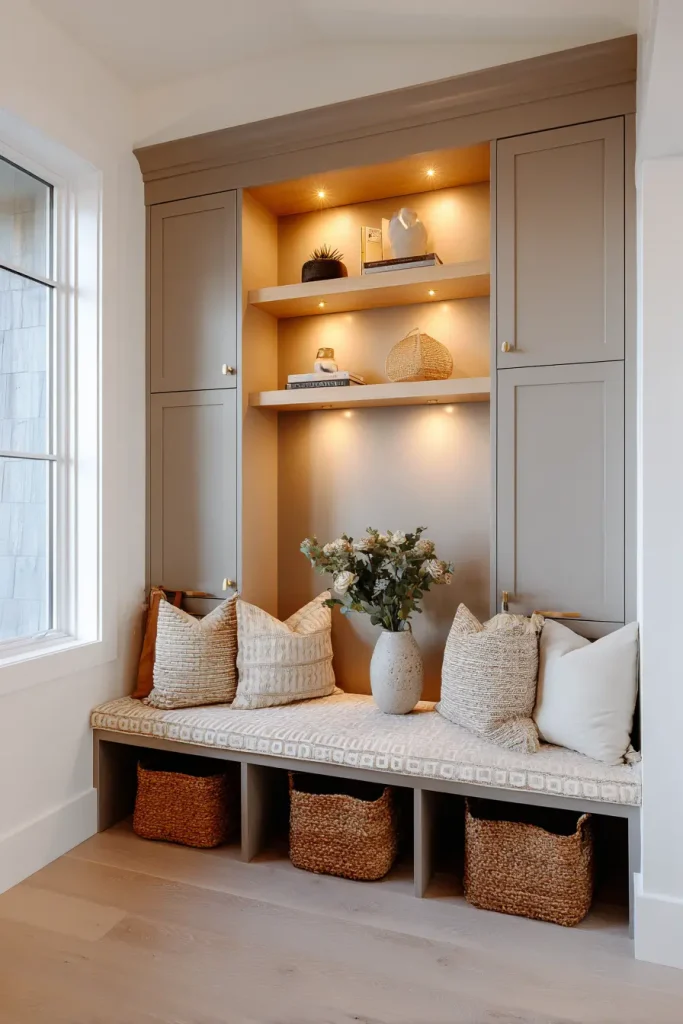
One piece of well chosen art changes how an entire entryway feels. Not because art is magic. But because it signals intention. It tells anyone who walks in that someone thought about this room.
In a small entryway, one large piece works better than a cluster of small frames. A single 24 by 36 inch print in a thin black frame creates a clear focal point. Six small frames in a tight grid just adds visual noise.
Size your art to the wall. The standard interior design guide is to hang art that covers 60 to 70 percent of the wall width it sits on. So if your wall is 36 inches wide, your art should be roughly 22 to 25 inches wide.
Hang it at the right height. The center of the piece should sit at 57 to 60 inches from the floor. That’s eye level for most adults. Art hung too high makes the ceiling feel lower.
For renters, Command picture hanging strips hold most standard sized frames without wall damage. Picture rails (a thin metal track installed near the ceiling) are another damage free option that let you adjust placement without new holes.
Affordable art sources that are popular in 2025 and 2026: Society6, Desenio, and Artifact Uprising. All three offer prints that look far more expensive than they are.
15. Organize Your Coat Closet Like It’s a Room, Not a Storage Disaster
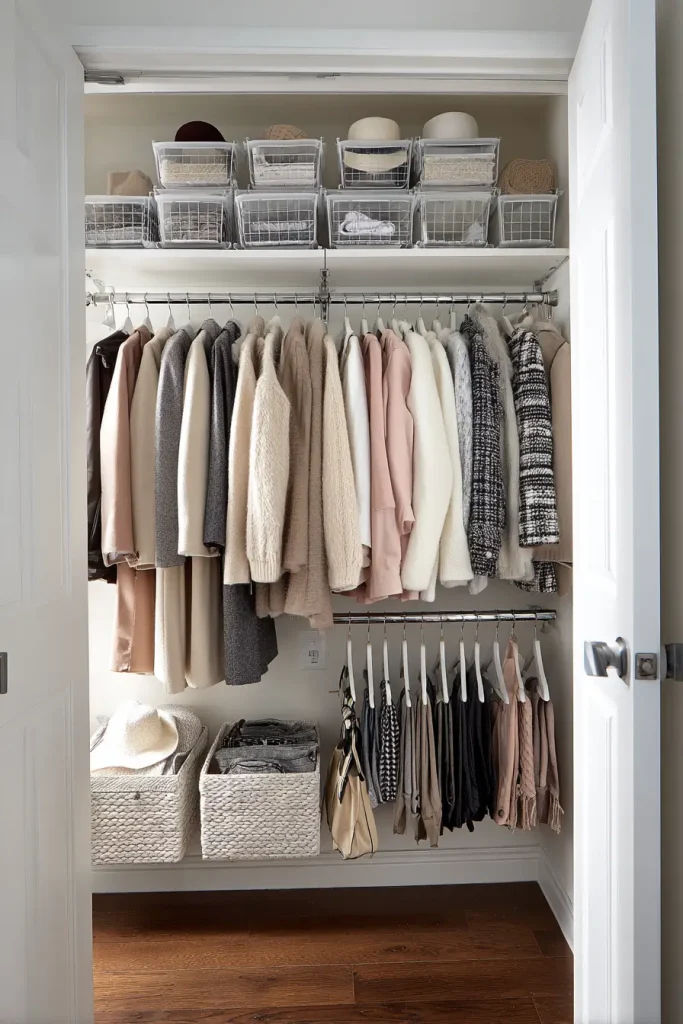
If you have a coat closet in your entryway, you have a huge opportunity that most people waste completely.
The average coat closet is 24 to 30 inches deep and 36 to 48 inches wide. That’s enough space for a complete organization system. But most closets have one bar, one shelf above it, and a pile of stuff on the floor.
Start with the double hanging rod trick. Add a second rod below the existing one, spaced about 24 to 30 inches below the first. Now you’ve doubled your hanging capacity for $15 to $30 in hardware. Use the top rod for long coats. Use the lower rod for shorter jackets and bags.
Add hooks to the inside of the door for scarves, hats, umbrellas, and reusable bags. Over the door organizers with clear pockets work well for smaller items.
Put clear bins with labels on the shelf above the rod. One for seasonal hats and gloves. One for sports accessories. One for items that belong to guests.
One trend worth considering: removing the closet door entirely. An open coat closet with organized shelves and styled storage looks intentional and actually makes the entryway feel bigger by removing a door that swings into the space. Architectural Digest and Apartment Therapy have both featured this approach heavily in 2024 and 2025.
16. Get a Styled Entryway Without Touching a Single Wall (Renter Edition)
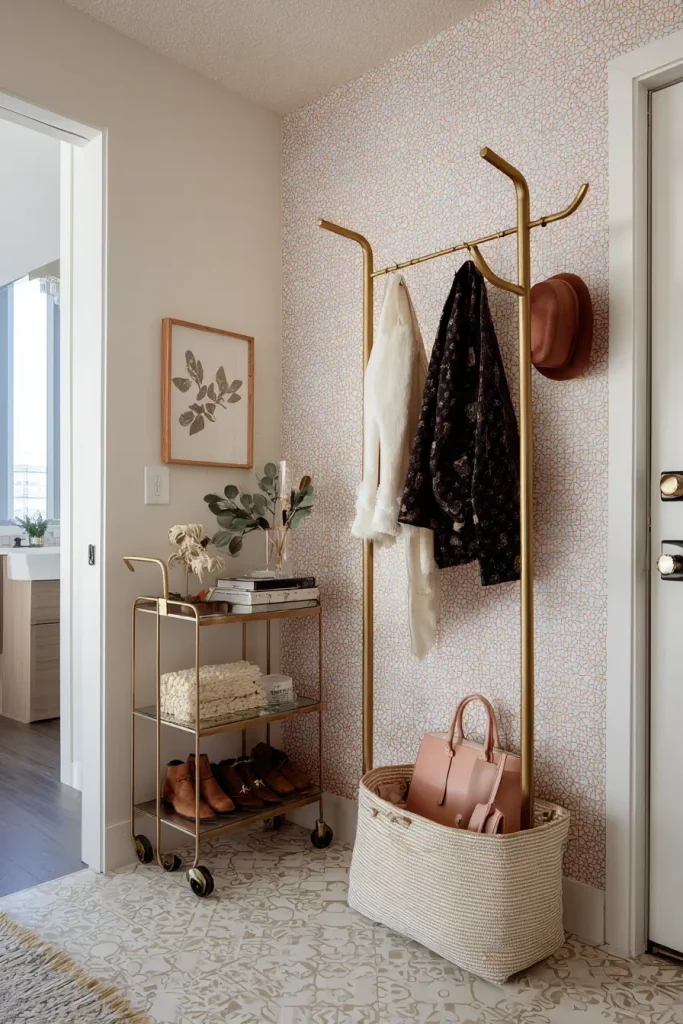
You don’t own the walls. That doesn’t mean you’re stuck with a blank, forgettable entryway.
Renters have more options now than ever before. Here’s what actually works without risking your deposit.
Command Large Hooks hold up to 7.5 pounds each. That’s enough for a coat or a heavy tote bag. They go up in 30 seconds and come off clean. A row of three or four of them on the wall takes under five minutes and costs about $10.
Peel and stick floor tiles can completely change how an entryway looks and feels. FloorPops tiles start at around $1.50 each. A small entryway floor might take 12 to 20 tiles. That’s a $20 to $30 floor transformation that peels back off when you move out.
Peel and stick wallpaper on one wall creates a designed look without permanent installation. Take your time applying it carefully and it comes off cleanly later.
For furniture only setups, freestanding coat stands, narrow console tables, and rolling carts give you storage and style without any wall work. A good freestanding coat stand with a base costs $40 to $100 and solves the coat problem completely.
One thing to verify before using any removable product: check the label for weight limits and always follow the manufacturer’s instructions for application. Temperature and surface type affect how well they stick and how cleanly they come off.
17. Build a Drop Zone System So Things Stop Getting Lost
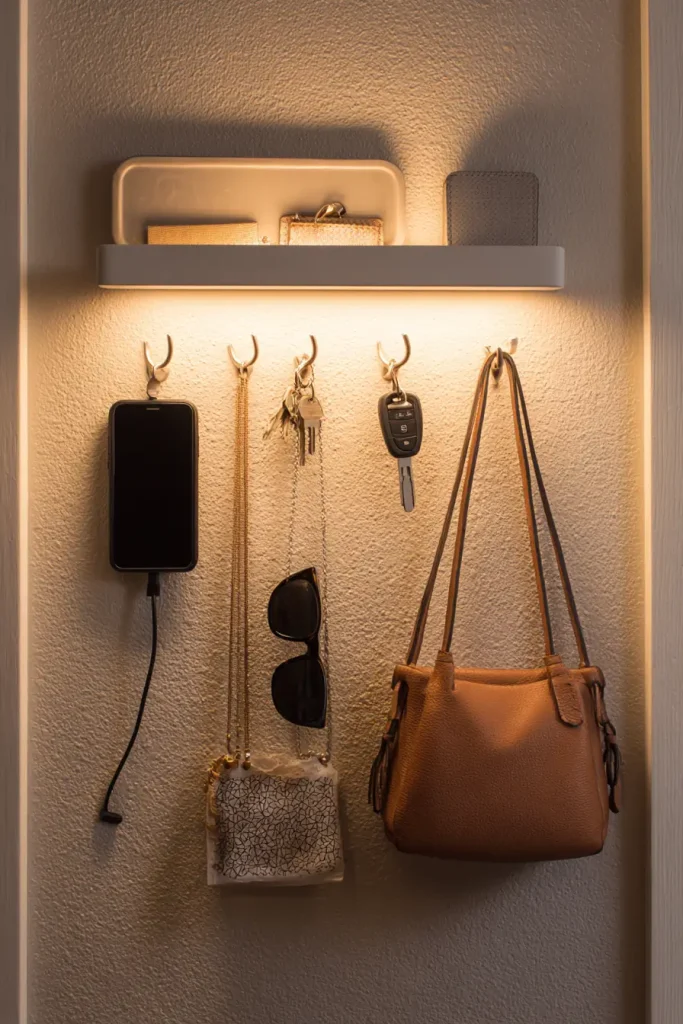
Here’s what happens without a drop zone. Bags go on a chair. Keys go on the counter, or in a pocket, or somewhere nobody can find them. Shoes get kicked off in random spots. And every single morning someone is late because they can’t find something.
A drop zone fixes this. It’s a specific, designated area for the everyday items that come in and out with you. It doesn’t need to be fancy. It needs to be functional and consistently used.
The core items for a functional drop zone are: one key hook, one small mail or paper tray, one phone or device charging spot, and one bag hook. That covers most of what people need at the door.
Trays and small bowls are the key to making this look intentional. A decorative tray ($10 to $30) contains keys, sunglasses, a charger, and whatever else lands at the door. Without the tray, those items look like clutter. Inside the tray, they look like a styled vignette. Same stuff. Completely different result.
The end of day reset habit is what keeps the system working. Spend 60 seconds at the end of each evening returning things to their spots. That’s it. Sixty seconds prevents the pile up from ever forming.
The Home Edit, the popular organization team with a Netflix show, has consistently recommended landing zone systems as the number one entryway habit since 2019. That advice hasn’t changed because it works.
18. Use Scent and Texture to Make Your Entryway Feel Like Home
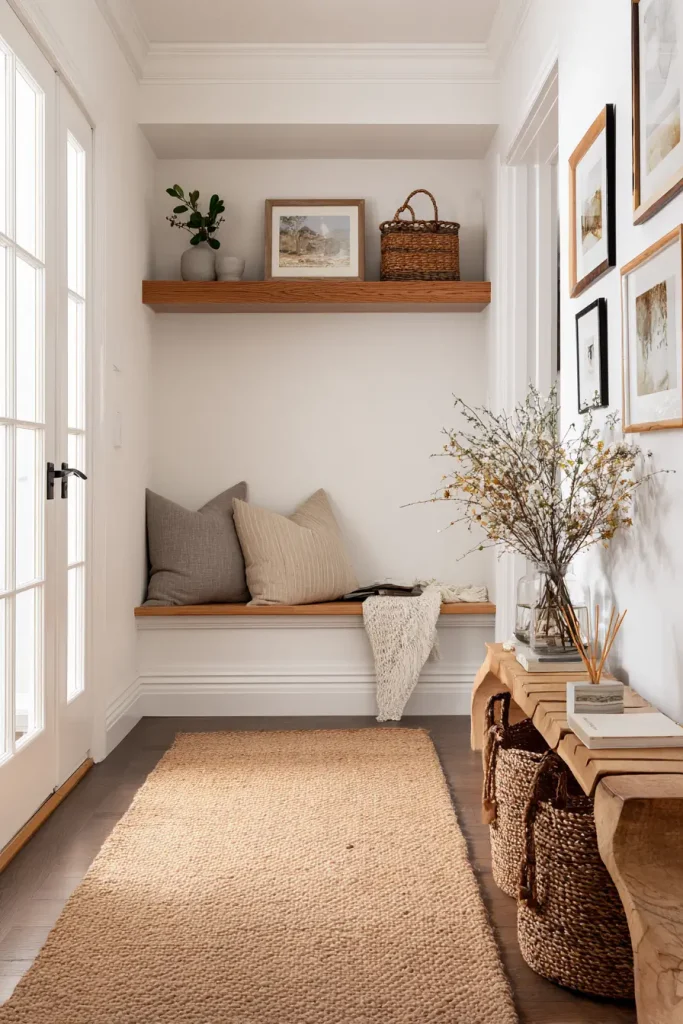
Most entryway guides stop at visual design. But the best entryways go further.
When you walk into a home and it immediately feels warm and welcoming, scent is almost always part of that. You might not consciously notice it. But it’s there. Environmental psychology research shows that scent is one of the most powerful triggers of the “home” feeling. It bypasses conscious thought and goes straight to emotion.
A simple reed diffuser in a consistent scent, cedar, clean linen, or eucalyptus, placed on your entryway shelf or console table, does this job for about $12 to $20. You don’t need a $50 candle. A reed diffuser works passively and lasts for weeks.
Texture does for the eyes what scent does for the nose. It adds warmth and depth that makes a space feel real instead of staged. A jute rug underfoot. A woven basket on a shelf. A linen cushion on a bench. These are small additions that make the space feel layered.
And then there’s the personal touch. The one item that tells someone this is your home, not a showroom. A framed photo from a trip. A ceramic piece you picked up at a market. A vintage find that means something to you.
Designers like Amber Lewis talk about this as the “lived in layer.” Without it, even a beautifully organized entryway can feel cold. That one personal item is what changes it from a designed space to your designed space.
19. Style the Whole Thing With the 3 Pillar Rule
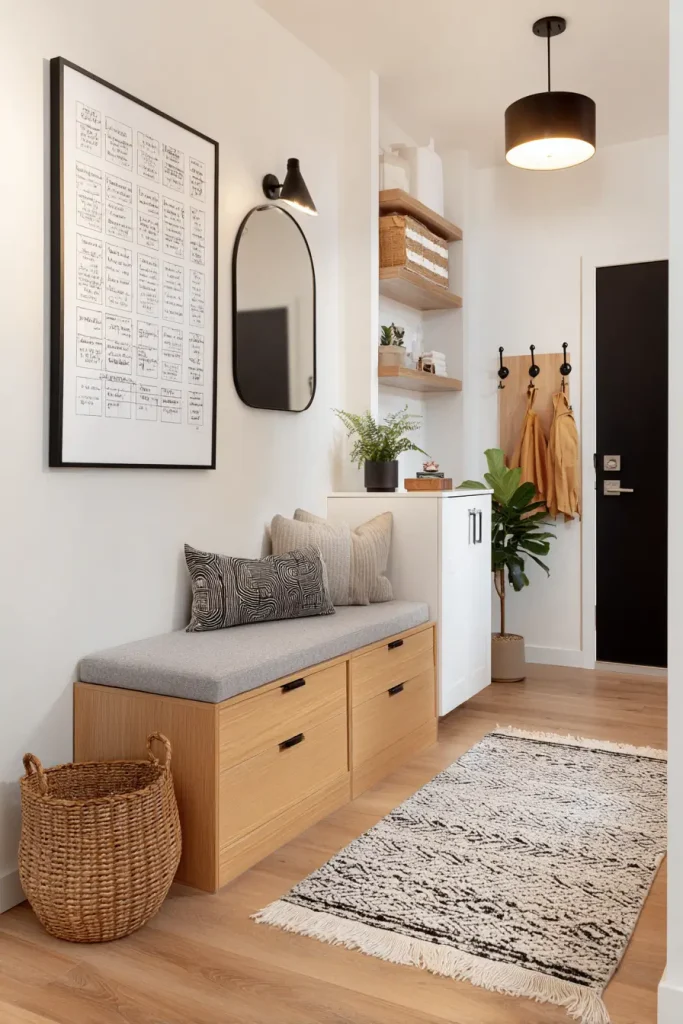
You’ve seen 18 specific ideas. Now here’s how to put them together without overdoing it.
Every small entryway needs three things. One landing zone, one visual anchor, and one storage solution. That’s the whole framework.
Your landing zone handles function. Hooks, a tray, a key spot, somewhere for shoes. Your visual anchor handles design. A mirror, a piece of art, a bold paint color, or a statement shelf. Your storage solution handles order. A bench with compartments, a slim shoe cabinet, wall mounted baskets, or a coat closet that’s been properly organized.
Once you have those three things in place, everything else on this list is optional. Add a plant if you want more life in the space. Add a rug if the floor needs grounding. Add wallpaper if you want a big design moment without a big renovation budget.
But start with the pillars. A well executed version of just those three will look more intentional than an entryway stuffed with ten half finished ideas.
Start With One Idea This Weekend
A small entryway does not need to stay small and chaotic. It needs a plan.
You now have 19 specific, tested ideas that work in real spaces. Pick the three that match your biggest problem right now. Then start with just one this weekend.
Hang the mirror. Install the hook rail. Set up the drop zone tray. Any one of those will move your entryway from frustrating to functional.
Small entryway ideas do not have to be complicated. They just have to be deliberate. Your tiny space can look and feel like it was designed on purpose.

- 17 Classy Living Room Ideas for a Cozy Elegant Look - April 23, 2026
- 16 Dark Moody Living Room Ideas That Feel Rich and Warm - April 22, 2026
- 14 Elegant Bedroom Trends for 2026 You’ll Love - April 22, 2026