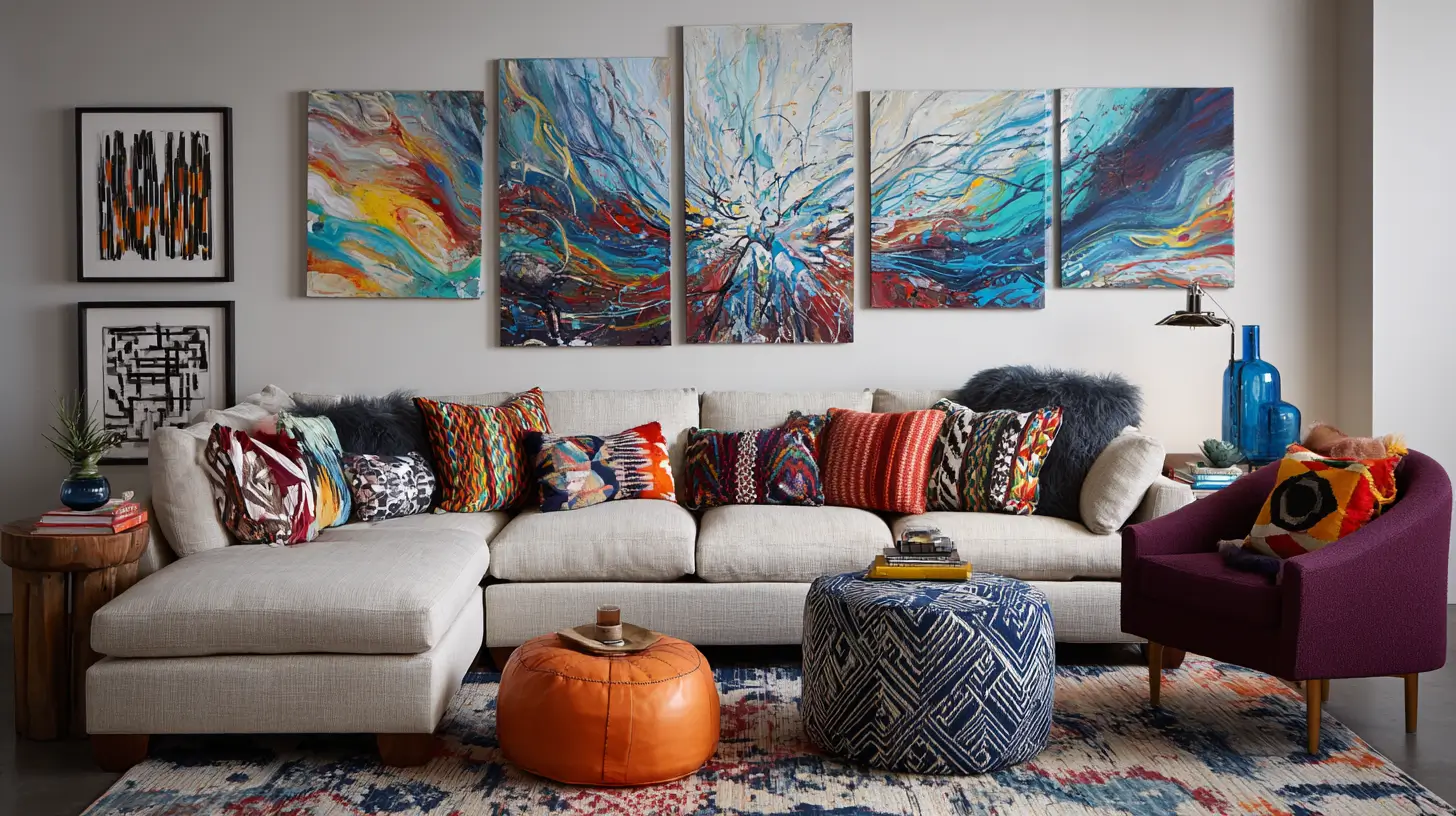
That blank wall above your sofa is staring at you again.
You walk into your living room, look up, and feel something is off. The room looks unfinished. Like a picture frame with no photo inside. You know something should go there. You just don’t know what.
This guide fixes that.
You’ll get 15 real, specific ideas for the wall above your sofa. Each one comes with sizing tips, budget options, and clear steps. Whether you rent or own, have $20 or $200, there’s something here you can do this weekend.
Let’s start with one rule that changes everything.
Why the Wall Above Your Sofa Is the Most Important Spot in the Room
Most people hang art too small or too high. That’s why it looks wrong.
Here’s the size rule every interior designer uses: your wall decor should be about two thirds the width of your sofa. So if your sofa is 84 inches wide, your art or grouping should span at least 56 inches. A small 16×20 print on an 8-foot wall looks lost. It makes the sofa look like it’s floating with nothing to hold it down.
The height rule is just as important. The center of your art should hang 57 to 60 inches from the floor. This is the same standard museums and galleries use. It puts the art at natural eye level.
When nothing is on that wall, your sofa looks disconnected from the room. When something is there, the whole seating area feels complete.
Pro Tip: Measure your sofa width before buying anything. Write it down. Use the two thirds rule every time.
According to Houzz research, the living room is the most renovated room in most homes. Wall decor is one of the top three updates homeowners make. You’re not alone in staring at that blank wall.
#1 Gallery Wall: The Most Flexible Option for Any Style
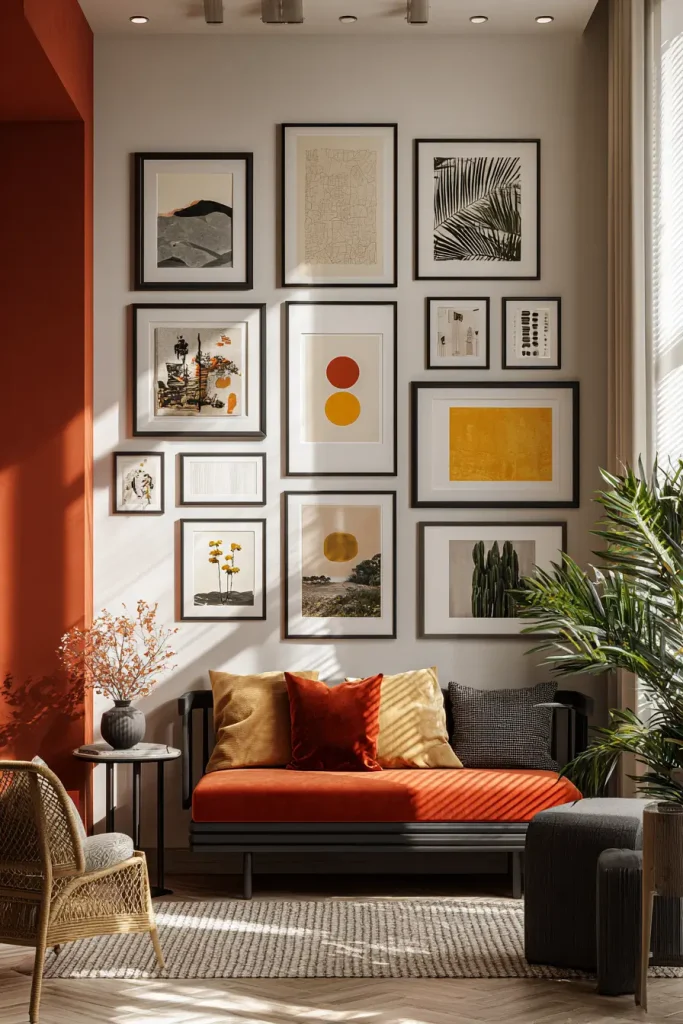
A gallery wall works in almost every home. Modern, boho, traditional, it doesn’t matter. You mix different frame sizes, art styles, and photos into one group. Together they fill the wall and feel curated.
The mistake most people make is putting nails in the wall before planning anything. Don’t do that.
Here’s a better way. Lay all your frames on the floor first. Move them around until the arrangement looks right. Then trace each frame onto kraft paper, cut out the shapes, and tape them to the wall with painter’s tape. Live with that paper layout for a day. Adjust as needed. Only then start nailing.
Keep gaps between frames consistent. Two to three inches between each piece looks clean. More than that and the grouping starts to fall apart visually.
Start with one large anchor piece, at least 24×36 inches, and build around it. Odd numbers work better than even. A group of 5 or 7 pieces looks more natural than 4 or 6.
Pro Tip: Black frames with white mats create a cohesive look even when the art inside is totally different. It’s the easiest way to make a mixed gallery feel intentional.
Pinterest trend reports from 2024 and 2025 consistently show gallery walls as the top pinned living room wall idea. It’s popular because it works.
#2 One Large Statement Piece: Simple, Bold, Done
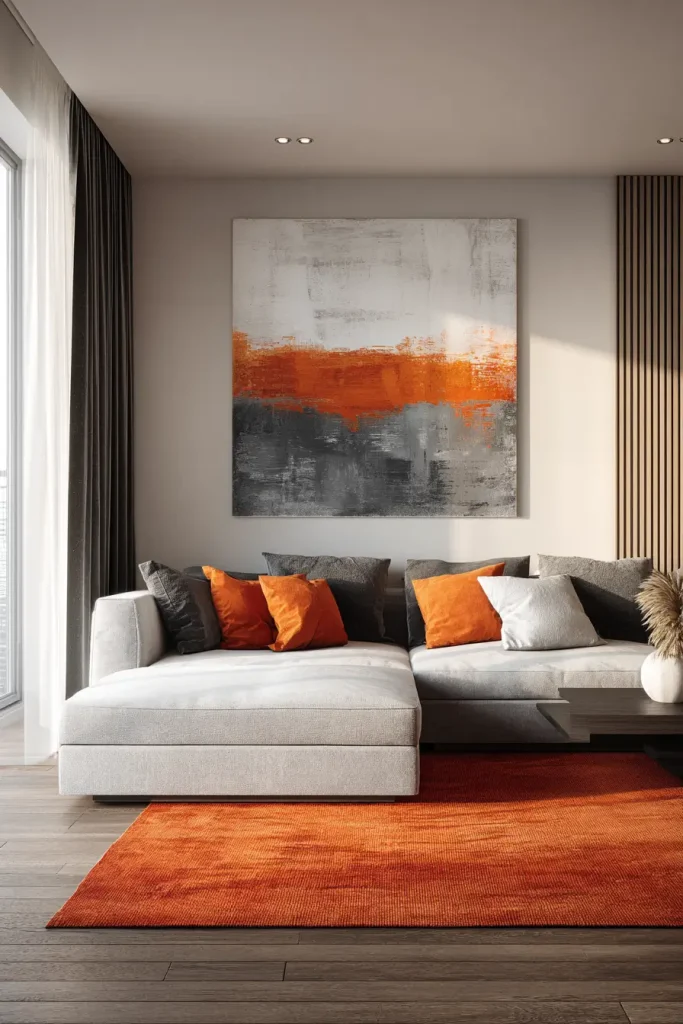
Sometimes the best answer is one big piece of art. No groupings, no gallery walls. Just one strong image that fills the space.
This works especially well in small living rooms where a gallery wall would feel crowded. It’s also the easiest option for renters who want minimal wall holes.
Size matters here more than anywhere else. For a standard 84-inch sofa, your art should be at least 40 inches wide. Ideally 48 to 60 inches. Anything smaller will look like a postage stamp on the wall.
Choose subject matter that connects to colors already in your room. If you have warm tones in your rug or throw pillows, pick art with similar warm colors. You don’t need an exact match. You just need it to feel like it belongs.
Large canvas prints are more affordable than most people think. Sites like CanvasDiscount and Printful let you upload any image and print it to custom sizes. Prices start around $40 to $80 for large formats. Local print shops often do the same.
Pro Tip: Keep the art width under 75 percent of the sofa width. So on an 84-inch sofa, cap it at about 63 inches wide. Go bigger and the art starts to visually crowd the space.
A single oversized piece is one of the fastest growing trends in minimalist interiors heading into 2026. It’s a clean look that ages well.
#3 Floating Shelves: Decor You Can Change Without Touching the Wall Again
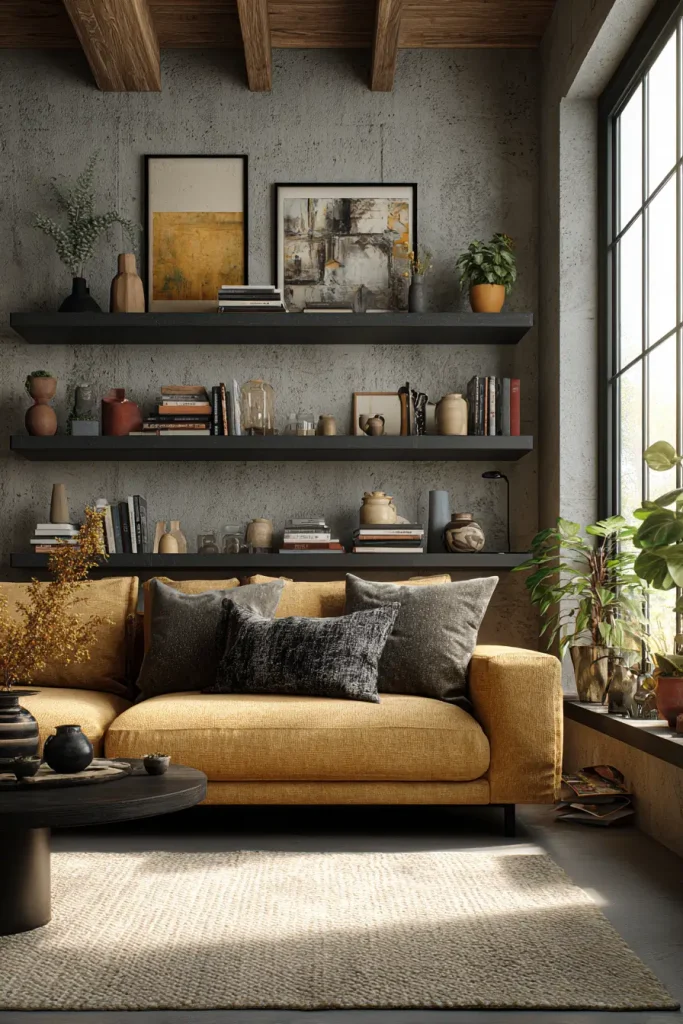
Floating shelves give you the most flexibility of any option on this list. Once they’re up, you can rearrange everything on them as often as you want. No new holes, no damage, no commitment.
This is the best option if you change your mind about decor a lot. It’s also great for renters who want to limit wall damage since you only drill once to install the shelves.
For above-sofa placement, choose shelves that are 8 to 10 inches deep. Deep enough to hold objects. Not so deep that it feels like a storage ledge. Anchor them into wall studs, not just drywall, especially if you plan to put heavier items on them.
When styling the shelves, use the rule of three. Group items in sets of three at different heights. One tall item, one medium, one small. Always include at least one small plant to add life. Mix textures: a ceramic vase, a few books with spines facing out, a small framed print.
Designers recommend no more than three shelves stacked above a sofa. More than that and the shelves start competing with the seating area instead of supporting it.
Pro Tip: IKEA’s LACK shelves are one of the best selling home products in the world for a reason. They’re inexpensive, clean looking, and hold more than they appear to.
The next idea is one of the fastest ways to make a small room feel twice as big.
#4 A Large Mirror: Make Your Room Look Bigger for Under $100
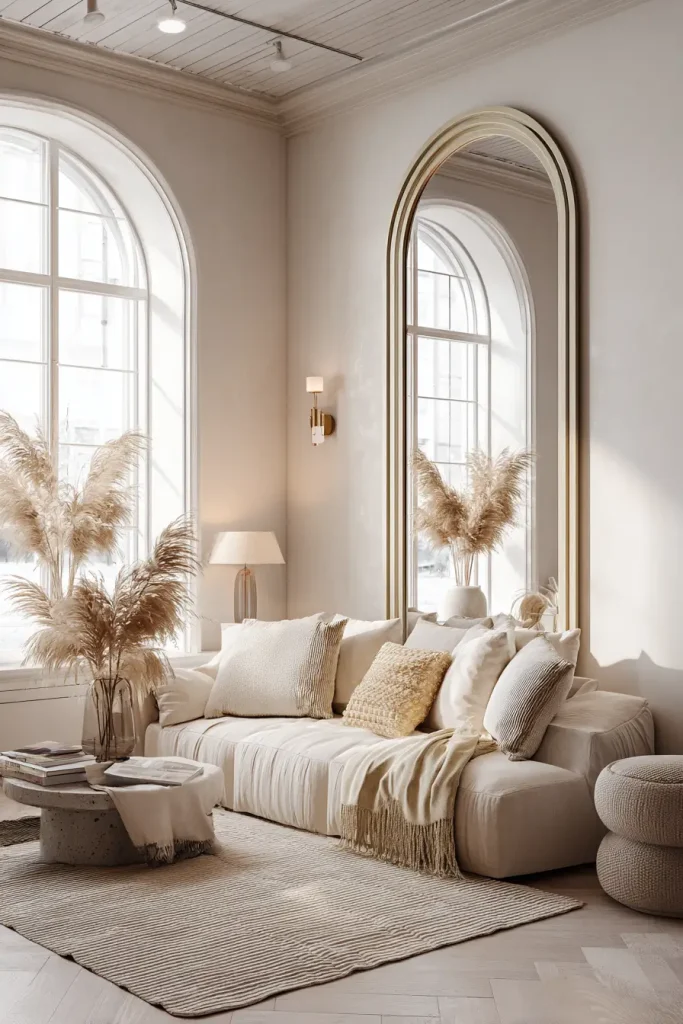
A mirror above your sofa does two things at once. It decorates the wall and it makes the room feel physically larger.
Mirrors bounce light around the room. If you have a window nearby, a mirror will catch that natural light and spread it further. Even in rooms with no windows on that wall, a large mirror adds depth that flat art can’t.
The best shapes for above-sofa placement in 2026 are arched mirrors, sunburst mirrors, and simple rectangular mirrors. Arched mirrors in particular have dominated home decor trend reports from Wayfair, Amazon, and design blogs through 2024 and 2025. They add softness to a room without looking fussy.
Size rule: go at least 24 inches wide. For real impact, aim for 36 to 48 inches. A small mirror above a large sofa looks like an afterthought.
One thing to check before you hang: stand where the mirror will sit and look at what it reflects. If it’s going to reflect a pile of laundry or a cluttered corner, reposition it.
Pro Tip: You can lean a large mirror against the wall rather than hanging it. This works especially well on a console table behind the sofa. No drilling required.
#5 Woven Wall Hangings: Add Texture That Paintings Can’t Give You
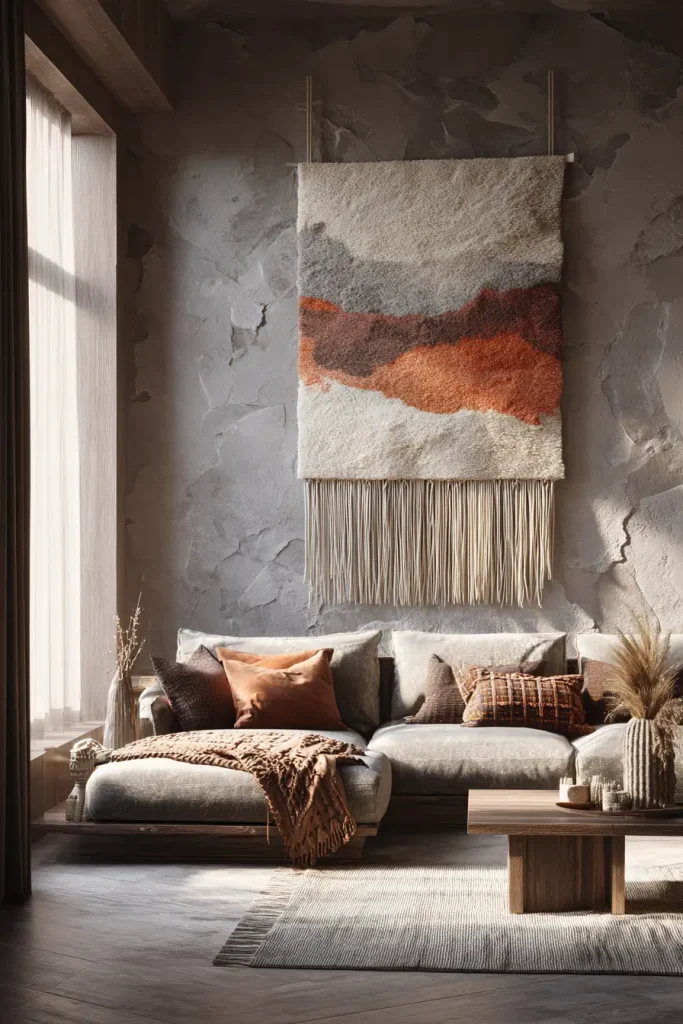
Paint and photos are flat. Woven art has texture, depth, and warmth that changes how a room feels physically.
This works best in boho, Scandinavian, and earthy style rooms. But it can work in modern spaces too, especially as a contrast element against clean white walls.
Materials include macrame, woven wool, rattan frames, and fabric tapestries. You can find handmade pieces on Etsy in almost every size and color palette.
Hanging tip: most woven pieces come on a dowel rod. Use two anchor points to keep it level. Since textile art is lighter than framed pieces, you can hang it from picture rail hooks or even removable adhesive strips in many cases.
One bonus: textile art absorbs sound. If your living room has hard floors and echoes, a large woven piece on the wall will actually help with that.
Pro Tip: Woven wall art can be wider than traditional framed art because it feels lighter visually. A 48-inch wide textile hanging doesn’t dominate the wall the way a 48-inch framed canvas might.
Searches for woven wall hangings have stayed consistently high through 2025. This is not a passing trend.
#6 A DIY Photo Ledge: Swap Art Any Time With Zero Extra Holes
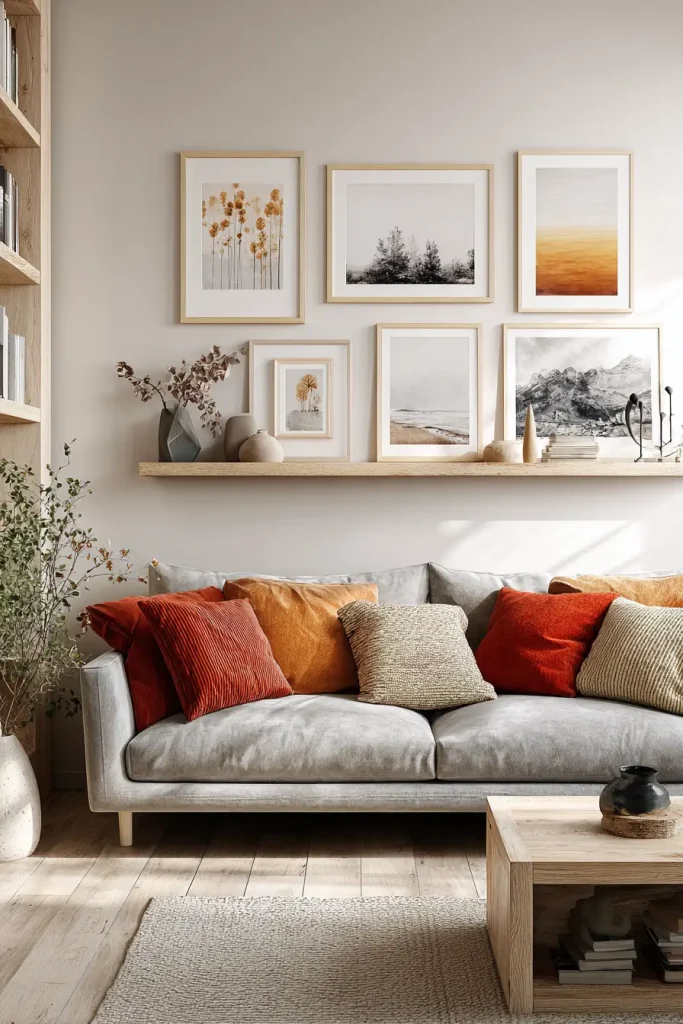
A photo ledge is a slim shelf with a small lip at the front. You set prints on it instead of hanging them. To change the art, you just swap the prints. No new holes. No patches. No repainting.
This is the best option for renters. You install the ledge once and then treat it like a rotating art display.
The IKEA MOSSLANDA picture ledge is the most widely used version. It costs between $5 and $10 and comes in multiple lengths. It’s been featured in thousands of home tours on Instagram and YouTube because it’s simple and it works.
Layer prints in front of each other for a stacked, curated look. Mix sizes: one large print at 18×24, two medium prints at 11×14, and one or two small prints at 5×7 or 8×10. Varying the sizes makes it feel intentional.
Swap prints seasonally. Buy affordable prints from Desenio, Society6, or Printful. Most are under $15 and you can change the whole look of your room in 10 minutes.
Pro Tip: Use two ledges side by side for extra width coverage above a long sofa. Keep them at the same height and treat them as one continuous display.
#7 3D Wall Objects: Add Dimension That Flat Art Can’t
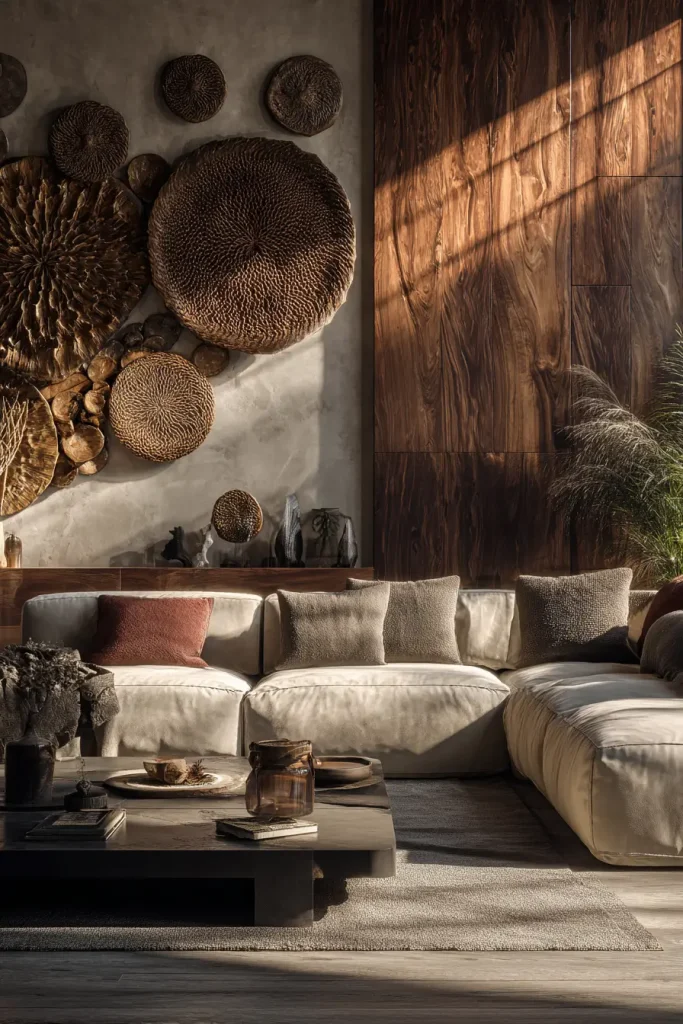
Most people think of wall decor as flat: paintings, photos, prints. But you can mount three dimensional objects to the wall and create something much more interesting.
Ideas include vintage window frames, decorative wall plates, wooden carved panels, and metal wall sculptures. These create shadows and depth that change throughout the day as light shifts.
The key to making a mixed grouping of 3D objects look designed: stick to one finish or one material. All brass tones. All raw wood. All matte black metal. When the finishes match, mismatched objects feel like a collection instead of clutter.
Good sources for 3D wall objects: thrift stores, Etsy, Facebook Marketplace, and architectural salvage shops. This approach tends to be affordable because you’re often working with secondhand pieces.
This style works especially well in farmhouse, eclectic, and maximalist rooms. It’s harder to pull off in minimalist spaces but not impossible if you keep the grouping tight and small.
Pro Tip: Decorative ceramic or wooden wall plates in an odd-number grouping of 5 or 7 is one of the easiest 3D wall arrangements to execute. Space them roughly 3 inches apart in a loose cluster.
#8 Neon and LED Signs: A Bold Option That Actually Works in the Right Room
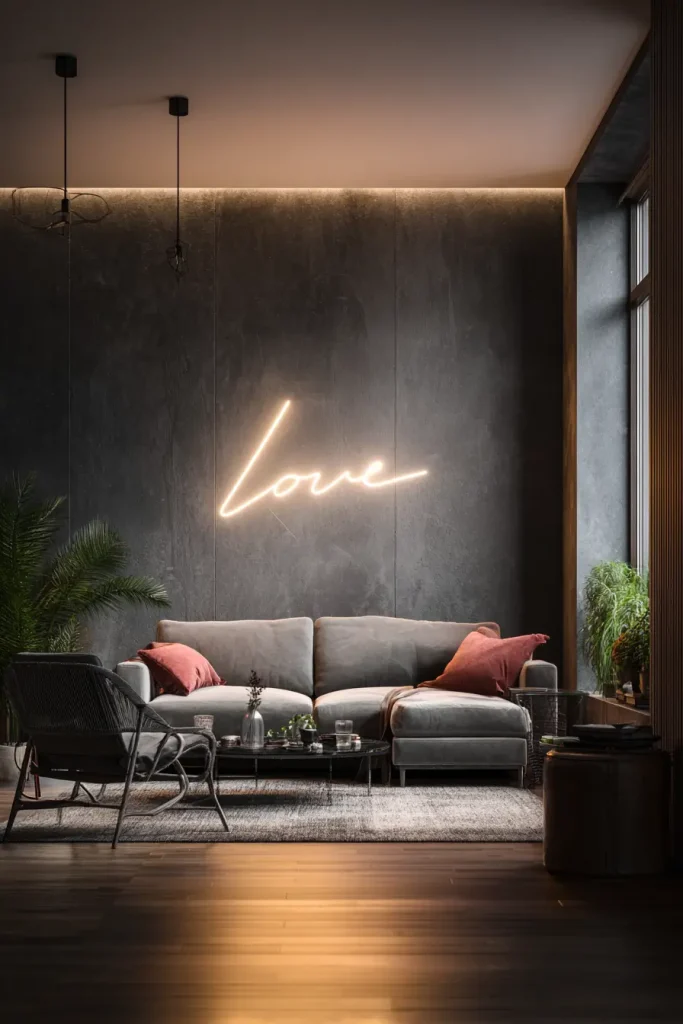
Custom neon signs used to cost hundreds of dollars. They were for restaurants and bars. That’s no longer true.
LED flex signs that look like neon are now widely available for $60 to $120 for custom pieces. You can order them on Etsy, Amazon, and sites like Neonize. Choose a word, a short phrase, coordinates of a place that matters to you, or a simple shape.
This works best in modern, eclectic, and maximalist rooms. It doesn’t work as well in traditional or farmhouse spaces. Be honest with yourself about your room’s style before buying one.
For the light to show up properly, pair a neon sign with a slightly darker wall color. On a bright white wall the effect gets washed out.
Placement: treat it like any other art piece. Center it above the sofa, hang it at the standard 57-inch height from center, and make sure it’s appropriately scaled.
Pro Tip: A single word in a warm white LED looks good in almost any modern space. It adds personality without the intensity of colored neon.
#9 Botanical Prints: Timeless Art That Works With Any Color Palette
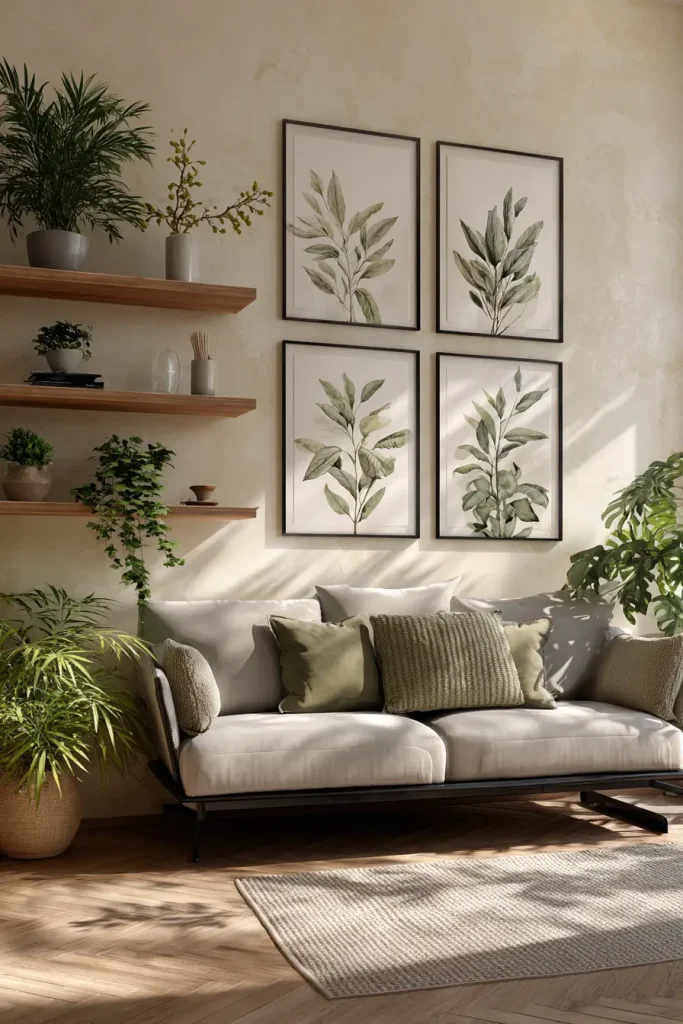
Botanical art has been around for centuries. It still works because it connects to something universal. Plants, nature, organic shapes. It fits in modern rooms, traditional rooms, and everything in between.
In 2026 the trend is leaning toward oversized single botanical prints or a four panel series where each panel shows a different plant. Both approaches fill the wall well and feel current.
The framing makes a big difference. Take an inexpensive botanical print and put it in a thin black frame with a white mat. It looks expensive. The mat adds visual breathing room and the clean frame keeps it modern.
You can get free botanical prints. The Biodiversity Heritage Library has thousands of public domain vintage botanical illustrations. RawPixel also has a large free public domain art section. Download, print, frame. Total cost: the price of printing and the frame.
Pro Tip: Pair botanical wall art with one or two real plants on nearby shelves or a side table. The connection between the art and the actual plants makes the whole corner feel intentional.
#10 Abstract Art: The Safest Choice for Getting Color Right
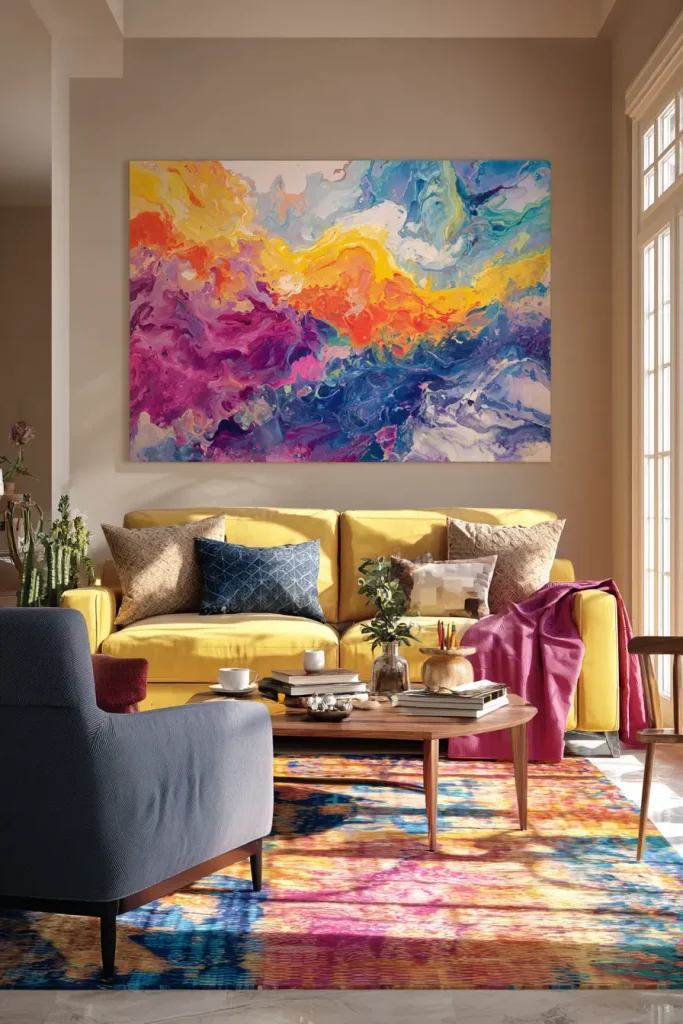
Abstract art is the most forgiving option when it comes to matching your room. There are no literal subjects to clash with your furniture. You’re just working with color, shape, and mood.
The easiest way to choose abstract art: look at your existing room. What colors show up most? Your rug, your throw pillows, your curtains. Pick art that shares at least one or two of those colors. It doesn’t need to match exactly. It just needs to feel like it came from the same palette.
The 60-30-10 color rule applies here. 60 percent of your room is a dominant color, usually walls and sofa. 30 percent is a secondary color, often rugs and curtains. 10 percent is an accent color. Your abstract art should speak to that 10 percent accent color.
For original affordable abstract art, try Saatchi Art, Artfinder, and Minted. Local art fairs are also excellent for finding original pieces at accessible prices.
One newer option: AI-generated art printed to canvas. Tools like Midjourney and Adobe Firefly let you generate custom images and then print them through CanvasDiscount or Printful. It’s a genuinely new way to get one-of-a-kind abstract art at a low cost in 2026.
Pro Tip: When buying abstract art online, order a small test print first to check colors on your screen versus real life. Monitor colors almost always look different than printed colors.
#11 Accent Walls and Peel-and-Stick Wallpaper: Change the Wall Itself
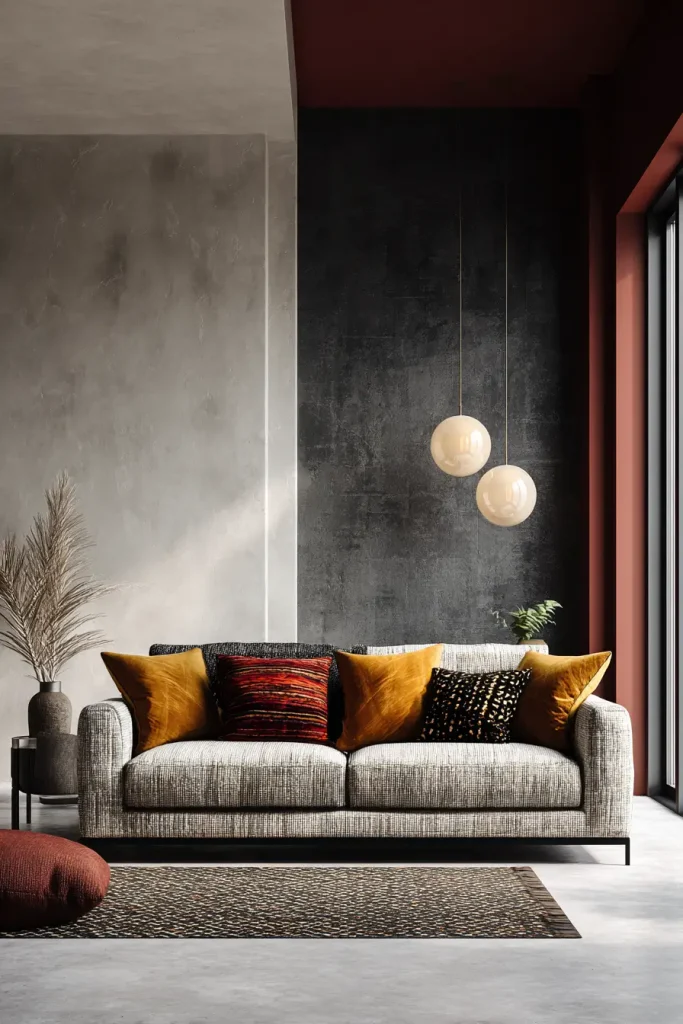
Sometimes the answer isn’t what you hang on the wall. It’s the wall itself.
You don’t need to wallpaper an entire room. Focus on just the sofa wall. A different paint color, a wallpaper pattern, or a textured treatment on that one wall creates a built-in focal point without hanging anything at all.
For renters, peel-and-stick wallpaper makes this possible without losing a security deposit. Brands like Tempaper, Chasing Paper, and NuWallpaper make removable wallpaper that goes on clean and comes off without damage. Apply it to just the sofa wall. It transforms the room.
For homeowners, limewash paint on the sofa wall is one of the most popular DIY techniques right now. It creates a soft, textured, old-world look. YouTube has dozens of tutorials showing exactly how to do it. Most cost under $50 in supplies.
Board and batten or shiplap paneling directly behind the sofa is another option. It creates a built-in architectural detail that looks like a custom room feature.
Pro Tip: Even just painting the sofa wall a different color than the rest of the room creates instant drama. Dark walls behind a lighter sofa is one of the most effective contrasts in interior design right now.
#12 Wall Sconces: Lighting That Doubles as Decor
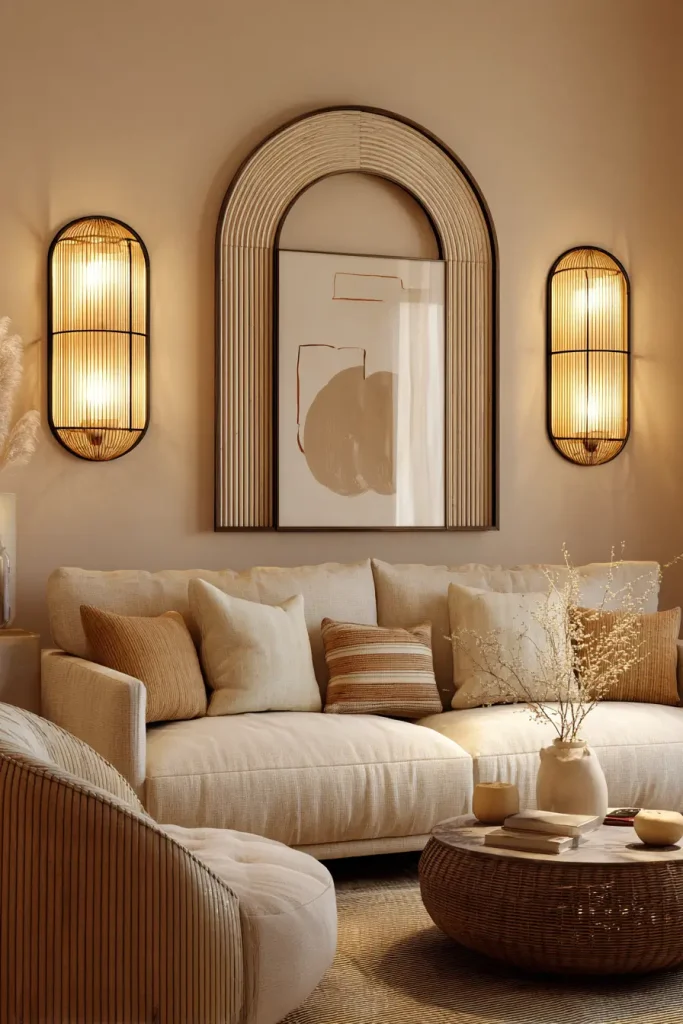
Most living rooms rely on one overhead light. The result is flat, harsh, and unflattering.
Wall sconces fix this. They add layered light at a lower level, which makes a room feel warmer and more inviting. And because they’re mounted on the wall above the sofa, they also function as visual decor.
The best placement: one sconce on each side of a central art piece or mirror. Place them about 6 inches out from the edge of the central piece, at roughly 60 to 65 inches from the floor. This creates a symmetrical arrangement that feels balanced.
Battery operated and plug-in sconces are widely available now. You don’t need an electrician. Battery sconces are especially good above sofas where there’s no nearby outlet.
Popular sconce styles heading into 2026: arched arm sconces, rattan shade sconces, and simple geometric metal sconces. All three work well above a sofa.
Pro Tip: Use warm white bulbs in your sconces, around 2700K color temperature. Cool white light above a sofa makes the seating area feel like a hospital waiting room.
#13 Custom Maps and Typography Art: Make It Personal
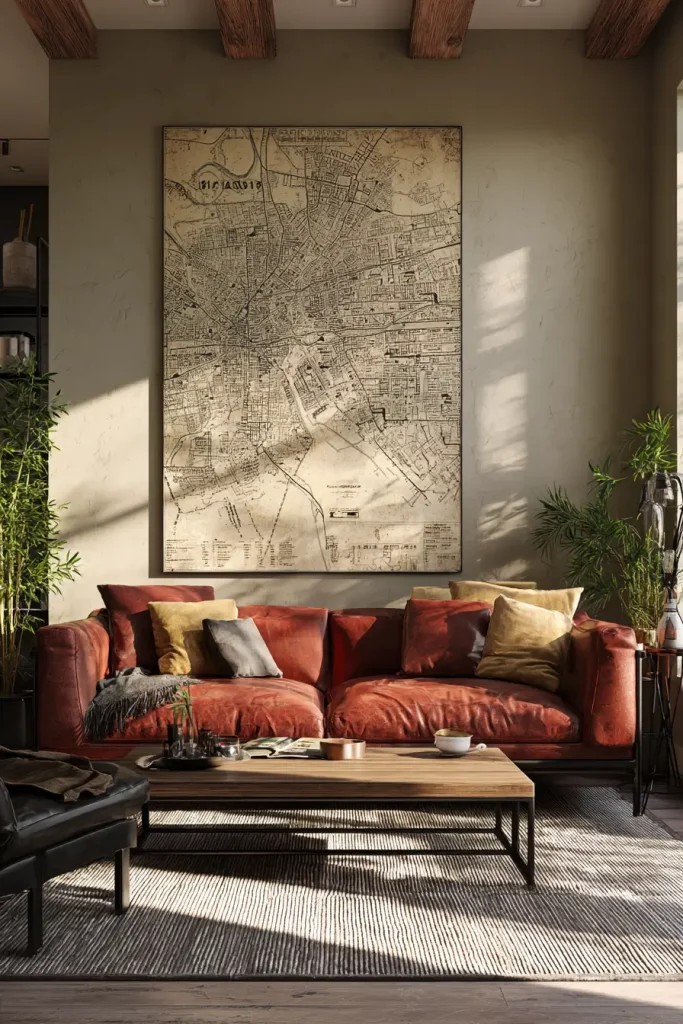
Generic art is fine. But something made specifically for you makes a room feel like yours.
Custom city maps are one of the most popular personalized art options right now. You choose a city, a zoom level, and a color palette. The result is a clean graphic print that means something to you. Mapiful and similar services let you order these online.
Star maps are another strong option. You enter a date and a location, and the service generates a map of exactly what the night sky looked like at that moment. A wedding date, a birthday, the night you moved into your home. Under Lucky Stars is one well-known source for these.
Typography art works well when kept simple. A family surname in large block letters. A single meaningful word. A short quote set in a strong typeface. Keep it to one or two lines. More than that and it gets hard to read from across the room.
These all work best as one large statement piece. At 24×36 or larger, a custom map or typographic print commands attention and reads clearly from a distance.
Pro Tip: When ordering text-based art, choose a font weight that is medium to bold. Light, thin fonts disappear on a wall. You want it legible from the other side of the room.
#14 Oversized Clock as a Functional Decor Piece
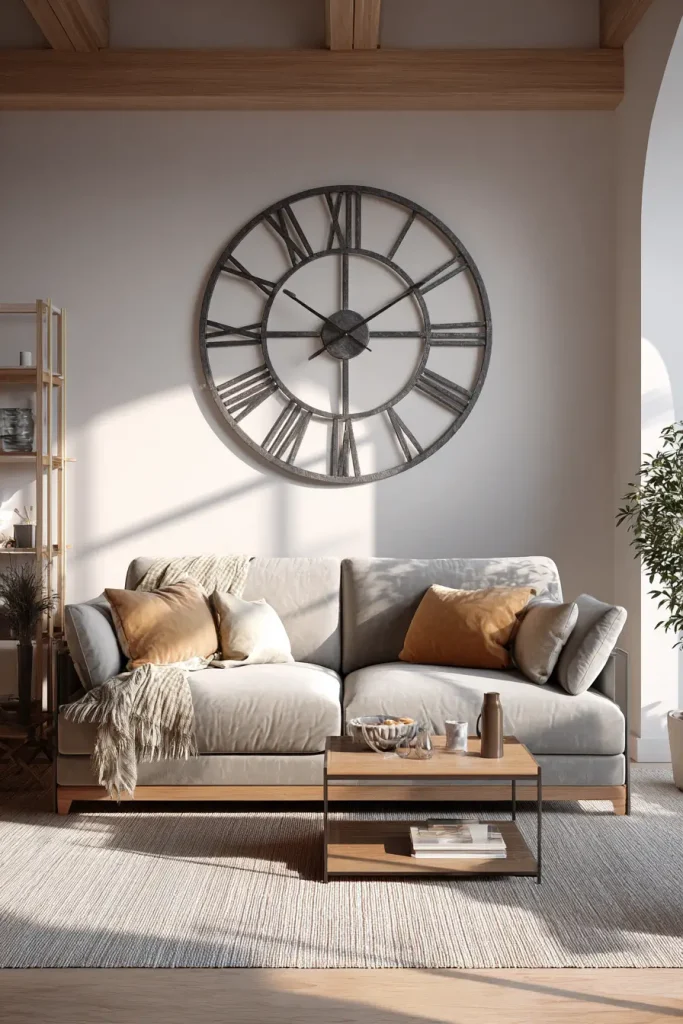
A large wall clock is one of the most underused options on this list. It’s functional and decorative at the same time.
Clock sizes for above-sofa placement: 24 to 36 inches in diameter works well. Anything smaller looks like a regular clock you’d put in a kitchen. At 24 inches and above, it becomes a design feature.
Modern farmhouse and industrial style rooms use oversized clocks most often. But a clean, minimal clock face in a metal or natural wood frame works in almost any room.
The key is choosing one that fits your existing style. A heavily distressed vintage clock in a sleek modern room will look out of place. Match the material and finish to what’s already in the space.
Good places to find large wall clocks in interesting styles: Wayfair, Etsy handmade sellers, and thrift stores where vintage oversized clocks show up regularly.
Pro Tip: Choose a clock with hands that are easy to read. Some decorative clocks sacrifice legibility for looks. The best ones do both.
#15 Layered Mixed Media: The Designer Look
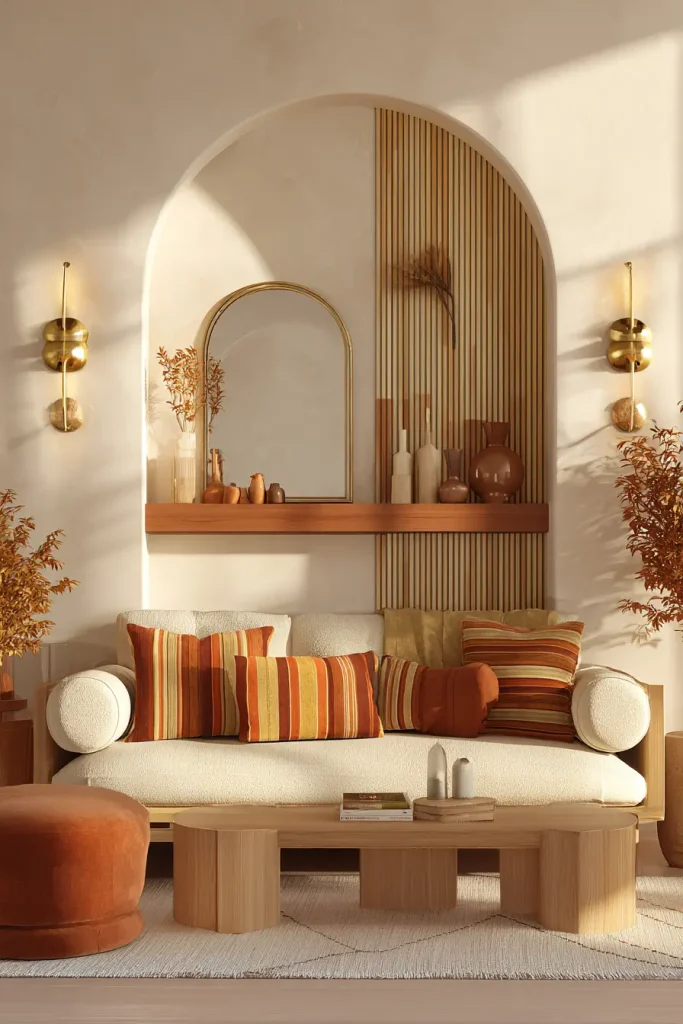
This is the most advanced approach. It combines multiple elements into one cohesive wall installation: art, shelves, sconces, plants, and objects working together.
This is also the one that requires the most planning. Without a plan, it looks cluttered. With a plan, it looks like it was designed by a professional.
The rule that keeps it from looking chaotic: limit yourself to two or three materials and stick to one color family. If you use brass metal, use it consistently. If your wood tones are warm, keep them all warm. One material family, one color story.
Start with the largest anchor piece and build outward. A real-world example that works well: a large arched mirror in the center, one floating shelf below it holding three objects, and one sconce mounted on each side. That’s it. Five elements, balanced, finished.
Before buying anything, sketch it out on paper or use a free room planning tool like Roomstyler or Planner5D. These tools let you place virtual furniture and decor elements on a wall so you can see proportions before spending money.
Pro Tip: When in doubt, remove one element. A layered wall with one item taken away almost always looks better. Less is usually more, even when you’re going for a maximalist effect.
Now Pick One and Start
You don’t need to redesign the whole room.
You just need to pick one idea from this list, measure your sofa width, and apply the two thirds rule to find your ideal art size. Then start there.
A gallery wall if you want variety. One large canvas if you want clean and simple. Floating shelves if you want flexibility. A mirror if you want the room to feel bigger. Whatever fits your style and your budget.
The living room wall decor ideas above the sofa that work best are the ones you actually follow through on. A perfectly planned wall that never gets executed changes nothing.
Measure the wall. Pick the idea. Do it this weekend.
The right piece in the right place makes the whole room feel finished. That blank wall won’t know what hit it.

- 17 Classy Living Room Ideas for a Cozy Elegant Look - April 23, 2026
- 16 Dark Moody Living Room Ideas That Feel Rich and Warm - April 22, 2026
- 14 Elegant Bedroom Trends for 2026 You’ll Love - April 22, 2026