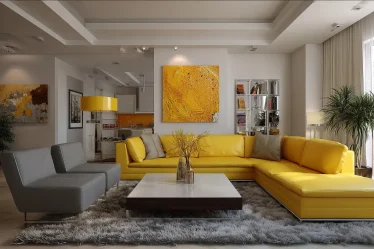
You love the serene emptiness of Scandinavian minimalism. They crave the vibrant chaos of bohemian maximalism. And somehow, you both need to watch Netflix in the same room without it feeling like a design war zone.
Sound familiar?
When two people with opposite tastes share a living room, the result is often one of two things: a constant power struggle or a bland beige compromise where nobody feels at home. The fear is real. You worry that giving in means losing your identity. They worry the same thing.
But here’s the truth. A shared living room doesn’t have to erase either of you. The goal isn’t to pick one style and bury the other. It’s to find the harmony in the contrast.
In this guide, you’ll learn a concept called “design diplomacy.” You’ll get the 80/20 rule for merging styles. And you’ll walk away with 18 actionable living room ideas for couples that respect both partners’ needs. No more fighting. Just a room that finally feels like both of you.
1. Embrace the 80/20 Rule: The Neutral Foundation Method

Does the phrase “greige walls” make one of you sigh in relief and the other sigh in boredom? Here’s the math to fix that.
The 80/20 rule is simple. Pick one neutral base that covers about 80 percent of your room. Think walls, sofa, and large rug. This becomes your peace treaty. Neither of you loves it, but neither of you hates it. It’s the Switzerland of your living room.
The remaining 20 percent is where you let your conflicting styles run free. This includes art, throw pillows, blankets, and decor objects. These are easy to swap out when moods or seasons change.
For 2026, look at colors like Sherwin-Williams’ “Quietude” or a soft sage. These act as neutral backdrops that satisfy nature-lovers and modernists alike.
This approach gives the minimalist a clean foundation to build on. And it gives the maximalist a blank canvas to layer their personality on top. Everyone wins.
2. Divide and Conquer: Zoning Without Walls
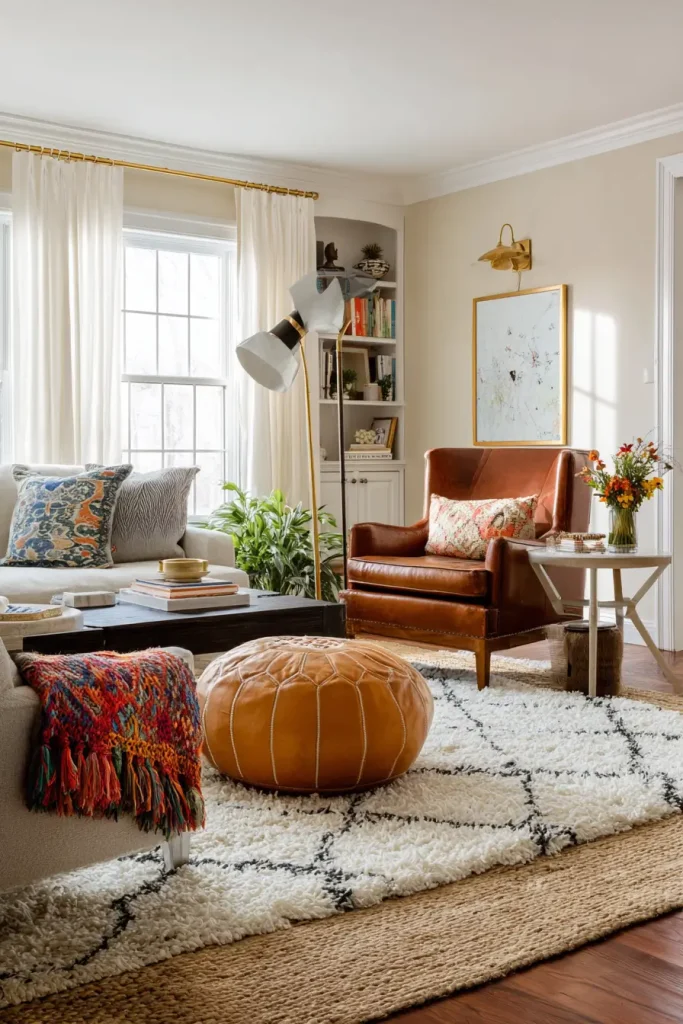
You don’t need to build a wall to create space for two different styles. Furniture can do the work for you.
The trick is to create “his,” “hers,” and “ours” zones within the same room. Start by identifying what matters most to each person. One of you might want a quiet reading nook. The other might want a vibrant crafting corner.
Use rugs to anchor each zone. A large neutral jute rug can define the main seating area where you both hang out together. A smaller colorful shag rug can mark a cozy corner that belongs to one partner.
For the reading nook, bring in a leather armchair and an industrial floor lamp. For the crafting corner, add soft textures and bold patterns. The zones are distinct, but they live side by side without fighting for attention.
This strategy works because it gives each of you a piece of the room that feels fully yours. And that makes the shared parts feel less like a compromise.
3. The “Third Style” Strategy: Find Your Unifying Element
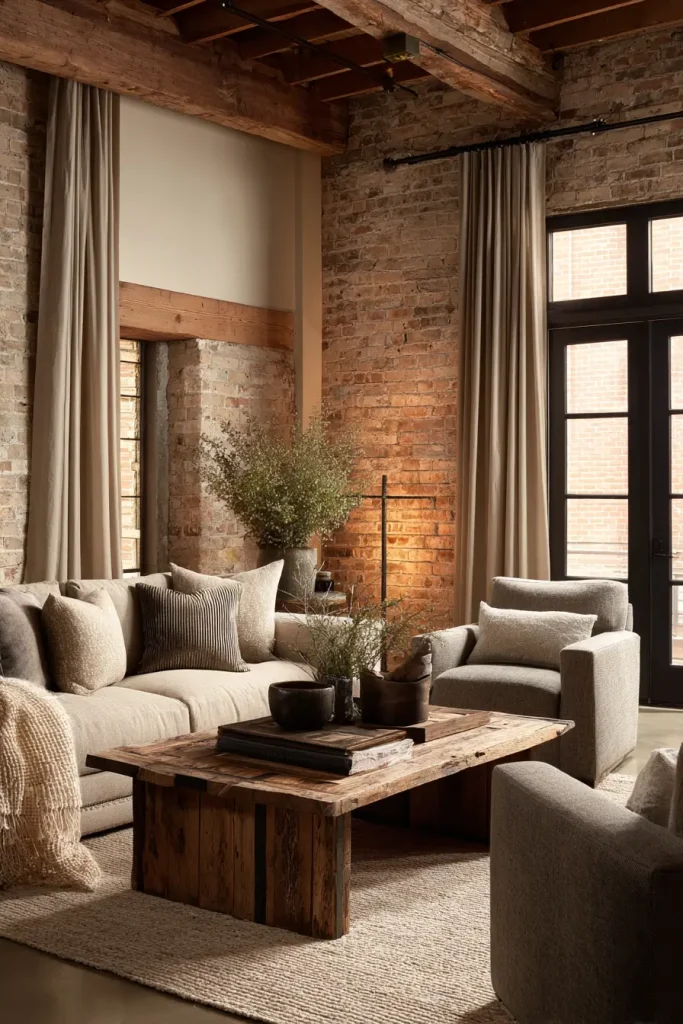
Sometimes merging two styles directly just doesn’t work. So don’t.
Instead, find a “third style” that you both can get behind. This is a hybrid style that pulls elements from both of your preferences without trying to force them together.
Let’s say one of you loves industrial design. Exposed brick, metal pipes, concrete floors. The other loves farmhouse style. Shiplap, soft linens, rustic wood.
The third style here is Modern Rustic. You keep the exposed brick from the industrial side and pair it with soft linen curtains from the farmhouse side. The result feels intentional, not chaotic.
Other popular third styles for 2026 include Japandi (Japanese minimalism meets Scandinavian warmth) and Organic Modernism (clean lines mixed with natural textures).
Pick a style you both genuinely like. Then use that as your guide. It’s easier to agree on a new shared direction than to argue over which old one is better.
4. Double the Joy: Symmetrical but Different

Symmetry creates balance. But it doesn’t require identical items.
This is a game-changer for couples who want visual harmony without sacrificing individual taste. Place two matching items on either side of a focal point, like a fireplace or TV. But let the items themselves be different.
For example, put two armchairs flanking the fireplace. One is a sleek Eames-style lounge chair. The other is a cozy floral wingback. They’re completely different styles. But because they sit in symmetrical positions, the room feels balanced.
You can do the same with floor lamps. Put one arc lamp on the left and one tripod lamp on the right. Or create a gallery wall where each partner curates their own side, but the frames are identical.
This approach respects both of your tastes while keeping the room from looking like a random collection of stuff.
5. The Chameleon Sofa: Invest in Neutral, Layer with Personality

The sofa is the largest piece of furniture in most living rooms. So it should be the one thing you both agree on without much fuss.
Invest in a high-quality, neutral sofa. Think bouclé, performance velvet, or leather in a color like cream, charcoal, or warm taupe. This piece acts as a blank canvas. It doesn’t lean too far in either direction.
Then layer your personalities on top using pillows and throws. This is where you can rotate styles based on mood or season. One month, go with geometric patterns that appeal to the modernist. Next month, switch to ikat or global prints for the maximalist.
A popular choice for 2026 is the cloud sofa style in a neutral tone. It’s comfortable, versatile, and easy to dress up or down. The sofa stays neutral. Your individual tastes get to come out and play on top.
6. Lighting Zones: Mood Over Matter
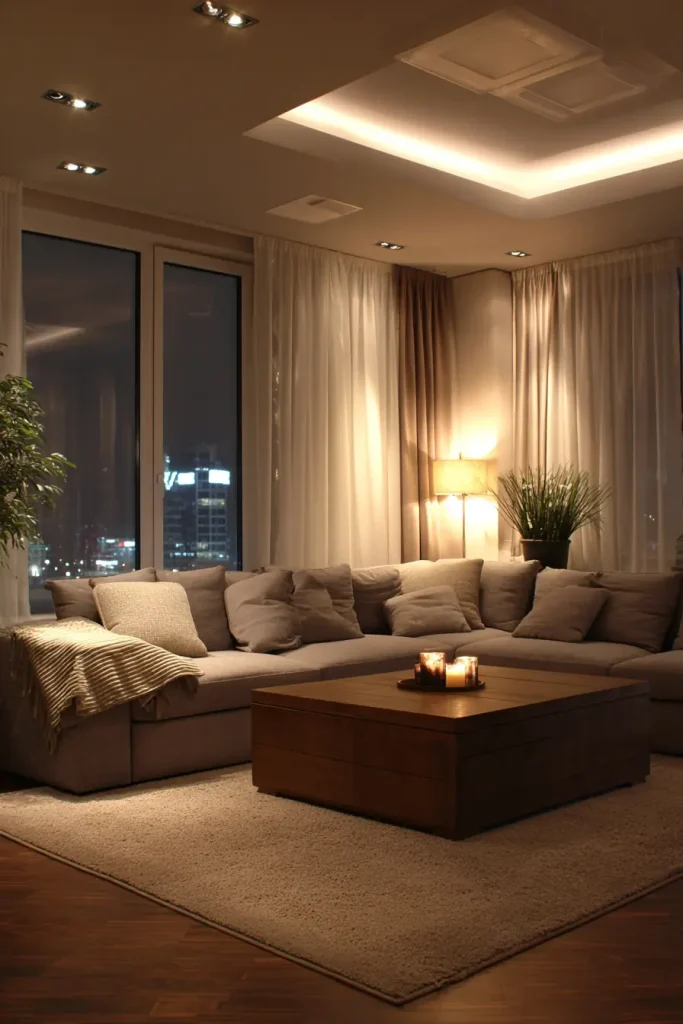
If one of you constantly complains it’s too bright and the other says it’s too dark, you have a lighting problem. The fix is zoning.
Use the three-layer lighting rule. Ambient lighting comes from the ceiling. Task lighting comes from reading lamps and desk lights. Accent lighting comes from picture lights and sconces.
Now give each person control over their zone. Smart bulbs are perfect for this. One partner can set the room to energizing cool white during the day for work or projects. The other can set it to warm candlelight in the evening for relaxation.
Philips Hue bulbs or similar systems let you change color and brightness without changing fixtures. You’re not arguing about the light. You’re just adjusting it to fit the moment.
This solves the “too bright or too dark” debate instantly. And it gives both of you control over your own space.
7. The “Yes, And” Gallery Wall

Gallery walls are a classic way to merge styles. But they often turn into a visual mess when two people with different tastes try to combine their art.
Here’s the trick. Keep the frames uniform. All black. All gold. All natural wood. The uniformity creates order that pleases the minimalist. But the content inside can be as varied as you want.
One partner can hang a vintage movie poster. The other can hang an abstract watercolor. Family photos, concert tickets, and children’s drawings can all live together. The matching frames make everything feel cohesive.
For layout, consider a grid if one of you prefers order. Or go salon-style (organized chaos) if that fits your vibe better. The key is that you’re both represented. And it looks intentional, not like a compromise.
8. Biophilic Diplomacy: The 2026 Trend That Unites Everyone

Plants are the great unifier. They soften industrial edges. They add life to sterile spaces. And almost nobody argues about having too many plants.
If one of you loves greenery and the other couldn’t care less, you can still make this work. The maximalist gets large statement plants like fiddle-leaf figs or monsteras. The minimalist gets sleek propagation stations with single stems in glass vases.
For low-maintenance couples, preserved moss walls or dried arrangements are trending in 2026. They give you the biophilic look without the watering schedule.
A 2025 study from the Journal of Environmental Psychology found that indoor plants reduce stress and increase the perceived attractiveness of a space by 15 percent. That’s a win for both of you.
9. Hidden Storage for the Minimalist, Open Display for the Maximalist
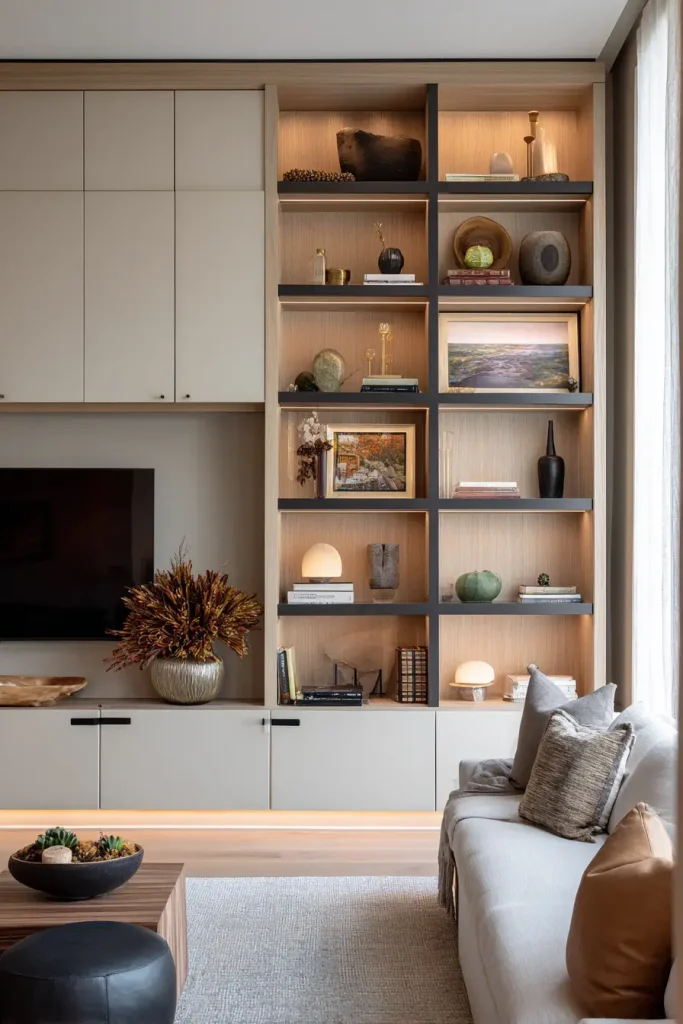
The clutter versus empty debate is one of the hardest to solve. One of you wants everything put away. The other wants their collections on display.
Modular shelving systems are your answer. Look at IKEA’s Besta or Elvarli lines. The idea is simple: mix closed cabinets with open shelves in the same unit.
Let’s say you get a floor-to-ceiling shelving unit. Sixty percent of the cubes have doors. This hides the stuff the minimalist finds messy. The remaining 40 percent are open. This gives the maximalist space to display their favorite books, collectibles, or art.
Add a “one-in, one-out” rule. Every time a new decor item comes in, something old goes out. This keeps the open shelves from overflowing. Both partners get what they want without resentment.
10. Texture as the Translator
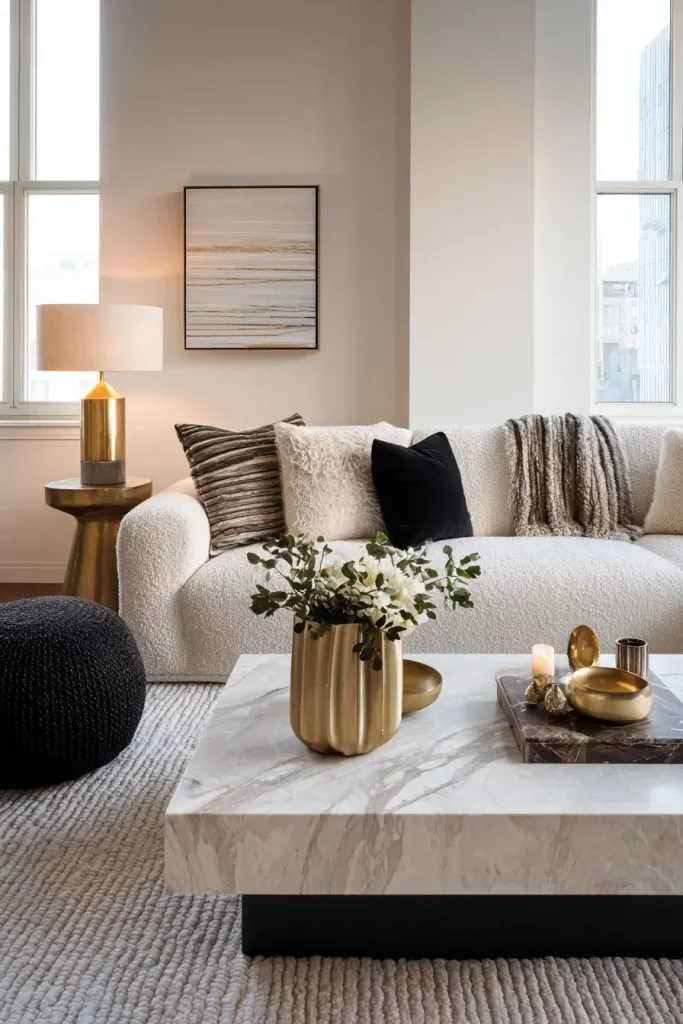
When colors clash, textures can bridge the gap.
Think about it this way. If one of you wants sleek marble and the other wants chunky knit, those two materials don’t naturally go together. But you can pair them in a way that creates contrast without conflict.
Put a marble coffee table on top of a thick wool rug. The hard, cold surface sits on top of the soft, warm texture. They balance each other.
For 2026, look for textures like bouclé, brushed brass, travertine, and velvet. Mixing these creates visual interest without requiring a color palette that pleases both of you. Texture becomes the translator between your two styles.
11. The Swing Vote: Use “Stealth” Color
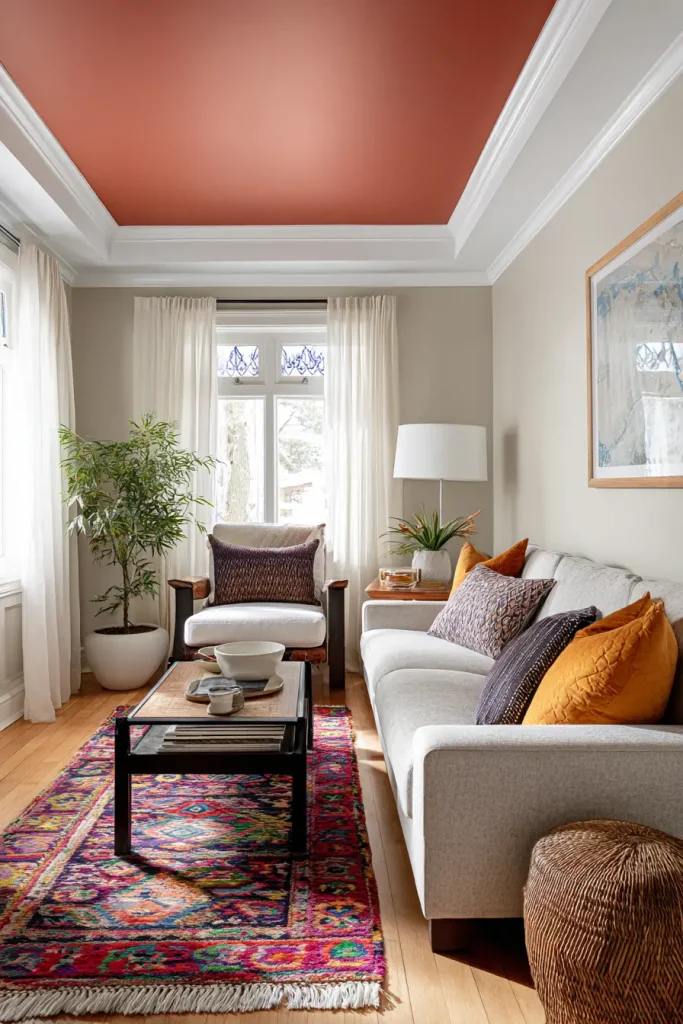
Color is often where couples get stuck. One person wants bold hues. The other wants all neutrals.
The solution is “stealth” color. Introduce color in places that aren’t permanent or overwhelming.
Painting the ceiling a bold color is a 2026 trend that works perfectly for this. A vibrant terracotta or deep green on the ceiling satisfies the color-lover. But since the walls and furniture stay neutral, the color-averse partner doesn’t feel overwhelmed.
Another approach is using a colorful rug as the anchor. Keep the walls and sofa neutral. Let the rug do all the heavy lifting color-wise. It’s easy to swap out later if tastes change.
This way, you get color without commitment. And both partners feel heard.
12. Furniture That Fights Fair: Modular and Mobile

Some arguments aren’t about how things look. They’re about how things function.
Modular furniture lets you change the room’s configuration based on what you’re doing. A modular sofa can be set up as a giant sectional for movie night together. Then reconfigured into two separate seating areas when you want to read or work independently.
Ottoman coffee tables with reversible tops are another smart choice. One side is a hard tray for holding drinks. Flip it over, and it’s a soft surface for putting your feet up.
Brands like Lovesac Sactionals make this easy. The furniture adapts to your needs, not the other way around. You stop fighting over the layout because the layout can change on demand.
13. Personal Corners: The Non-Negotiable

You don’t have to compromise on everything. In fact, you shouldn’t.
Every person needs a corner of the living room that is fully theirs. It doesn’t have to be big. A bookshelf, a chair, a small side table. But it has to be a place where the other person doesn’t get a vote.
Psychologist Dr. Sarah Thompson puts it this way: “Interior design is emotional. If a partner feels they have no space that reflects them, resentment builds. A designated corner preserves identity.”
So pick your spots. You get this bookshelf. They get that chair. You don’t comment on what they put in their space. They don’t comment on yours.
This simple rule can take the pressure off every other design decision in the room. Because you both know you have a place that’s just yours.
14. Digital Detox: Hiding the Tech
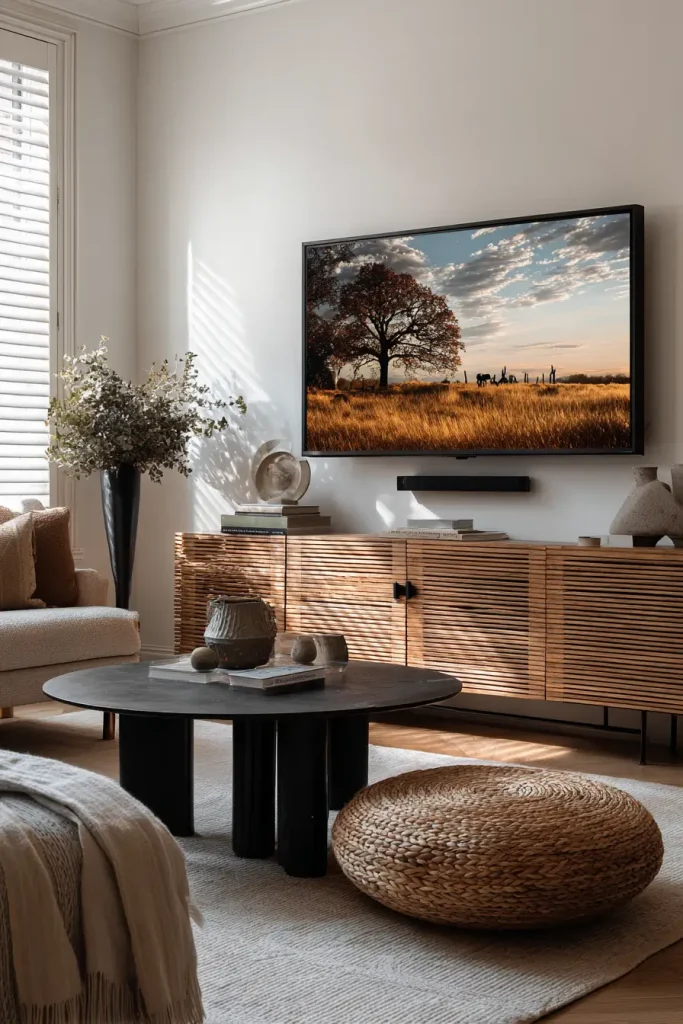
Gaming consoles, cable boxes, and streaming devices are essential. But they’re also an eyesore for anyone who values a clean aesthetic.
The fix is smart storage. Look for media consoles with vented doors or lift-top cabinets. These let you hide the tech while keeping it accessible and cool.
Cord management is another area where you’ll both agree. Nobody likes visible cords. Use cord covers, cable boxes, or run wires behind walls to clean up the clutter.
And if you’re upgrading your TV, consider the Samsung Frame. It displays art when it’s off. The art-lover gets a gallery piece on the wall. The tech-lover gets a high-quality screen. Everyone’s happy.
15. The Co-Creation Project: DIY Your Compromise

Sometimes the best way to solve a design disagreement is to build something together.
Pick a project that combines both of your styles. Build a coffee table using reclaimed wood (for the rustic lover) and hairpin legs (for the industrial lover). The result is something that belongs to both of you.
Before you start building, create a collaborative mood board. Pinterest has a feature for shared boards. You can both pin images, colors, and furniture pieces you like. The “Remodel” app lets you visualize furniture in your actual room.
The process becomes a bonding activity. And the finished piece becomes a symbol of your partnership, not a battleground.
16. Sensory Design: Sound and Scent

If you keep arguing about the visual stuff, shift the conversation to the other senses.
Acoustic panels are a great example. If one of you is sensitive to noise, felt wall tiles can absorb sound. The bonus is they can be designed as art. Geometric patterns, bold colors, or soft neutrals. They serve a function and look good doing it.
Scent is another area where you can find common ground. Instead of clashing floral vs. masculine scents, go neutral. Sandalwood, fig, or cedar work for almost everyone.
These sensory choices don’t replace visual design. But they give you something else to agree on while you figure out the rest.
17. The Trial Period: Use Peel-and-Stick

Commitment issues aren’t just for relationships. They happen with decor too.
Peel-and-stick wallpaper solves this problem. It’s trending in 2026 with bold patterns and textures. You can do an accent wall behind the TV or sofa. If one of you hates it in six months, it peels right off.
The same goes for removable tile backsplashes around a fireplace or bar area. Brands like Tempaper make it easy to experiment without permanent consequences.
This gives the risk-taker a chance to try bold ideas. And it gives the cautious partner peace of mind knowing it can all be undone. No harm, no foul.
18. Professional Neutrality: Hire a Designer for One Session

Sometimes you just need a referee.
Hiring an interior designer for a single consultation can break the stalemate. You don’t need a full-room renovation. Just two hours with someone who can look at your space and create a master plan that blends both of your styles.
Virtual services like Havenly offer this for a flat fee. You both fill out style quizzes. The designer creates a 3D render of the room. You get to see the compromise before you buy a single thing.
The investment is small compared to the cost of redoing a room after months of arguing. And having a third party say, “Here’s how this works,” can be the permission you both need to stop fighting and start decorating.
Conclusion
A house becomes a home when it reflects the people living in it. Plural.
The goal here isn’t to erase individual taste. It’s to create a conversation between styles. A room that tells the story of two people, not one.
You don’t have to tackle all 18 ideas at once. Start small. Pick one idea from this list. Maybe it’s the peel-and-stick accent wall. Maybe it’s agreeing on the 80/20 rule. See how it shifts the dynamic.
Living room ideas for couples don’t have to mean giving up who you are. They mean finding the harmony in the contrast. And that’s a style worth living with.

- 17 Classy Living Room Ideas for a Cozy Elegant Look - April 23, 2026
- 16 Dark Moody Living Room Ideas That Feel Rich and Warm - April 22, 2026
- 14 Elegant Bedroom Trends for 2026 You’ll Love - April 22, 2026