
In 2026, the era of sterile, all-white “sad beige” interiors is officially over. People are trading blank canvases for rooms with depth, personality, and a little edge. You might love the idea of a dark, cozy living room but worry it will feel cramped or gloomy instead of chic and inviting. That fear makes sense—get it wrong, and you’ve got a cave. Get it right, and you have a retreat you’ll never want to leave.
This guide gives you 16 current, actionable ways to master the moody aesthetic. We’ll go beyond painting walls black. You’ll learn about layered textures, strategic lighting, and the rise of darker maximalism. We’ll show you how to use charcoal greys, inky blues, and forest greens to create a space that feels luxurious, not claustrophobic. Ready to go dark? Let’s get started.
1. Lean Into the “Dark Maximalism” Trend (Not Minimalism)

Many people assume a dark room needs to be minimalist to avoid clutter. In 2026, the opposite is true. Dark maximalism is about layering patterns, textures, and pieces from different eras. Think a Victorian velvet sofa next to a brutalist concrete coffee table. That mix gives the room richness and prevents it from feeling cold or empty.
The key is to keep a cohesive color story. Stick to deep jewel tones, blacks, and charcoal greys, then layer in patterns like florals, geometrics, and stripes. According to the 2026 Houzz Interior Design Trends report, searches for “maximalist living room” and “dark paint colors” jumped 40% compared to 2024. That’s not a coincidence—it’s a shift toward spaces that feel personal and enveloping.
Pro tip: Start with one statement piece you love, then build around it. A bold patterned rug or an ornate mirror can anchor the whole look.
2. Use “Color Drenching” for a Cohesive Canvas

Color drenching means painting the walls, trim, ceiling, and even radiators the same dark shade. It blurs the lines of a room, making it feel larger—not smaller—because there are no visual interruptions. You’re not chopping up the space with white trim or a lighter ceiling.
For 2026, look at shades like Benjamin Moore’s Wrought Iron, Farrow & Ball’s Stiffkey Blue, or Sherwin-Williams Cyberspace. These colors are deep but not flat; they shift throughout the day. The Sherwin-Williams 2026 Colormix Forecast highlights “Envelop” as a key theme, focusing on single-hue, immersive spaces. That’s color drenching in a nutshell.
Pro tip: If painting the whole room feels like too much, try drenching a small area like a reading nook or a home office corner. You’ll get the effect without the commitment.
3. Anchor the Room with a Statement Velvet Sectional

Velvet is the perfect fabric for moody rooms. It catches light and adds a layer of tactile luxury that flat paint alone can’t provide. A large, low-profile sectional in deep emerald, sapphire blue, or even rust-colored velvet grounds the space. It gives the eye somewhere to land and prevents the room from feeling like it’s floating.
Brands like Article and Interior Define offer popular 2026 velvet sectionals in these deeper hues. When you pair velvet with dark walls, you get a space that feels cozy and intentional—like a high-end boutique hotel, but way more comfortable.
Pro tip: Choose a sectional with clean lines if your room is small. A bulky, ornate sofa can overwhelm the space. Keep the base simple, then add pillows and throws for texture.
4. Layer in Organic Textures to Soften the Drama

Dark rooms need texture. Without it, sound bounces off hard surfaces, and the space can feel echoey and harsh. The fix is to layer in natural, soft materials. Think jute rugs, chunky knit throws, raw wood coffee tables, and linen curtains (even in dark tones). This mix of industrial and organic is a key 2026 look.
A raw-edge wood coffee table against dark walls adds warmth and a rustic element that balances the formality of velvet. A jute rug brings a casual, grounded feel. And linen curtains in a deep charcoal or navy add softness without brightening the room too much.
Pro tip: Don’t be afraid to mix textures. A velvet sofa + a jute rug + a leather armchair + a wool throw? That’s the kind of layered look that makes a moody room feel lived-in and inviting.
5. Master the “Ambient Trio” Lighting Strategy

Overhead lighting is the enemy of a moody room. It casts harsh shadows and kills the cozy vibe. Instead, use three layers of light: ambient (overall), task (reading), and accent (art or architecture). The goal is to create pools of warm light, not one bright source.
Use sconces on either side of a fireplace or artwork. Place floor lamps in corners. Add table lamps on side tables. For bulbs, stick to 2700K—that’s the warm, incandescent-like glow. In 2026, sculptural brass lamps and paper lanterns are having a moment because they diffuse light softly.
As lighting designer Schoolhouse Electric notes, “The best dark rooms rely on pools of light rather than overall illumination. You want to see the light, not just the bulb.”
Pro tip: Put your lamps on dimmers. Being able to lower the light as the evening goes on makes the room feel like it’s shifting with your mood.
6. Introduce Moody Florals or Dark Botanical Wallpaper

If you want pattern but don’t want to commit to an entire wall of art, wallpaper is your answer. A bold, dark-floral or jungle-print pattern on a single accent wall—or even the ceiling—adds narrative and personality without overwhelming the space.
Brands like Rifle Paper Co., Milton & King, and Hygge & West have 2026 collections featuring “dark tropical” and “moody chintz” patterns. These wallpapers work especially well behind a bed, a sofa, or in a dining area. They bring in a sense of history and romance that plain paint can’t match.
Pro tip: If you’re renting, look for removable wallpaper. You get the drama without risking your security deposit.
7. Incorporate High-Shine Finishes and Metallics

Matte walls need shiny accents to reflect light and add depth. Polished nickel, brushed brass, and high-gloss lacquer on furniture are your friends. A high-gloss ceiling in a dark color can create a stunning, reflective “sky” effect that makes the room feel taller.
Try painting the inside of a bookshelf with a high-gloss version of your wall color. The subtle sheen catches light and adds a layer of sophistication. Even a single mirrored tray or a brass floor lamp can bounce light around the room.
Pro tip: Stick to one metal finish to keep the look cohesive. If you choose brushed brass for your lamps, use it for your cabinet hardware and picture frames too.
8. Curate a Dark, Gallery-Style Art Wall
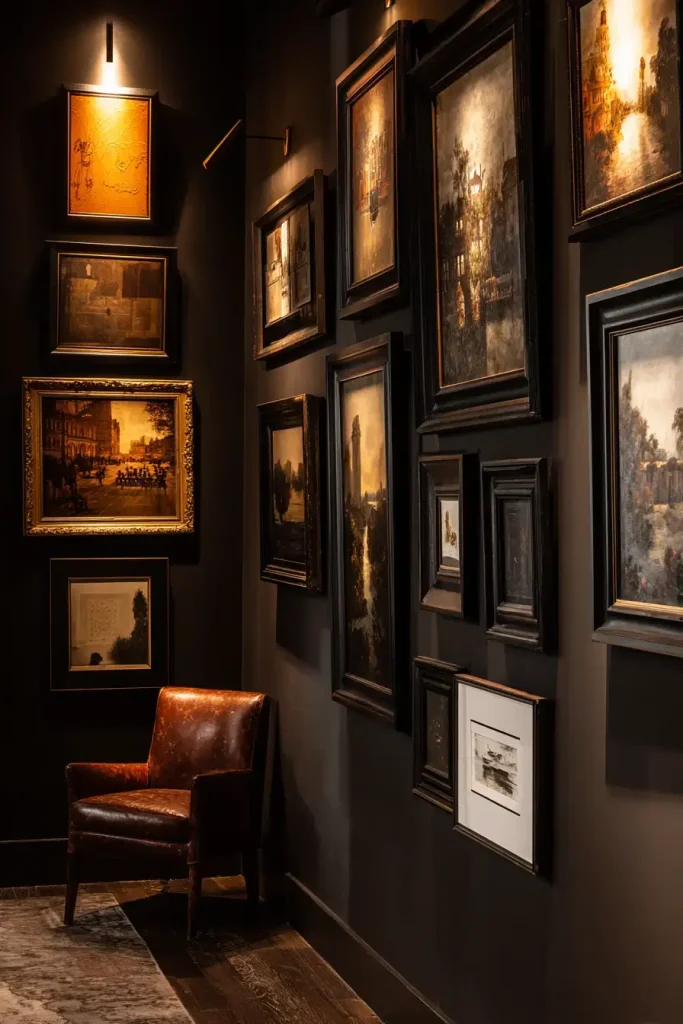
Move past beige art. A gallery wall of black-and-white photography, dark oil paintings, or pieces with deep jewel tones looks incredible against dark walls. Use black or dark wood frames so they blend into the background, making the artwork itself pop.
This creates a focal point and adds intellectual depth to the room. Resources like The Poster Club or Minted make it easy to find affordable, moody art. Look for pieces with dramatic lighting, shadowy landscapes, or abstract compositions in deep blues and greens.
Pro tip: Lean large-scale art against the wall instead of hanging it for a more relaxed, modern look. It’s an easy way to test placement before you commit to nails.
9. Use Black Metal and Iron Accents

Black metal window panes, shelving brackets, or a fireplace screen add an architectural edge. These elements break up large expanses of color and give the room definition. They’re timeless and work with almost any dark color scheme.
If you have existing black metal elements—like a window frame or stair railing—lean into them. Paint the walls a complementary dark shade to make those details stand out. The contrast between soft velvet and hard black metal is one of the most effective pairings in moody decor.
Pro tip: A black metal floor lamp with an adjustable arm gives you both task lighting and that industrial touch.
10. Go Dark on the Floor with a Statement Rug

Don’t be afraid to put dark floors or a dark rug in a dark room. A large, dark patterned wool rug—like a Persian or Moroccan style in deep reds and navys—anchors the furniture and adds warmth. It also hides everyday wear and tear better than a light rug.
To keep the room from feeling too heavy, contrast the dark rug with a light-colored coffee table or sofa. A cream or oatmeal sofa on a deep navy rug is a classic high-contrast look that feels intentional and balanced.
Pro tip: Make sure your rug is big enough. The front legs of your sofa and chairs should sit on the rug. That grounds the seating area and makes the room feel larger.
11. Create a “Book Nook” with Dark Library Shelving

Floor-to-ceiling built-in shelving painted a dark color turns an ordinary wall into an architectural feature. Style the shelves with a mix of books, ceramics, and personal objects—not just clutter. The dark background makes everything on the shelves stand out.
This is a classic moody look because it feels like a private library. It’s cozy, intellectual, and gives you a place to display your favorite things. If you don’t have built-ins, a large dark bookcase works too. Just make sure it’s tall enough to draw the eye up.
Pro tip: Paint the back of the shelves a slightly lighter shade than the wall to add depth. Or use removable wallpaper on the back panel for a surprise pop of pattern.
12. Use Strategic “Negative Space” with a Lighter Sofa

If you’re hesitant about going all-dark, use a light-colored sofa as a visual “breathing space.” A sofa in cream, oatmeal, or light grey against dark walls creates high contrast that feels modern and less intimidating.
This approach works especially well if you’re renting or planning to move soon. The dark walls set the mood, but the light sofa keeps the room from feeling closed in. You get the best of both worlds: drama without the commitment of dark upholstery.
Pro tip: If you choose a light sofa, balance it with dark accessories. A black coffee table, dark throw pillows, and a charcoal rug will tie everything together.
13. Bring in Biophilic Elements with Dark Foliage

Plants are essential in any room, but in a dark space, they add life and organic shape. Choose plants that thrive in lower light: Zamioculcas (ZZ plant), snake plants, and monsteras are all excellent options. Their deep green leaves complement the moody palette.
Use black or dark ceramic planters to continue the theme. The contrast between the dark planter and the green foliage is subtle but effective. According to the American Society of Interior Designers (ASID) 2026 biophilic design trend, bringing plants indoors is no longer optional—it’s a key part of creating a healthy, comfortable home.
Pro tip: Group a few plants together at different heights. A tall snake plant next to a shorter ZZ plant in matching dark pots creates a mini jungle vibe.
14. Play with Scale Using Oversized Art and Mirrors
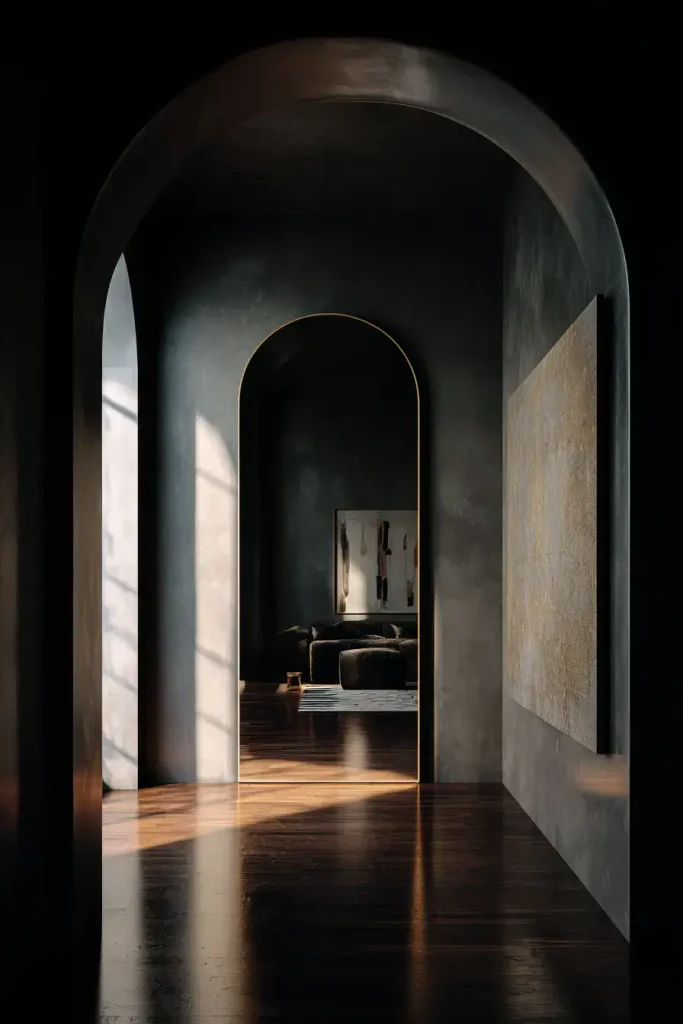
One huge piece of art or a massive arched mirror makes a bold statement and breaks up a dark wall. It draws the eye and gives the room a clear focal point. A large mirror placed across from a window will double the natural light, which is especially helpful in a dark room.
Oversized art doesn’t have to be expensive. Look for large canvases at thrift stores and paint them yourself with a dark, abstract composition. Or find a vintage mirror with an ornate frame and let it be the star.
Pro tip: Hang oversized pieces slightly lower than you think—eye level should be about 57–60 inches from the floor to the center of the art. In a dark room, that low placement feels more intimate.
15. Don’t Forget the Ceiling: The Fifth Wall

Most people paint the walls and stop. But the ceiling is the fifth wall, and painting it a dark color can make the room feel taller and more intimate. When the ceiling matches the walls, the boundaries of the room disappear, creating a cocooning effect.
This technique, often called “color drenching the ceiling,” has been popularized by designers like @kiva_brent and @barker_architectural on TikTok. One viral video showing a dark blue ceiling in a living room racked up over 2 million views. People are finally realizing that a painted ceiling adds depth and drama without extra square footage.
Pro tip: If you’re nervous about a fully dark ceiling, try painting it a dark color but leaving the trim white. That still gives you the drama but keeps some contrast.
16. Embrace the Imperfect: Vintage and Worn Finishes

New, shiny furniture can look stark against a dark backdrop. Vintage leather, worn wood, and antiqued mirrors add soul to a moody room. They prevent the space from feeling like a cold, staged showroom.
Look for a vintage leather armchair with patina or a rustic wooden trunk as a coffee table. Even a slightly tarnished brass lamp adds character. In 2026, searches for “vintage leather sofa” are outpacing “new leather sofa” on sites like Chairish and 1stDibs. People want furniture with history.
Pro tip: Mix one or two vintage pieces with new items. A sleek new velvet sofa paired with an old wooden bench creates the kind of layered look that feels collected, not curated.
Conclusion
Designing a moody living room isn’t about choosing one dark paint color and calling it done. It’s about orchestrating a mix of texture, lighting, and intentional layers. From the 2026 trend of color drenching to the essential ambient trio lighting strategy, each element works together to create a space that’s dramatic yet deeply livable.
Ready to embrace the dark side? Start with one idea from this list—maybe a charcoal grey accent wall or a velvet throw—and build from there. Share your moody makeover with us on social media using #DarkDramaticDecor. With these 16 moody dark living room ideas, you can transform your home into a dramatically stunning retreat that feels personal, cozy, and perfectly on-trend for 2026.

- 17 Classy Living Room Ideas for a Cozy Elegant Look - April 23, 2026
- 16 Dark Moody Living Room Ideas That Feel Rich and Warm - April 22, 2026
- 14 Elegant Bedroom Trends for 2026 You’ll Love - April 22, 2026


