
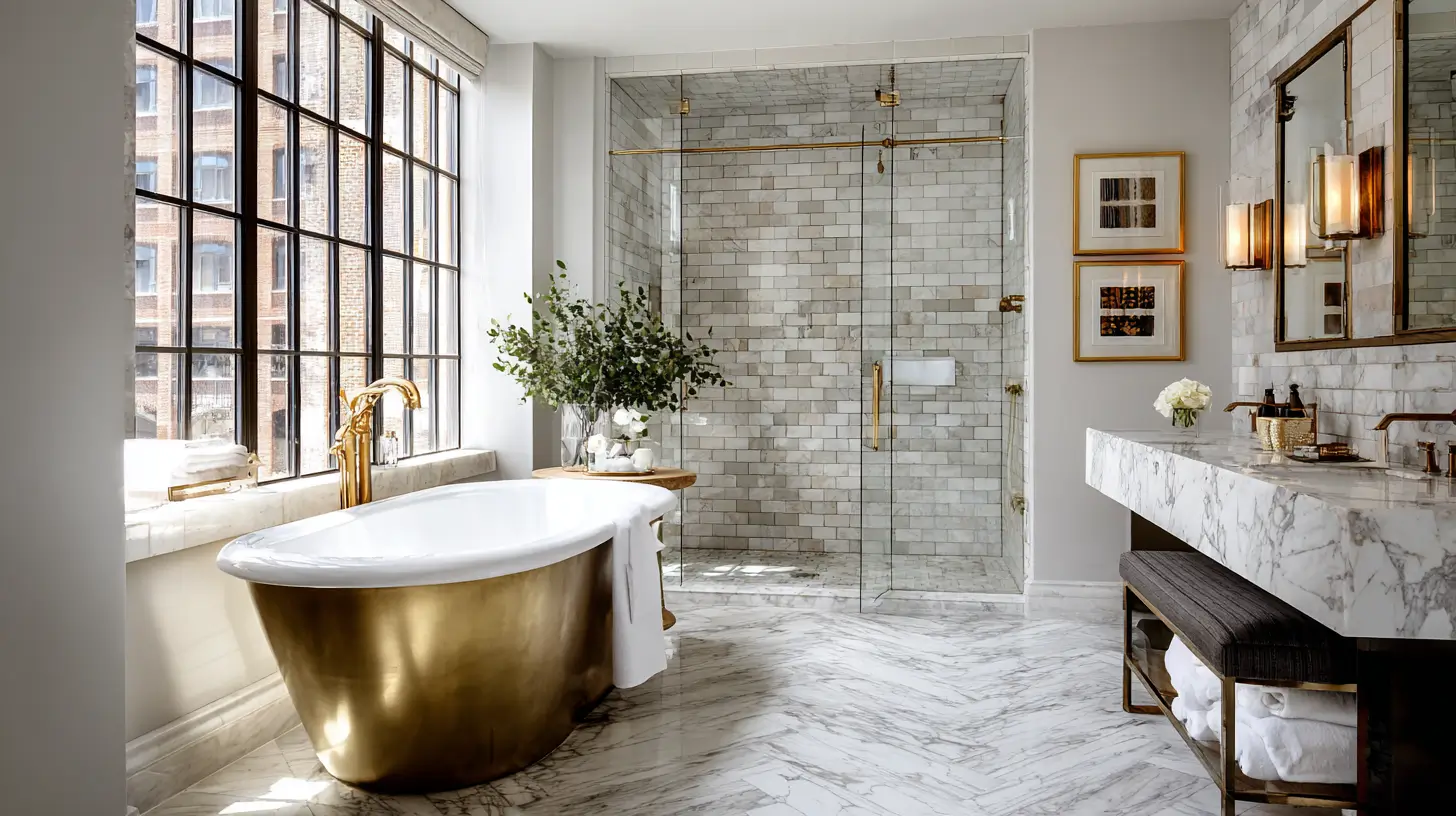
Your bathroom should lower your blood pressure — not raise it.
But most master bathrooms do the opposite. Cold lights. Cluttered counters. A shower curb you trip over every morning. You see hotel spas on social media and think: “Why can’t my home feel like that?”
Here’s the truth: You don’t need a bigger bathroom. You need better choices.
This guide gives you 14 specific, budget-aware ideas for 2026. You’ll learn which upgrades add resale value and which are just expensive trends. We’ll cover biophilic bathroom design 2026, smart spa shower systems, and the difference between a wet room vs curbless shower.
Let’s fix your bathroom.
1. Start with a Wet Room Instead of a Traditional Shower + Tub
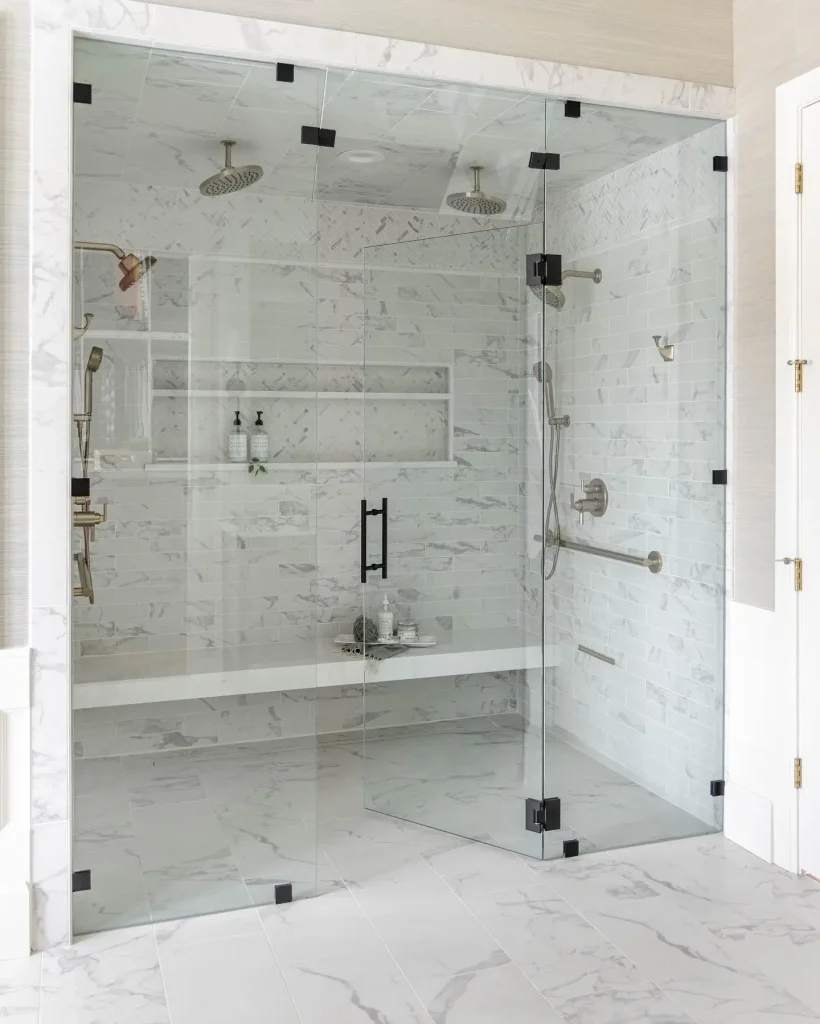
You’ve stepped over a shower curb 3,000 times. That one motion tells your brain “obstacle” — not “retreat.”
A wet room fixes that. It’s a fully waterproofed, open floor plan with no curb and no door. The whole bathroom floor can get wet.
Why wet rooms dominate 2026 spa designs: They work for aging in place. And they look expensive without being complicated.
Here’s the data: A 2026 NKBA trend report found that 68% of luxury bathroom remodels now include a wet room or curbless shower.
What you need:
- Minimum 60 square feet of floor space
- Drainage slope of ¼ inch per foot toward a trough drain
- A waterproof membrane under all tile
Real example: Instagram account @bathroomdesign2026 (January 2026) showed a 70 sq ft wet room with a heated towel ladder and teak shower bench. It cost $8,200 in materials.
What NOT to do: Don’t skip the waterproofing inspection. Leaks in wet rooms cost $5,000+ to fix.
Pro tip: Measure your bathroom length tonight. If it’s over 8 feet in any direction, you have room for a wet room.
2. Install a Steam Shower System (Not Just a Rain Head)

A rain head looks pretty. Steam actually helps you recover.
Steam showers open your sinuses. They relax sore muscles. And they make a 10-minute shower feel like a spa treatment.
Here’s the 2026 upgrade: Smart steam systems with app-controlled temperature, aromatherapy cartridges, and chromotherapy lights.
Cost range: $3,000 to $6,000 for a quality residential system.
What the data shows: Consumer Reports 2026 says steam showers increase perceived home value by 8–12% in mid-range markets.
Expert quote: “A rain head is visual. Steam is functional. Do both if you can.” — Sarah Thompson, certified master bathroom designer (Houzz 2026 interview).
Ventilation requirement: You must have an exhaust fan rated for the room size. Steam without ventilation ruins drywall in 18 months.
What NOT to do: Don’t buy a cheap steam generator under $1,500. They break in two years.
Pro tip: Install the steam head at ankle height. Heat rises. Your whole body gets warm faster.
3. Add Heated Floors Only Where You Stand

You don’t need to heat the whole bathroom. Just the spots where your bare feet land.
Zoned electric radiant heating goes under three places:
- In front of the vanity
- In front of the toilet
- Where you step out of the shower
Why this works: 2026 energy-efficient mats use only 90 watts. A full floor uses 300+ watts.
Cost to run: Energy.gov 2026 update says zoned radiant floor heating costs $0.08 to $0.12 per hour in a master bath.
Best flooring for heated floors: Porcelain, natural stone, or luxury vinyl. Never under a freestanding tub (traps heat and cracks the tub).
DIY or pro? Electric mats are DIY-friendly. Hydronic (water-based) systems need a pro.
Product to know: Schluter-DITRA-HEAT-E (2026 model with Wi-Fi thermostat and usage tracking). About $1,200 for a 50 sq ft kit.
What NOT to do: Don’t put mats under a toilet. The wax ring melts.
Pro tip: Run the floor heat 30 minutes before your morning shower. Use the app timer, not all day.
4. Use Large-Format Porcelain That Mimics Natural Stone

Small tiles mean lots of grout lines. Grout lines trap soap scum and mildew.
The fix: 24”x48” or larger porcelain slabs. Fewer grout lines = less cleaning.
Top 2026 finishes:
- Calcatta macro (white with gray veins)
- Basalt gray (dark and matte)
- Travertine-look matte (warm beige)
Why matte over polished: Polished stone gets slippery when wet. Matte hides water spots too.
Data point: The 2026 Coverings Show reported that large-format porcelain now outsells natural stone 3:1 in primary bathrooms. Zero sealing required.
Real product: Floor & Decor’s “Aria Stone” series — $4.99 per square foot, PEI rating 4 (durable enough for wet areas).
Design trick: Run the same tile from the floor onto the shower wall and up to wainscot height (about 36 inches). Creates visual flow.
What NOT to do: Don’t use polished marble in a wet room. It etches from acidic soap.
Pro tip: Buy 10% extra tile. Large-format breaks easier during cutting.
5. Build a Floating Vanity with Hidden Storage

A floating vanity makes your floor visible. That alone makes the room feel bigger.
The 2026 must-have: A tip-out drawer in the front false panel. Hides small items like razors and toothbrushes.
Height recommendation: 34 to 36 inches. Standard is 32 inches, but taller is better for back comfort.
Why open shelving fails: Houzz 2026 Bathroom Study found that 73% of homeowners regret open under-vanity storage. It looks cluttered within weeks.
What works instead: Soft-close drawers with built-in organizers. Same study says floating vanities with soft-close drawers have 94% satisfaction.
Product example: IKEA Godmorgon series (2026 updated version) has an integrated outlet inside the top drawer. $489 for a 48” unit.
What NOT to do: Don’t mount a floating vanity on drywall alone. You need blocking between studs.
Pro tip: Leave 8 inches of clearance from the floor. That’s enough for a robot vacuum to clean under it.
6. Add a Dedicated Trough Drain (Not a Center Drain)

Center drains leave standing water around your feet. Trough drains (linear drains) go along the edge of the shower area.
Why 2026 building codes favor them: They’re ADA-compliant, easier to clean, and less slippery.
Two placement options:
- At the entrance of the wet room (water flows away from the door)
- Along the back wall (water flows toward the wall)
Hidden vs. tileable covers: Tileable covers disappear into the floor. You don’t see a metal grate.
Slope requirement: 1 to 2 degrees toward the trough.
Code update: The 2026 IRC (International Residential Code) now recommends linear drains for all curbless showers over 36 inches wide.
Product mention: QuickDrain USA’s BendShowerPro (2026 model). Has a hair-catching basket you empty from the top. No need to pull up the drain cover. About $450.
What NOT to do: Don’t put the trough drain in the middle of the floor. You’ll stand on it. It’s uncomfortable.
Pro tip: Use a laser level for slope, not a bubble level. Bubble levels aren’t accurate enough for 1-degree slopes.
7. Install a Heated Towel Ladder or Rack
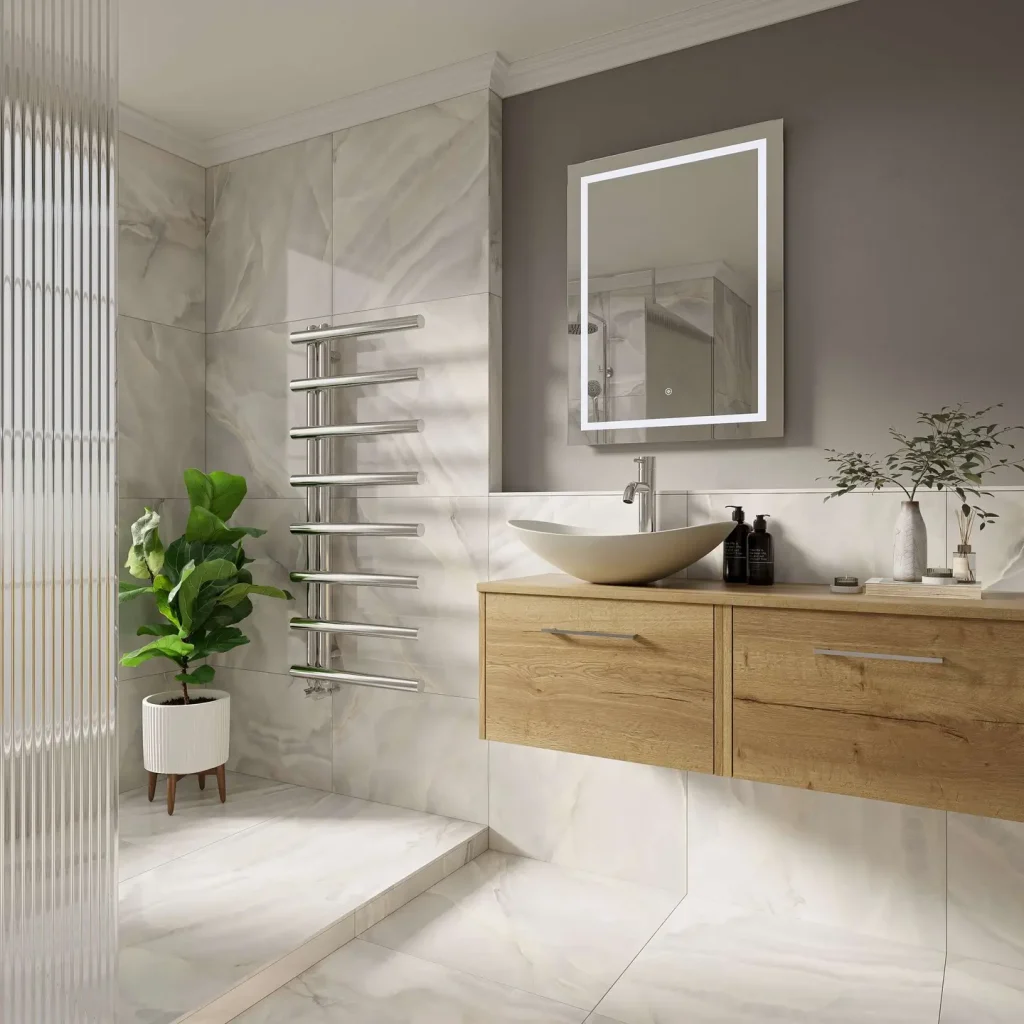
A cold towel ruins a warm shower. A heated towel ladder fixes that.
Ladder-style vs. horizontal rack: Ladder style (vertical bars) saves wall space. Horizontal racks need more width.
Hardwired vs. plug-in: Hardwired looks cleaner. Plug-in is fine if you rent or don’t want to hire an electrician.
2026 low-wattage models: 150 watts. They run on timers or humidity sensors.
Running cost: Energy monitoring data from Sense.com (2026) says running a heated towel rack 2 hours per day costs about $12 per year.
Position rules: Within arm’s reach of the shower exit. Not above the toilet (germs). Not behind the door.
Product example: Amba RAL5010 (2026 model). Auto shut-off at 130°F to prevent fabric damage. $279.
What NOT to do: Don’t buy a rack without a timer. You’ll forget to turn it off.
Pro tip: Mount it at 48 inches high. That’s the right height to grab a towel without bending.
8. Bring in Living Plants That Actually Thrive in Bathrooms

A spa without plants is just a tile showroom.
Best low-light, high-humidity plants for 2026:
- Philodendron micans (velvet leaves)
- Calathea orbifolia (big round leaves)
- Snake plant (Sansevieria) — almost impossible to kill
New 2026 product: Umbra makes magnetic ceramic pots that stick to shower walls. No drilling.
What to avoid: Ferns drop spores everywhere. Succulents rot in humidity.
Plant count: At least three different heights. Tall snake plant in the corner. Medium calathea on the counter. Small philodendron mounted on the wall.
Data point: A 2025 meta-analysis (updated from NASA Clean Air Study) found that bathrooms with three or more medium-sized plants have 47% lower airborne VOCs from cleaning products.
Expert quote: “A spa without plants is just a tile showroom.” — James Wong, botanical designer (2026 interview, Gardenista).
What NOT to do: Don’t use soil with fertilizer beads. They wash out and stain grout.
Pro tip: Water plants while you shower. The steam does the work. Just once a week.
9. Upgrade to a Wall-Mounted Bidet Toilet

A wall-mounted toilet makes floor cleaning easy. No base to scrub around.
The 2026 bidet features you want:
- Heated seat
- Warm air dryer
- UV nozzle cleaning
- Night light
Dual-flush specs: 0.8 gallons for liquid. 1.28 gallons for solid. Meets EPA WaterSense 2026 standards.
Water savings: Porcelain Superstore data says homeowners save 3,200 gallons per year switching from a standard 1.6 GPF toilet to a dual-flush bidet.
Weight limit: Most wall-mounted bidets support 500 to 600 pounds when properly installed.
Sales trend: Toto Neorest series (2026) reported 40% year-over-year growth for wall-mounted bidets in master baths.
Rough-in height: 26 to 30 inches from floor to center of waste pipe.
What NOT to do: Don’t install a wall-mounted toilet on a non-load-bearing wall. It will crack.
Pro tip: Run electrical and water supply before closing the wall. Retrofits are expensive.
10. Use a Single Sconce on a Dimmer (Not Overhead Can Lights)

Overhead lights cast shadows under your eyes. You look tired even when you’re not.
The 2026 spa bathroom rule: No overhead cans. Only vertical sconces.
Placement: One sconce on each side of the mirror. Mount them at 66 inches high. Or use one long horizontal bar above the mirror.
Color temperature: 2700K to 3000K only. No daylight bulbs (5000K). They make skin look gray.
Dimmers are required. And they must be ELV dimmers (compatible with LED). Standard dimmers cause flickering.
Data point: American Lighting Association 2026 report says 81% of homeowners rated side-mounted sconces as “significantly more relaxing” than overhead lights.
Product example: Visual Comfort’s “Porte” sconce (2026 model). Opal glass with backward-facing LED. No glare. $229 each.
What NOT to do: Don’t use exposed bulbs. The glare hurts eyes first thing in the morning.
Pro tip: Put the dimmer switch inside the bathroom, not outside. You’ll adjust lights while looking in the mirror.
11. Add a Freestanding Soaking Tub (But Only If You Have Space)

A soaking tub looks great. But only if you have room.
Minimum clearance: 24 inches on all sides of the tub. That means a 60-inch tub needs a 108-inch wide room.
2026 material winner: Lightweight solid surface (acrylic mixed with stone dust). Warm to the touch. Easier to clean than cast iron.
Avoid these tubs:
- Slipper tubs (uncomfortable back angle)
- Copper (expensive, hard to keep shiny)
Filler placement: Floor-mounted or wall-mounted. Never deck-mounted on a freestanding tub.
Resale value: 2026 realtor survey from the National Association of Home Builders says freestanding tubs recoup 63% of cost in primary bathrooms over 150 square feet.
Product example: Woodbridge “Baja” 67-inch solid surface tub. $1,200. Weighs 140 pounds (cast iron is 350+ pounds).
What NOT to do: Don’t put a freestanding tub against a wall. You need access to both sides for cleaning.
Pro tip: Fill the tub with cold water first, then hot. That prevents thermal shock cracks in solid surface tubs.
12. Install a Recessed Niche with Built-in Lighting

Shower niches are great. But most are too small and poorly lit.
Size rule: Niche must be 24 inches tall minimum. That fits full-size shampoo bottles standing up.
2026 trend: Backlit niches. Waterproof LED tape inside an aluminum channel.
Position: Opposite the shower head. If you put the niche under the shower head, water fills the bottles.
Avoid corner niches. Hard to clean. And avoid soap dishes — they look dated.
Leak data: A 2026 Schluter-KERDI survey found that 58% of shower leaks happen at poorly installed niche corners.
Solution: Use a pre-formed niche. Kerdi-Board niches cost $89 to $129. They’re waterproof out of the box.
Product example: “GloNiche” by Innovate Building Solutions. Pre-wired, waterproof, and dimmable. $299.
What NOT to do: Don’t cut the waterproof membrane to fit a DIY niche. That’s where leaks start.
Pro tip: Angle the niche shelf slightly downward (1/8 inch). Water drains off instead of pooling.
13. Choose a Single Organic Material Palette

Too many materials make a bathroom feel chaotic. Limit yourself to three.
Example palette: Oak vanity + basalt tile + matte black fixtures.
2026 color direction: Warm neutrals. Greige, mushroom, taupe. Cool grays are out.
Wood rules: Use teak or thermally modified ash. Both resist rot. No sealing needed.
Design trick: Run the same material from floor to accent wall. Creates visual quiet. Your brain relaxes faster.
Data point: Sherwin-Williams 2026 Colormix forecast shows their “Grounding” palette (SW 9585 Accessible Beige, SW 9579 Spare White) is up 210% in bathroom searches.
Real example: TikTok account @spabathroomdesign (February 2026 video) showed a 110 sq ft master bath using only brushed oak, matte black, and large-format limestone-look tile.
What NOT to do: Don’t mix warm wood with cool gray tile. The clash feels wrong even if you can’t say why.
Pro tip: Buy sample tiles and hold them next to your vanity wood at home. Store lighting lies.
14. Add a Sound System (But Not Built-In Speakers)

Built-in speakers seem cool. But tech changes every three years. And replacing in-wall speakers means cutting drywall again.
The 2026 approach: A waterproof Bluetooth mirror or one portable speaker.
Why portable is better: You can update it for $200 instead of $2,000.
Mirror with integrated speaker: Also has a defogger and dimmable light. Under $300 now.
Speaker placement: Counter height, not ceiling. Sound clarity is better at ear level.
CES 2026 data: Kohler’s “Moxie” shower speaker (magnetic docking) — 78% of buyers chose the removable version over fixed built-ins.
Product example: Fresca “Milano” 2026 mirror. 24 inches round. Bluetooth 5.3. IP44 rated (water resistant). $279.
What NOT to do: Don’t put a portable speaker inside the shower. Steam kills the battery even if it’s “waterproof.”
Pro tip: Connect the speaker to a smart plug. Say “Alexa, start shower speaker” before you get in.
Conclusion
You don’t need to remodel your whole bathroom at once.
Pick one high-impact change from this list. A trough drain. A floating vanity. Three living plants. Start there.
Then pick two more. Sketch them into your floor plan this week.
Prioritize wet rooms over traditional showers. Warm lighting over cold. And materials you actually want to touch.
Here’s your action step: Save one product link from this article into a folder called “bathroom 2026.” Do it today.
Because your bathroom should lower your blood pressure — not raise it. That’s the whole point of master bathroom ideas for a spa like retreat at home.

- 17 Classy Living Room Ideas for a Cozy Elegant Look - April 23, 2026
- 16 Dark Moody Living Room Ideas That Feel Rich and Warm - April 22, 2026
- 14 Elegant Bedroom Trends for 2026 You’ll Love - April 22, 2026


