Introduction
Your hallway is the first thing people see when they walk into your home. And most of the time, it says nothing.
Beige walls. A coat hook. Maybe a mirror from five years ago. That’s it.
You’ve probably spent real money on your living room and kitchen. But the hallway? It gets ignored. And that’s a problem, because first impressions stick.
Here’s the good news. You don’t need a full renovation to fix this. Dark hallway ideas are one of the easiest ways to make a bold, lasting first impression. We’re talking about paint, lighting, wallpaper, and a few smart choices that turn a forgettable corridor into the most dramatic room in your home.
These 16 ideas are specific and practical. Each one works on its own. Put two or three together, and your hallway becomes something people actually talk about.
Let’s get into it.
Why Dark Hallways Work (And the Myths You Should Ignore)
Most people avoid dark colors in hallways for one reason. They think it’ll feel like a cave.
It won’t.
Here’s what actually happens. In a small, enclosed space like a hallway, dark walls absorb the sharp edges of the room. The corners soften. The space starts to feel intentional instead of cramped. Light doesn’t bounce around randomly. It settles.
Architects use a technique called compression and release. A dark entry leads into a bright living room. That contrast makes the bright room feel bigger and more welcoming than it would on its own. The dark hallway does the work before anyone even sits down.
Designers like Kelly Wearstler and Axel Vervoordt have built entire careers on dark, moody interiors. These are not small names. Wearstler’s work appears regularly in Architectural Digest. Vervoordt’s book Wabi Inspirations is used as a reference by interior designers worldwide. Both of them use darkness on purpose.
Pinterest data from their annual trend reports shows that searches for dark interior design have grown significantly year over year. Houzz’s research consistently places entryways in the top five most renovated spaces in the home. People are paying attention to hallways now.
The myth that dark means small is just that. A myth. What dark actually means is dramatic. And dramatic is exactly what a hallway should be.
1. Choose a Paint Color That Commands Attention
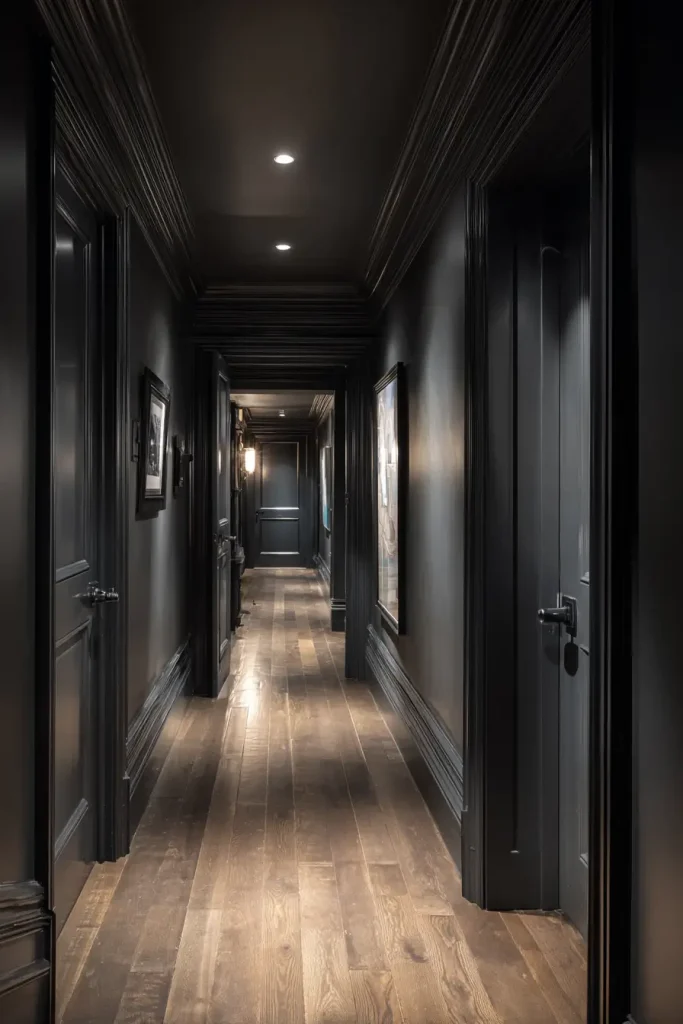
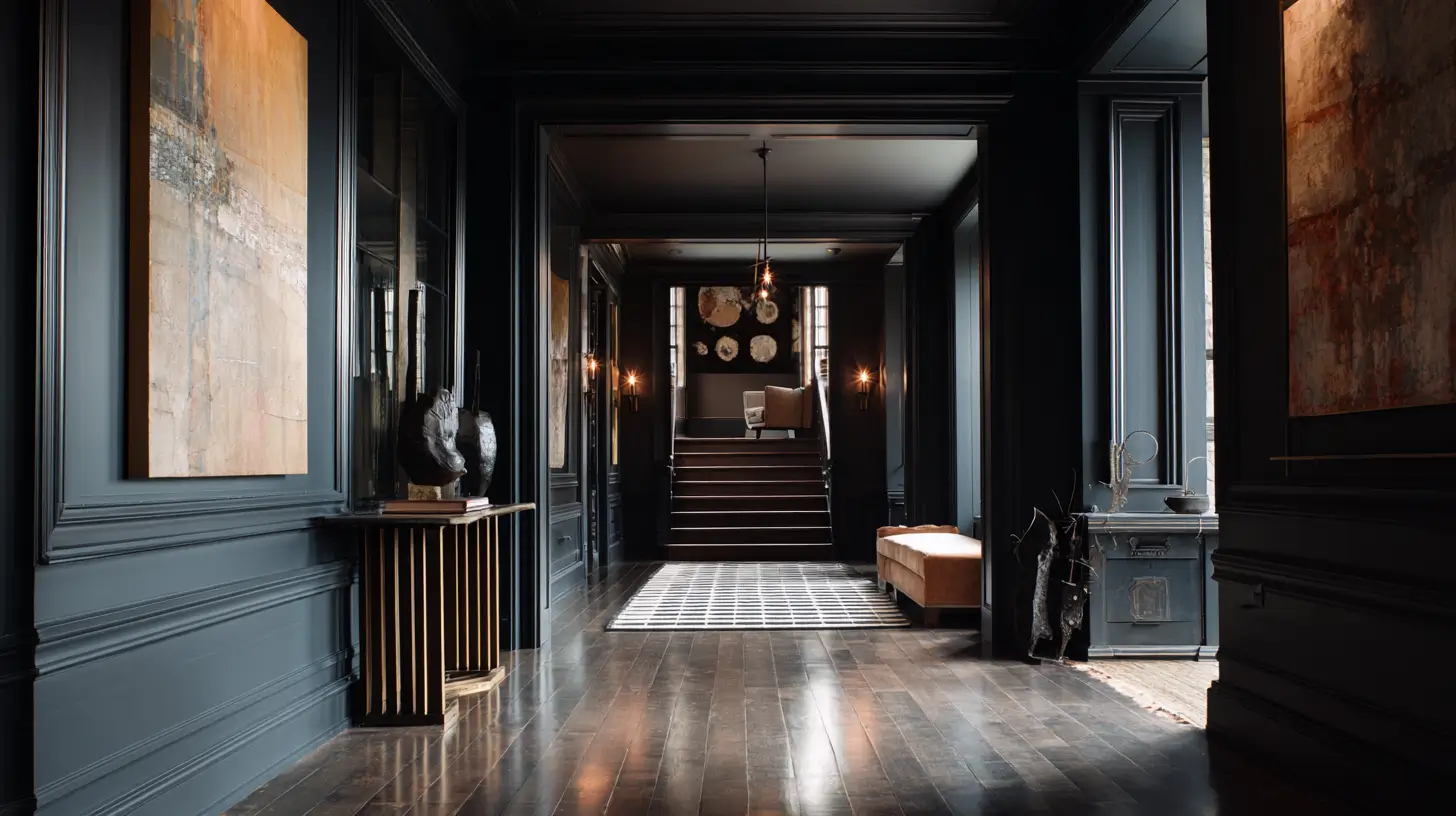
Paint is your starting point. It’s also your most powerful tool.
The finish matters as much as the color. Flat or matte finishes absorb light completely. They create the deepest, richest look. Eggshell has a slight sheen and is easier to wipe clean in a high traffic space. For hallways, eggshell is usually the smarter choice.
Here are five specific colors worth looking at:
- Farrow & Ball Railings No.31 — a near black with blue undertones. It reads as almost black in low light and deep navy in daylight.
- Benjamin Moore Black Panther 2125-10 — a true, warm black. No purple or blue cast.
- Sherwin-Williams Tricorn Black SW 6258 — one of the most popular near-black paints in the US. Clean and neutral.
- Little Greene Obsidian — a deep charcoal with green undertones. Works well with wood and brass.
- Dulux Midnight Dream — a rich indigo that adds color without going too bold.
Test dark paint the right way. Buy the largest sample size available. Paint a piece of white cardboard or lining paper at least 12 inches square. Pin it to the wall and look at it in the morning, afternoon, and evening. Dark colors shift a lot depending on the light.
One move that designers use often: paint the trim and woodwork the same dark color as the walls. No white skirting boards. No contrast. Just one continuous dark tone. It looks expensive and removes the “painted box” effect.
Order your samples this week before you do anything else.
2. Use Moody Wallpaper to Add Instant Drama
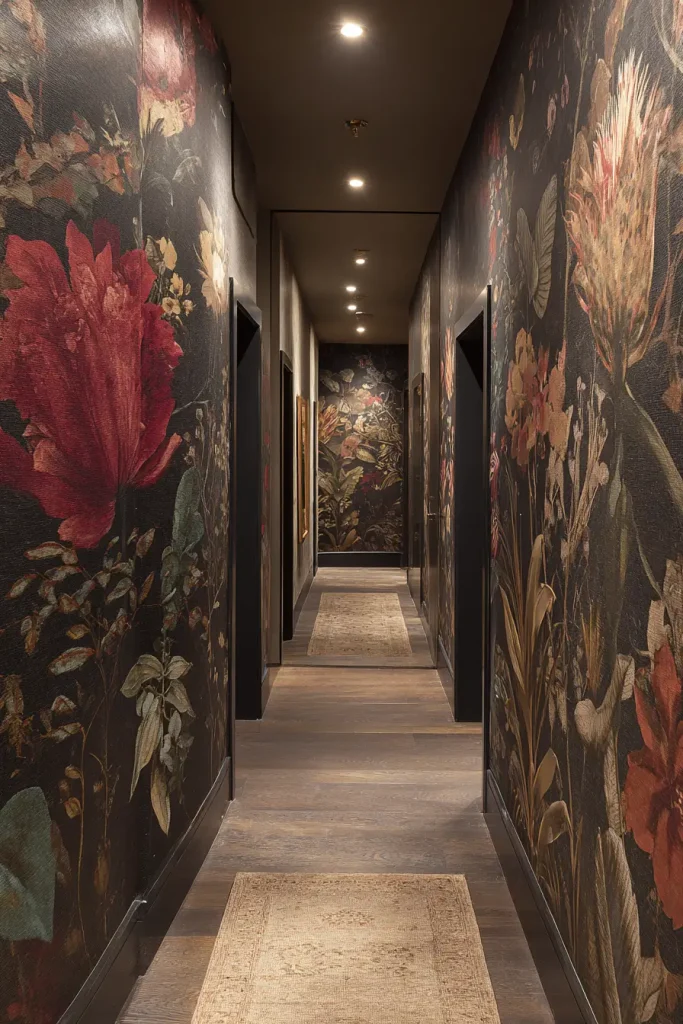
Wallpaper in a hallway is one of the smartest investments you can make. Here’s why. Hallways are small. That means the total square footage is low. You can afford a truly special wallpaper without spending a fortune.
Large scale botanicals work well. So do abstract murals, dark grasscloth textures, and rich maximalist prints. The key is scale. Go bigger than feels comfortable. Small prints shrink in a dark corridor.
These brands are worth looking at:
- Rebel Walls — mural wallpapers that ship internationally. Strong botanical and abstract collections.
- Graham and Brown — more accessible price point. Good range of dark, dramatic options.
- Schumacher — designer grade. Higher cost but the quality is exceptional.
- Feathr — artist-made mural wallpapers. Good if you want something genuinely unique.
If you rent, this doesn’t have to be off limits. Chasing Paper and Tempaper both make peel and stick wallpaper that actually looks good. Not every peel and stick option is worth buying, but these two brands have good reputations.
On whether to wallpaper one wall or all of them: in a narrow hallway, covering all walls creates the most impact. In a wider entry, a single feature wall behind a console table is enough.
3. Layer Your Lighting Like a Set Designer
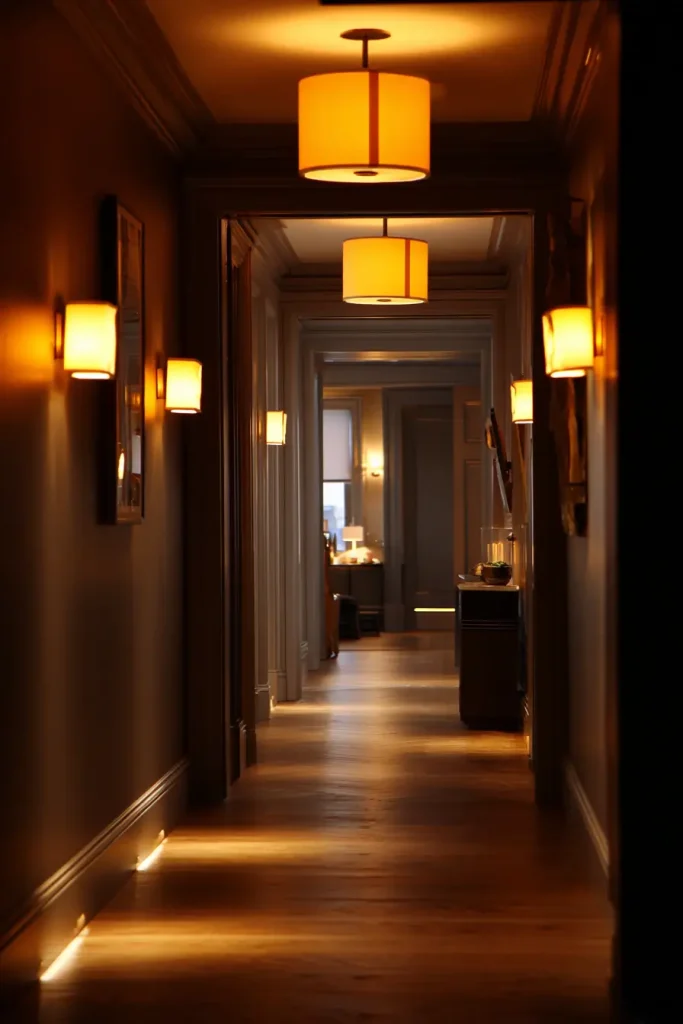
A single overhead light is the fastest way to kill any sense of drama in a hallway. One bulb, one flat circle of light. Everything looks the same. Nothing stands out.
Good hallway lighting works in layers. You need at least two of these three:
Ambient light is your main source. A ceiling pendant or flush mount. This sets the base brightness of the space.
Accent lighting adds depth. Wall sconces at eye height. Picture lights above art. A lamp on a console table. These create pools of light rather than even coverage, and that contrast is what makes a space feel dramatic.
LED strip lighting hidden behind a floating shelf or under a console table adds a soft glow at floor level. It costs very little and makes a big difference at night.
Bulb temperature is something most people get wrong. Warm white bulbs sit between 2700K and 3000K. They produce a golden, flattering light that suits dark spaces. Cool white bulbs (4000K and above) make dark walls look flat and grey. Avoid them completely in a hallway.
Dimmer switches are not optional. Install one. Bright hallway during the day. Low, moody light in the evening. That flexibility changes how the whole space feels.
For quality sconces, look at Rejuvenation or Schoolhouse. For smart dimmer integration, Lutron Caseta works well and is easy to install. IKEA NYMANE is a budget-friendly option that still looks considered.
4. Install Dark or Patterned Flooring That Anchors the Space
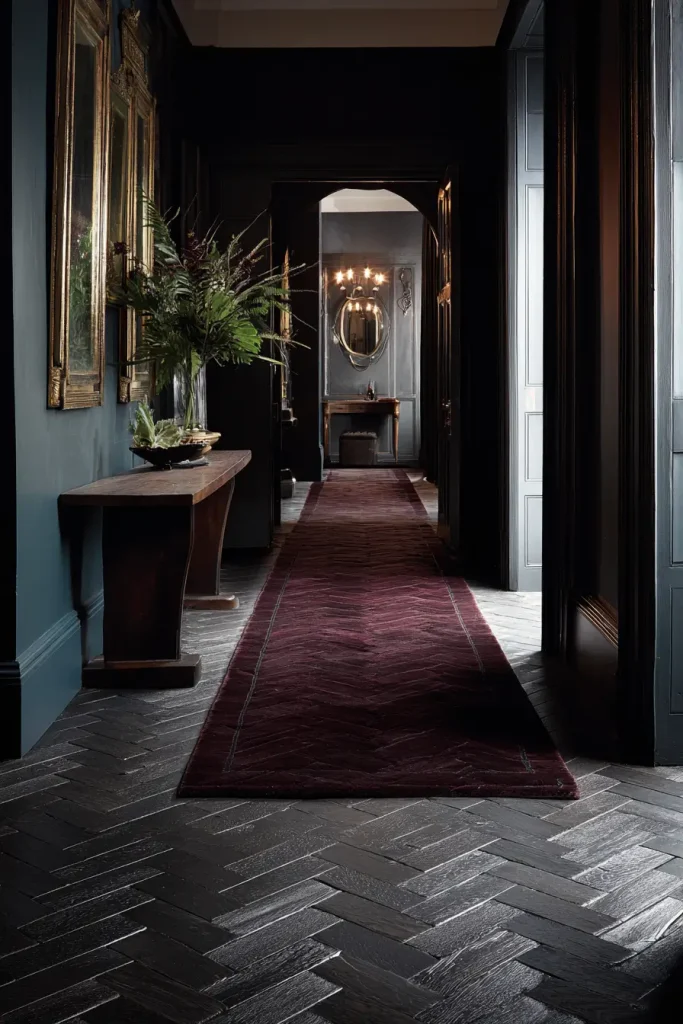
The floor is the base of everything. It sets the tone before anyone looks at the walls.
Dark floors create what designers sometimes call a stage effect. Everything on top of them feels elevated. A dark console table, a large mirror, a piece of art — all of it reads as more intentional when the floor beneath it is equally serious.
Dark flooring options that work:
- Stained hardwood in ebony or jacobean stain
- Dark slate tile
- Black encaustic cement tiles
- Herringbone laid in dark oak
Encaustic cement tiles have had a real comeback in the last few years. Cle Tile and Bert and May are both active brands with strong editorial coverage. Their patterns add visual interest without needing any other decoration on the floor.
If you can’t change the floor, a runner solves the problem. A vintage Persian runner in deep burgundy, teal, or gold adds all the richness of a dark floor without touching a single tile. Etsy is one of the best places to find authentic vintage runners at reasonable prices.
One practical note: matte dark floors hide scuffs and dust better than gloss finishes. Choose matte if you have the option.
5. Add a Statement Mirror — The Bigger, The Better
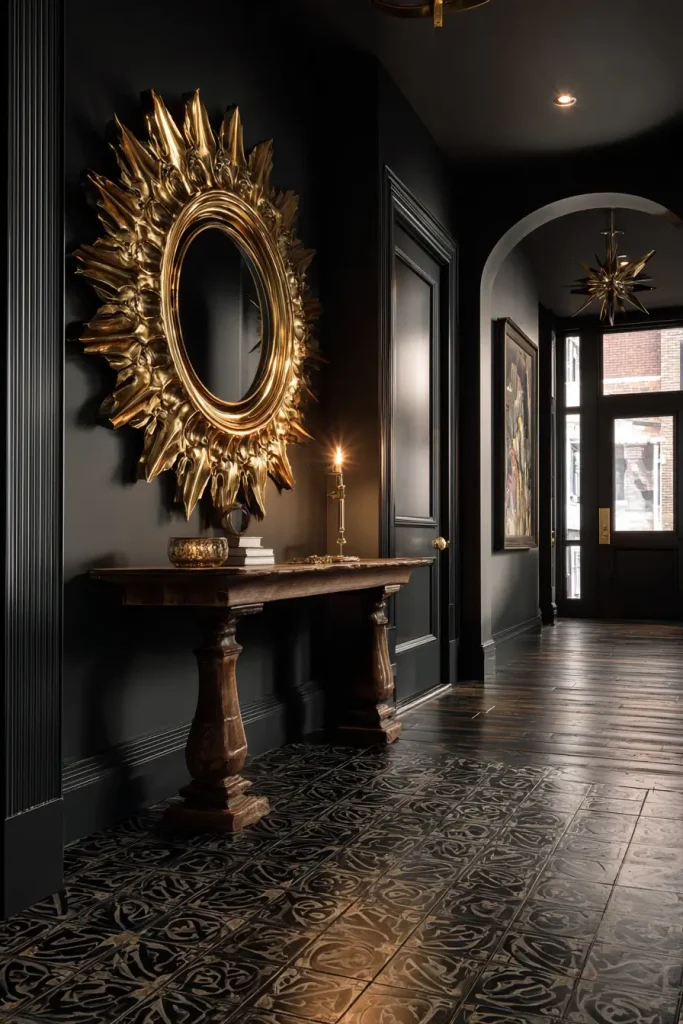
Mirrors do three things in a dark hallway. They reflect light back into the space. They add visual depth. And they give you a clear focal point on the wall.
Frame style matters a lot here. In a dark hallway, you want the frame to add to the drama rather than disappear. Good options include:
- Ornate gilded frames with aged or tarnished gold
- Blackened iron frames with strong geometric shapes
- Starburst mirrors in gold or brass
- Antique mirrors with foxed glass (the speckled, aged look)
Size rule: your mirror should be at least 24 inches wide. Larger is almost always better. A mirror that feels too big in the shop will usually feel right once it’s on the wall.
Placement tip: hang the mirror opposite a light source. A sconce, a lamp, or even a window. The mirror picks up that light and throws it back into the space. This is one of the simplest ways to stop a dark hallway from feeling too dim.
You don’t have to spend a lot. Etsy vintage sellers and local auction houses often have exactly the kind of aged, character-filled mirrors that work best. Anthropologie and Wayfair both carry good options at a range of price points.
6. Create a Gallery Wall With a Dark, Curated Edit
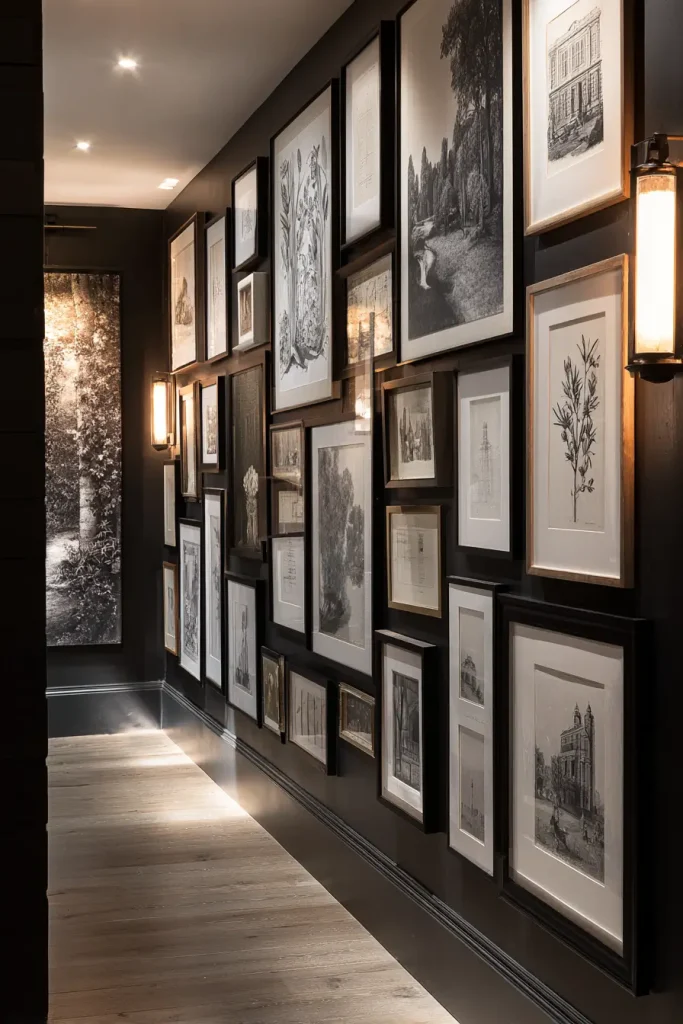
A gallery wall in a dark hallway is different from a gallery wall anywhere else. The darkness changes everything about how art reads on the wall.
You have two options that both work. Light frames on dark walls create strong contrast. Each piece pops. The art is immediately visible. Dark frames on dark walls let the art itself float. The frames almost disappear. It looks like the images are hanging directly on the wall.
For subject matter, think architectural. Old engravings, botanical prints, black and white photography, abstract pieces in deep tones. These hold their own in a dark space. Light, airy prints tend to get lost.
In a narrow hallway, a tight grid arrangement works better than a loose salon style. A grid with consistent spacing feels more intentional. It looks like someone made a decision rather than just filled a wall.
Spacing between frames: aim for 2 to 3 inches. Consistent gaps matter more than the exact measurement.
For affordable prints, Desenio has a large range that suits dark interiors. For custom framing, Framebridge (US) and Simply Framed both do good work at reasonable prices.
7. Add Texture With Dark Panelling or Limewash Paint
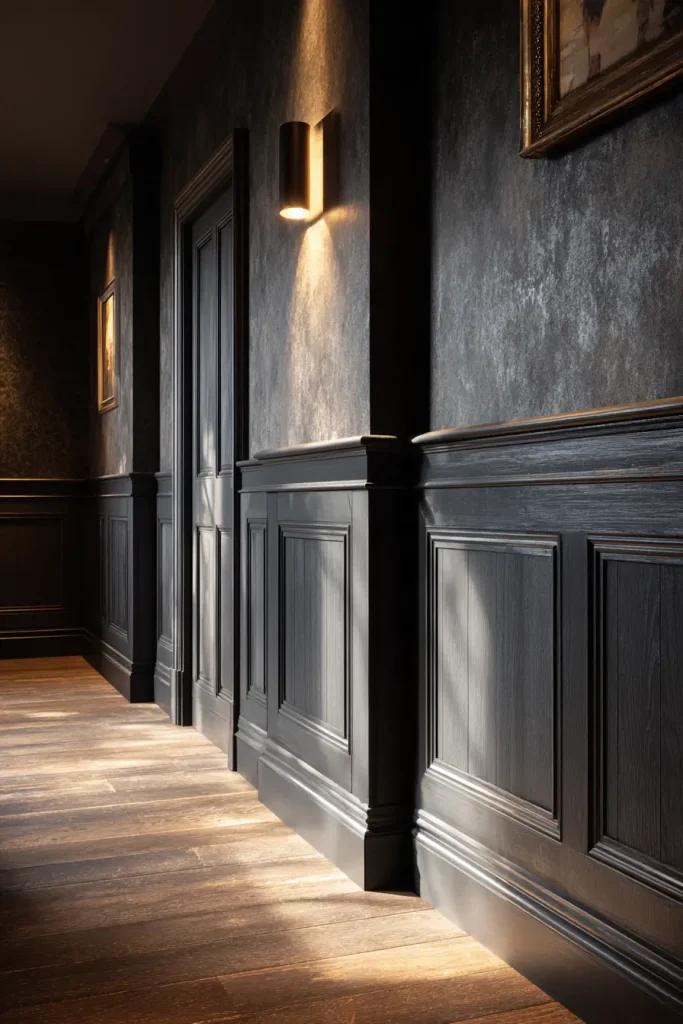
Plain flat walls in a dark color look good. Dark walls with texture look exceptional.
Wall panelling is one of the most effective ways to add texture without pattern. Types of panelling that work well:
- Beadboard (vertical lines, traditional feel)
- Shaker or recessed panel (classic, works in any style of home)
- Fluted wall panels (contemporary, strong vertical lines)
- Board and batten (bold, graphic, good for wider hallways)
Painting panelling in a dark tone adds depth because the recesses and raised edges catch light differently. You get shadow and dimension from a single color. It looks far more expensive than it is.
DIY panelling is genuinely achievable. MDF strips, some wood glue, and a coat of dark paint can transform a wall in a weekend. Pre-made panel kits also exist if you want an easier route.
Limewash paint is a different kind of texture. It creates a cloudy, layered effect that looks like old European plaster. Portola Paints Lime Wash and Romabio Classico Limewash are both good products used by professionals and homeowners alike.
If you want maximum texture, combine the two. Dark limewash below a dado rail. Dark wallpaper above it. Different textures, same tone. The result is rich without being busy.
8. Choose Dark, Dramatic Furniture That Earns Its Place
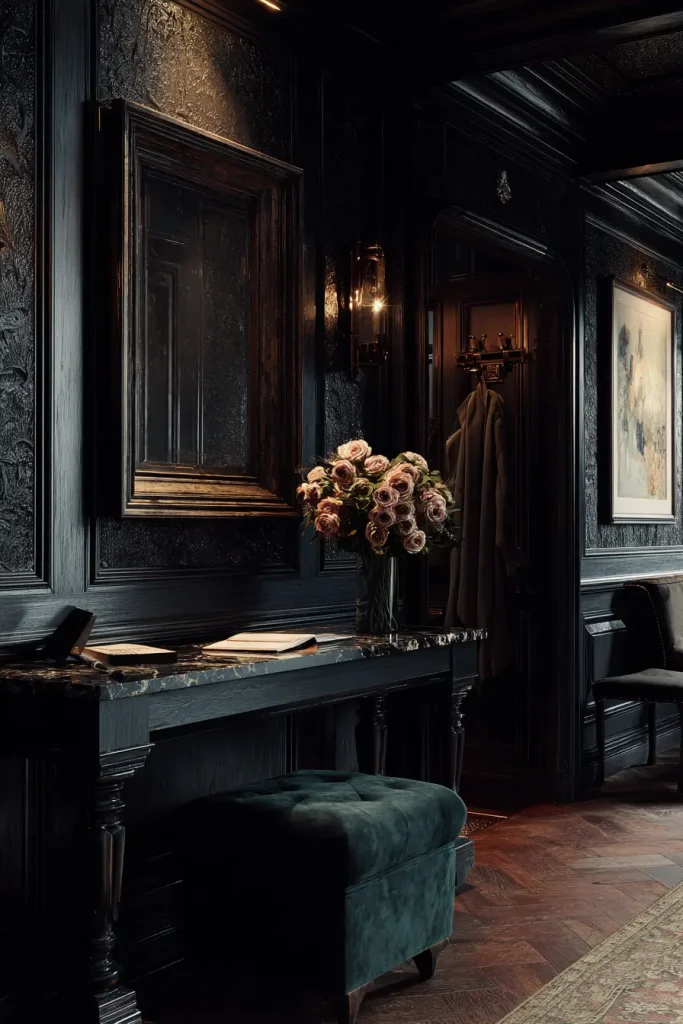
Every piece of furniture in a hallway has to justify being there. It’s a small space. Clutter kills the drama.
The console table is the most important piece. In a dark hallway, go dark. A deep wood finish, a lacquered black surface, or a marble top on dark legs. The console anchors the wall and gives you a surface for accessories, a lamp, and a vase.
If your hallway is wide enough, add a bench or small upholstered stool. Velvet in deep tones works well. Forest green, midnight blue, and oxblood red all look strong against dark walls. This adds a softness that prevents the space from feeling too hard.
Mix rather than match. A dark wood console with an aged iron mirror and a marble lamp base looks collected. A matching set looks like a showroom.
Coat hooks deserve more attention than they usually get. Builder-grade hooks in chrome or brushed nickel do not work in a dramatic hallway. Replace them with matte black hooks or aged brass alternatives. The difference is bigger than you’d expect.
For accessible options, CB2, West Elm, and H&M Home all carry pieces that suit dark hallways. Restoration Hardware is worth looking at if you’re making a longer term investment.
9. Bring in Plants — Dark Spaces Need Living Things
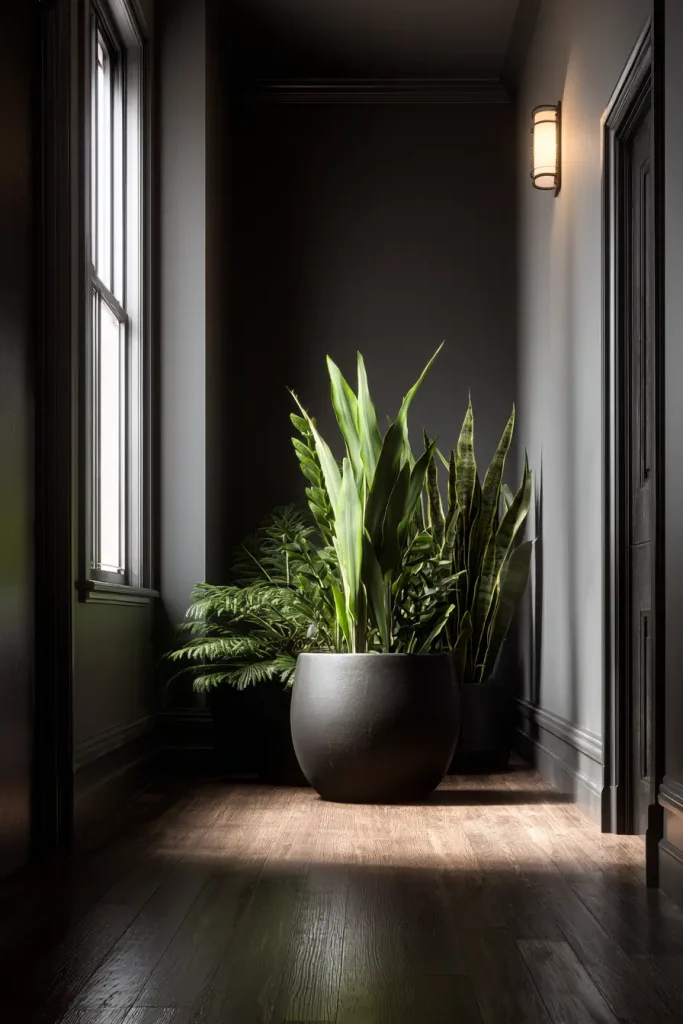
Plants in a dark hallway might seem counterintuitive. Most plants need light. But there are species that genuinely thrive in low light conditions, and they add something no paint or furniture can match.
Low light plants that work in a dark hallway:
- Cast Iron Plant (Aspidistra) — almost indestructible and genuinely tolerates very low light
- ZZ Plant — slow growing, architectural, needs almost no attention
- Snake Plant — strong vertical lines, dramatic silhouette, low maintenance
- Heartleaf Philodendron — trails and cascades, adds softness
One large plant in a corner makes more impact than several small ones scattered around. A floor-standing monstera or fiddle leaf fig creates a real moment in the space.
Pot choice matters. In a dark hallway, go dark with the pots too. Matte black, terracotta, aged bronze, dark olive ceramic. White pots or glossy finishes interrupt the mood.
If you don’t want to deal with live plants, dried botanicals are a good alternative. Dried pampas grass in a tall dark vase, preserved eucalyptus, or dried magnolia leaves all look striking and require zero maintenance.
10. Use Scent to Complete the Atmosphere
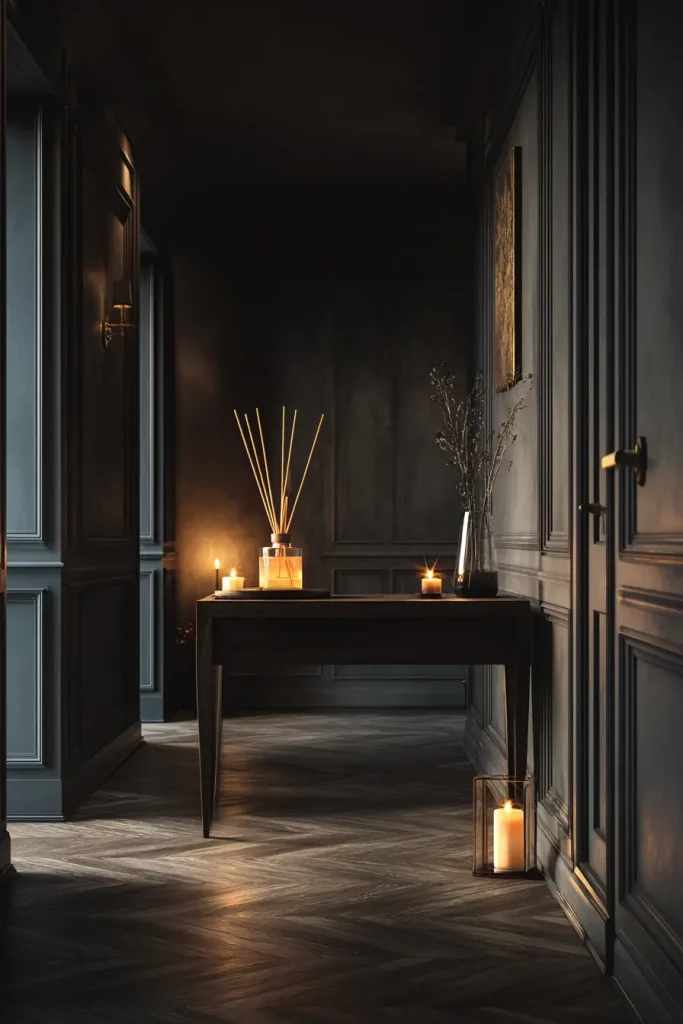
You walk into a room and something smells extraordinary. You don’t know exactly what it is, but you notice it. That’s what scent does. It finishes the experience before you’ve even looked around properly.
A dark, dramatic hallway that smells like nothing is a missed opportunity.
Reed diffusers work well in hallways. They’re continuous, safe to leave unattended, and build up a consistent background scent over time. Candles are better for evenings when you want a stronger presence.
Scent profiles that suit dark interiors: oud, amber, tobacco, cedarwood, vetiver, dark florals like tuberose or black rose. These are rich and grounded. They match the weight of a dark space.
Specific products worth considering:
- Diptyque Baies diffuser — consistently well reviewed, recognizable for a reason
- Aesop Hwyl — cedarwood and hinoki, clean and serious
- Boy Smells candles — dark, interesting scent profiles
- Skandinavisk NATT — nordic night scents, very fitting for a moody space
Place your diffuser or candle at nose height as you walk in. A console table or mid-height shelf works. Floor level is too low. High shelves push the scent above where you naturally breathe.
11. Add Architectural Details That Look Like They’ve Always Been There
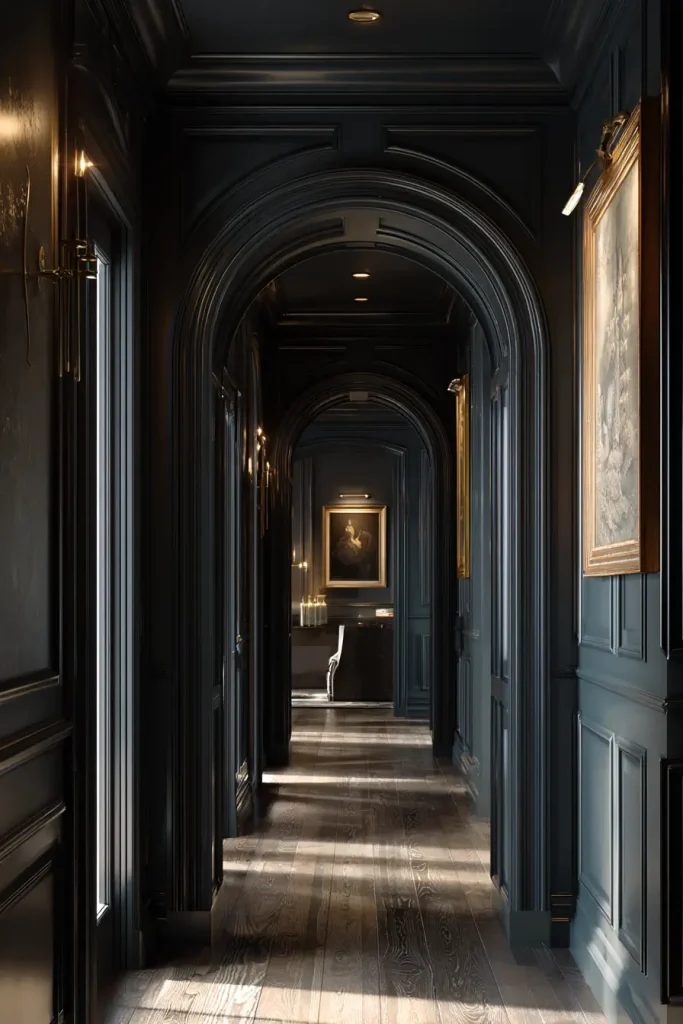
Good architectural details make a hallway feel like it was designed rather than decorated. They add age and permanence. And many of them are achievable without structural work.
Crown moulding or picture rail adds height and visual weight to a room. In a dark hallway, these details disappear slightly into the color, which actually makes the room feel more cohesive.
If your hallway connects to another room through a doorway, consider painting a simple arch around it. Not structural. Just painted. Even a trompe l’oeil arch changes the character of the space completely.
Door color is one of the most overlooked details. Painting your interior doors the same dark tone as the walls creates a seamless, immersive effect. Alternatively, a contrasting deep tone on the doors (deep green walls, black doors for example) adds a deliberate layer of drama.
If you rent, this is still possible. Removable wall moulding strips that attach without nails exist and work reasonably well. Temporary arch decals are another option. Peel and stick floor tiles let you change the flooring without permanence.
Hardware is often ignored but shouldn’t be. Swapping cheap chrome door handles for matte black, unlacquered brass, or aged iron makes a real difference. It’s one of the lowest cost, highest impact changes you can make.
12. Layer Rugs and Runners for Warmth and Pattern
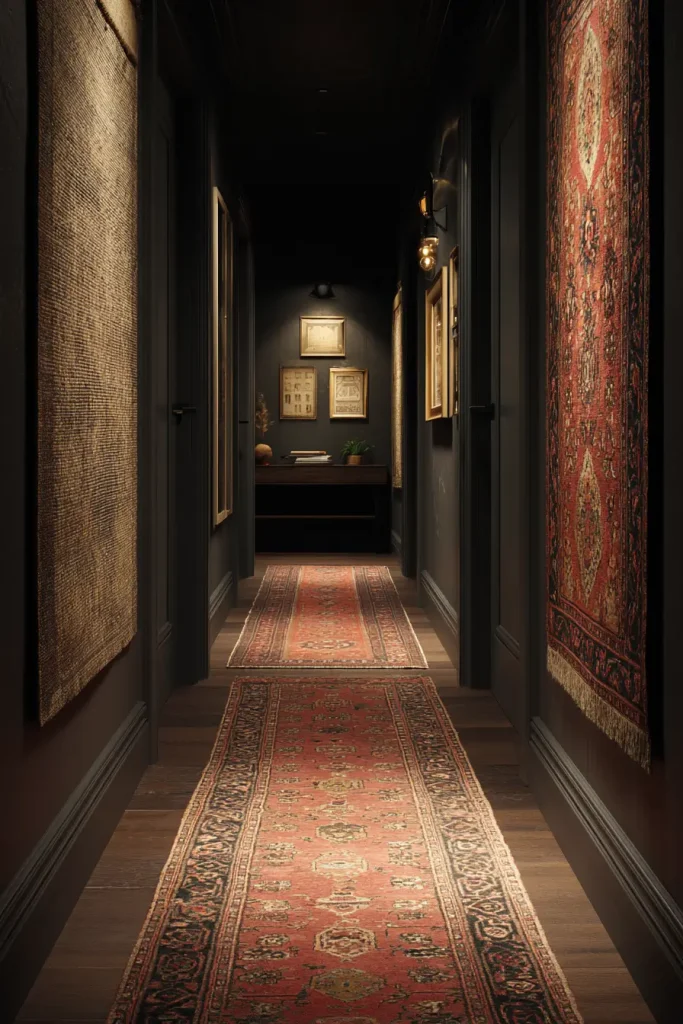
A runner in a hallway does several things at once. It adds color and pattern. It softens sound. It protects the floor. And it makes the space feel finished in a way that bare floors often don’t.
For a dark hallway, the best runner styles are:
- Vintage Persian runners in jewel tones (burgundy, teal, gold, navy)
- Moroccan geometric patterns in dark palettes
- Abstract modern runners with deep, complex coloring
Sizing: your runner should leave four to six inches of floor visible on each side. A runner that’s too narrow looks like an afterthought. One that’s too wide looks like a carpet that didn’t quite fit.
A layering trick that works well: place a flat woven jute or sisal mat under your patterned runner. The natural texture base adds dimension without competing with the pattern above.
Non-slip pads underneath are not optional. They prevent the runner from moving and protect the floor beneath.
For sourcing: eBay and Etsy are genuinely good places to find authentic vintage runners. Ruggable is worth considering if you want something washable. Loloi makes accessible, designer-quality rugs that photograph well and hold up in real use
13. Use Art That Stops People in Their Tracks
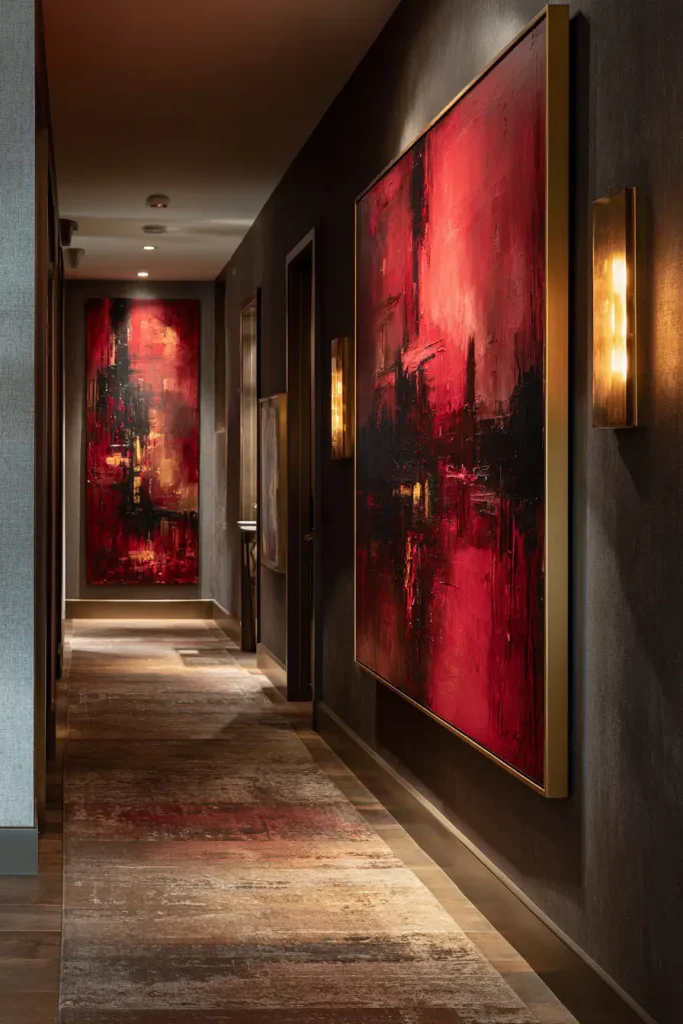
Your hallway is seen by every person who enters your home, every single time. That makes it the most-viewed wall space in your house. Use it for your best piece.
In a dark hallway, scale matters more than anywhere else. One large canvas or print almost always looks better than several small ones. A single oversized piece feels deliberate. Many small pieces can start to look crowded against a dark background.
Subject matter with real impact:
- Portraiture, especially pieces with dark backgrounds in the Old Masters style
- Abstract expressionist works in black, ochre, or deep crimson
- Large format architectural photography in black and white
- Maximalist botanical illustrations with dark grounds
Framing choices for dark walls: slim gold or brass frames let the art stand alone. Chunky dark frames blend into the wall and create a shadow box effect. White frames create the sharpest contrast and work if you want something graphic and bold.
For affordable statement art:
- Society6 for prints in large sizes
- Saatchi Art for originals and quality prints at a range of prices
- Desenio for oversized prints with good reproduction quality
- Local art school degree shows for genuinely original work at very accessible prices
14. Paint the Ceiling Dark Too (This Changes Everything)
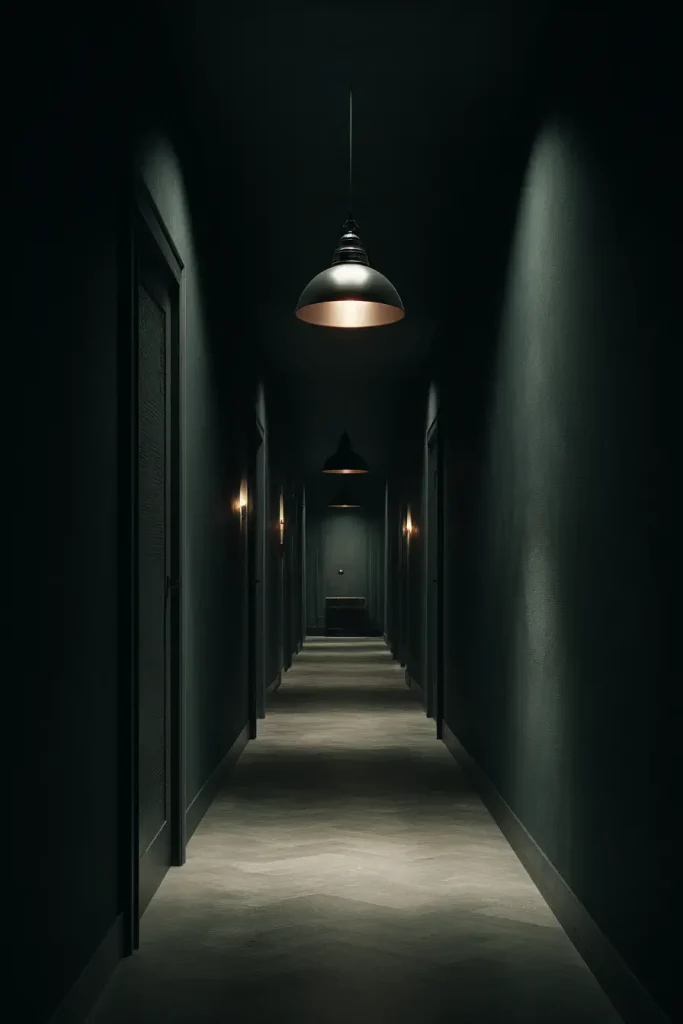
Most people stop at the walls. The ceiling stays white. And that white ceiling sits above a dark room and ruins the effect.
Painting the ceiling the same dark color as the walls is one of the most transformative things you can do in a hallway. It is also one of the most underused.
Here’s what it does. The ceiling visually lowers. The space becomes more enclosed, more intimate. That’s exactly what you want in a corridor. A cocooning, dramatic entry that makes the room you walk into feel bigger by comparison.
The tone on tone approach, where ceiling and walls are the same color, creates a seamless effect. There are no visual breaks. The space reads as one continuous dark shell.
One subtle trick: use the same color but different finishes. Matte on the walls. Eggshell on the ceiling. In strong light you can see the difference. In normal light it reads as a single tone but with a slight dimensional quality.
If your ceiling has a fitting in the center, this idea gets even better. A dark ceiling frames a pendant light or lantern perfectly. The fitting becomes the only point of contrast in that zone. It draws the eye up in exactly the right way
15. Finish With Intentional Accessories — Not Clutter
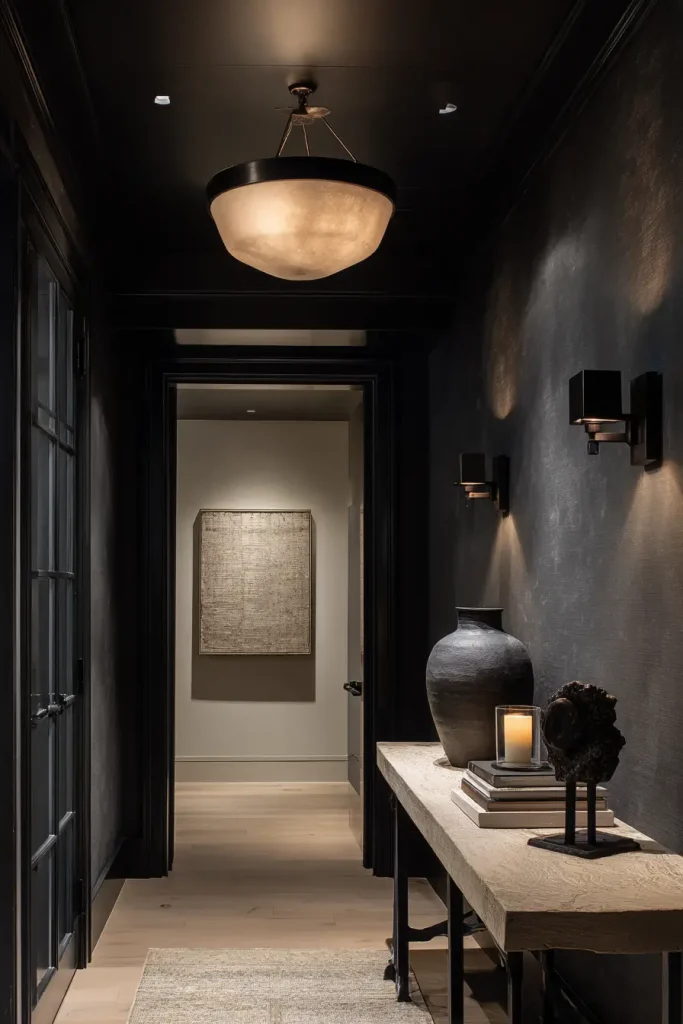
In a dark hallway, every single object is visible. There’s no bright background noise to dilute the effect. Each thing you put on a shelf or console table is a choice that either adds to the mood or breaks it.
The rule is simple: less, but better.
Group accessories in odd numbers. Three objects work better than two or four. Vary the heights. A tall vase next to a stack of books next to a small sculptural object creates visual interest. Three items of the same height just look flat.
A practical checklist for a dark hallway console table:
- One ceramic vase with a dark or interesting glaze
- One stack of design or art books used as a prop, not storage
- One unexpected object. An antique fragment, a sculptural find, something with a story
- One candle in a holder that earns its place
What to avoid: too many small objects, anything plastic, anything shiny and cheap. If you wouldn’t put it in a photograph of the space, it probably shouldn’t be there.
Rotate one or two accessories with the seasons. New dried botanicals in autumn. A different vase in spring. You don’t need to redesign the hallway. Small swaps keep it feeling fresh without any real effort.
16. Use Scent, Sound, and Small Details to Seal the Experience
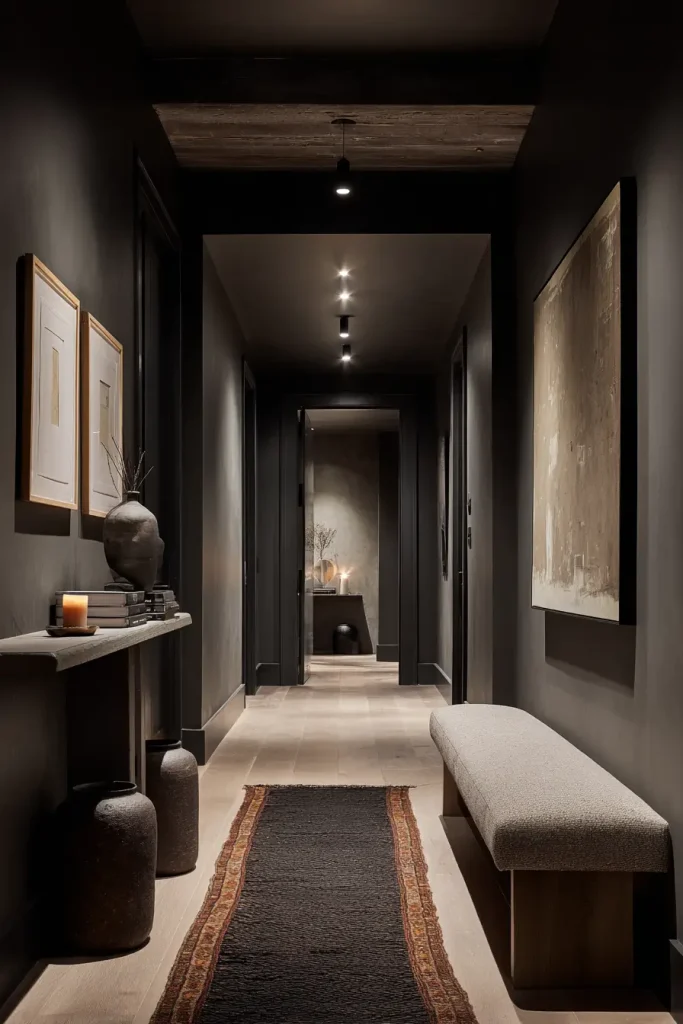
The final layer of a dramatic hallway is everything people notice without knowing they noticed it.
Scent is covered above, but it belongs here again as a reminder. It’s the one thing most people forget and the one thing that completes the experience more than anything visual.
Sound is worth thinking about. A hallway with hard floors and bare walls echoes. A runner dampens footsteps. A soft upholstered bench absorbs sound. These changes make the space feel quieter and more considered.
Small hardware details: your light switch plates, your outlet covers, your door hinges. In most homes these are white plastic or chrome. In a dark hallway they stand out in the wrong way. Replace them with matte black or aged brass alternatives. This costs very little. The difference is immediate.
The entry experience should feel complete the moment the door opens. Dark walls, layered light, a strong scent, good art on the wall, a runner underfoot. Each piece supports the others.
That’s what separates a dark hallway that looks dramatic from one that just looks dark.
Conclusion
A boring hallway is not a space problem. It’s a decision problem. The space is already there. What it needs is intention.
Dark hallway ideas work because darkness forces you to choose carefully. Every paint color, every light fitting, every object on a shelf has to mean something. That’s what creates the drama. Not the darkness itself, but the decisions made inside it.
You don’t need to do all 16 things at once. Start with paint. Add the right lighting. Then layer in a mirror, a runner, some art. Each step makes the next one feel more obvious.
Pick one idea from this list and start this weekend. These dark hallway ideas are not complicated. They just require you to make a choice and commit to it.
Your hallway is the opening line of your home. Make it one people remember.

- 17 Classy Living Room Ideas for a Cozy Elegant Look - April 23, 2026
- 16 Dark Moody Living Room Ideas That Feel Rich and Warm - April 22, 2026
- 14 Elegant Bedroom Trends for 2026 You’ll Love - April 22, 2026